

Next-Gen App & Browser Testing Cloud
Trusted by 2 Mn+ QAs & Devs to accelerate their release cycles


What Is a DevOps Pipeline: A Complete Guide
A DevOps pipeline is a series of automated processes that facilitate the continuous integration, delivery, and deployment of software applications. Learn more!

Chandrika Deb
January 21, 2026
DevOps has transformed how organizations build and ship software applications. The main objective is to provide high-quality software quickly and efficiently to end users and customers.
To achieve this, many organizations implement automated testing in the SDLC to speed up delivery times. When this automation is paired with the right tools and processes, it is known as a DevOps pipeline.
What Is a DevOps Pipeline?
DevOps is a software development process that combines development (Dev) and operations (Ops). It intends to shorten the development life cycle while delivering features, fixes, and updates frequently in close alignment with business objectives.
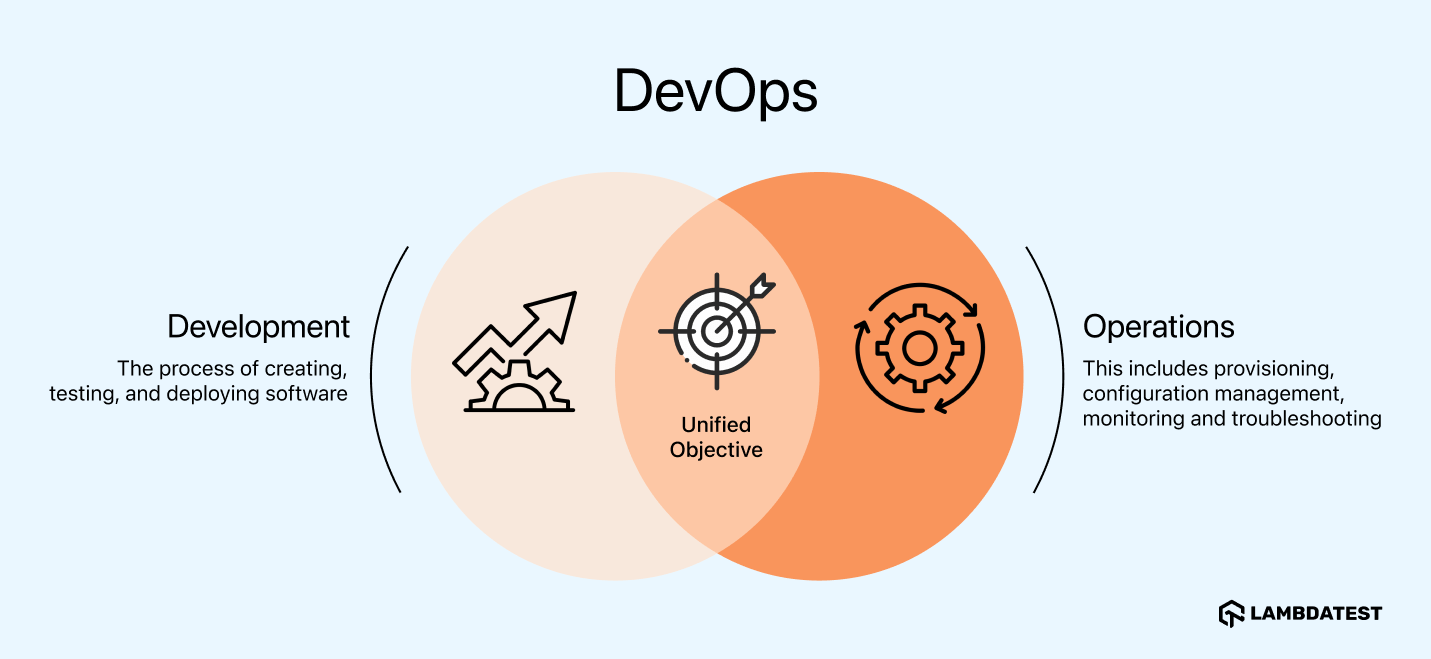
On the other hand, a DevOps pipeline constitutes the procedural framework software engineers use to conceive, develop, assess, deploy, and perpetually enhance a software product across its development life cycle. This method entails the integration of individuals, tools, and DevOps automation mechanisms to facilitate the delivery of quality software applications.
The DevOps pipeline consists of multiple stages where development and operations professionals collaboratively prepare code for end-user dissemination. These stages include planning, coding, building, testing, deployment, monitoring, and feedback.
After the code is pushed, Continuous Integration and Continuous Delivery (CI/CD) processes ensure automated testing and seamless deployment, fostering a faster feedback loop in the SDLC. Every new code push triggers a new regression cycle that allows for efficient updates, quicker bug resolution, and enhanced overall software quality.
Key Components of a DevOps Pipeline
A successful DevOps pipeline is a critical component in achieving this goal, consolidating the work of various teams to streamline software development. At its core lie the seven key components that form the foundation of a DevOps pipeline – Continuous Integration, Continuous Delivery, Continuous Testing (CT), deployment, monitoring, feedback, and operations.
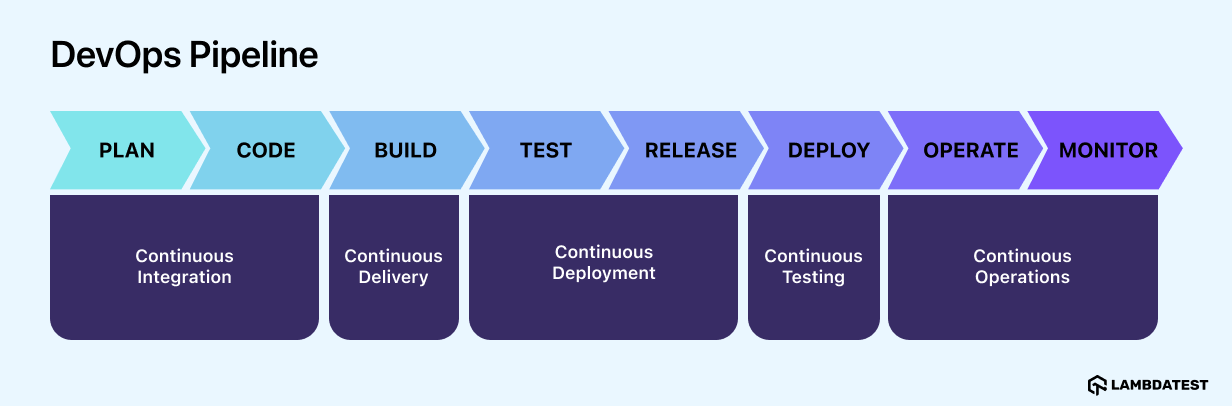
- Continuous Integration and Continuous Delivery (CI/CD): Continuous Integration leads by streamlining code integration. By automating merging code changes from multiple developers and ensuring compatibility, CI reduces integration issues and accelerates the development cycle.
- Continuous Testing: It is a crucial component of a DevOps pipeline that enables automated testing at every stage of development. By seamlessly integrating into the development process, continuous testing in DevOps provides swift risk assessments for code integrations, ensuring that software is thoroughly tested and meets the highest quality standards before deployment.
- Continuous Deployment: It follows Continuous Delivery and automatically deploys updates into production if they successfully pass the automated testing phase. While this expedites deployments, there’s a risk of undetected bugs reaching the end users, potentially causing application failures.
- Continuous Monitoring: It ensures stability, providing real-time insights into system health and performance. Organizations can proactively detect and resolve potential issues by leveraging monitoring tools and collecting metrics on key performance indicators, ensuring smooth operation.
- Continuous Feedback: Once software is deployed, continuous feedback becomes the bridge between developers, stakeholders, and customers, gathering real-time insights into user reactions. This vital component is crucial in aligning expectations and identifying critical issues identified by testers and end users.
- Continuous Operations: It is vital in maintaining uninterrupted service and minimizing planned downtime for end-users. This approach emphasizes the importance of ensuring Continuous Operations by mitigating disruptions caused by hardware or software changes, thereby enhancing the reliability and availability of services.
Whereas Continuous Deployment refers to the automated process of deploying the tested and integrated code changes directly to the production environment, seamlessly moving code from development to release. CD further accelerates the delivery of new features and improvements to users.

Note: Automate your CI/CD testing on the cloud. Try TestMu AI Today!
Stages of a DevOps Pipeline
The DevOps pipeline consists of the following stages:
- Plan: This phase establishes the project’s foundation. It involves mapping the workflow, breaking down the development roadmap, and structuring tasks before coding begins.
- Code: In the coding stage, the development team writes code and tracks progress with version control tools like Git or any other Version Control System (VCS).
- Build: The build stage in a DevOps pipeline plays a crucial role in ensuring code quality and reliability. When a developer commits code changes, a code review is triggered through a manual pull request, and an automated build process is initiated concurrently.
- Test: In the DevOps approach, automation testing is vital to ensure product quality with minimal human intervention. It leverages various frameworks and tools to detect bugs, reduce errors, and improve product reliability.
- Release: In a DevOps pipeline, the release stage is critical, signifying the deployment of a thoroughly tested build. Operational performance is validated, instilling confidence in smooth live operations. Organizations vary in release approaches, including continuous deployment, manual release with final approval, or scheduled automated releases.
- Deploy: In a DevOps pipeline, the release stage is designed to automate the deployment process using tools like Infrastructure as Code (IaC) or methods such as blue-green deployment.
- Operate: This stage involves efficiently managing the infrastructure, making necessary real-time adjustments to optimize resource utilization, and continuously monitoring user interactions through behavioral logs and feedback forms.
- Monitor: In the final stage of a DevOps pipeline, automated DevOps monitoring tools identify performance issues, application glitches, and overall application performance.
In the planning stage, you can leverage project management tools like Jira, Azure DevOps, or Asana to record and track the product roadmap.
By leveraging version control, static analysis, cloud-based IDEs, and CI/CD integration, the coding phase has become more efficient, collaborative, and secure, delivering high-quality code consistently.
To further enhance the code quality before deployment, it is important to incorporate cross-browser tests within the pipeline, which can be achieved by several third-party tools.
The foundation of automation testing is laid by unit tests, initiated through Test-Driven Development methodologies using tools like JUnit.
CI/CD platforms and DevOps tools, such as Jenkins, GitLab, CircleCI, Travis CI, and GitHub Actions, offer flexibility in tailoring release schedules and incorporating automation.
IaC not only ensures that the infrastructure is in a desired state but also provides the ability to roll back to previous configurations if needed. This flexibility and version control provides an added layer of safety during the release process.
The operations team plays a crucial role in configuring and overseeing the live environment of the DevOps project. They rely on automation tools and processes to ensure the deployed product runs smoothly and meets the desired performance standards.
DevOps monitoring tracks vital metrics like deployment frequency, code errors, pull request cycle time, failure rates, MTTD, MTTM, and MTTR. These insights allow proactive issue resolution in real-time, optimizing the DevOps toolchain and identifying automation opportunities.
How to Build an Effective DevOps Pipeline?
Establishing a DevOps pipeline is paramount for organizations seeking to optimize their Software Development Life Cycle. This comprises five essential steps:
- Select a CI/CD Tool: Choose a robust CI/CD tool aligned with the project’s requirements. Popular choices like Jenkins, GitLab, TeamCity, or Bamboo offer versatile solutions. Jenkins, renowned for its open-source nature and remarkable customizability, emerges as an excellent option, enabling tailored adaptations to specific organizational needs.
- Establish a Source Control Environment: Development teams necessitate a centralized repository for code storage and collaborative work. Git, GitLab, or BitBucket serve as effective control environments, facilitating version management and conflict resolution. These platforms enable multiple developers to collaborate seamlessly on the same codebase while avoiding merge conflicts.
- Set Up a Build Server (CI Server): A dependable build server is critical for integrating code changes and ensuring code integrity. Jenkins, Travis-CI, or TeamCity are centralized environments retrieving integrated code from source repositories. These servers provide a clean and stable platform for validating code, a crucial step in ensuring it functions correctly.
- Use Automation Testing Tools: Since automated testing is pivotal in the DevOps process, various tools are essential for running multiple tests, including unit, regression, and functional tests.
- Deploy to Different Environments: The final stage involves deploying the developed software to production or any other staging environment. This can be executed manually or automatically, considering deployment frequency, size, success metrics, and time to value.
The CI server is triggered whenever a developer pushes code changes to the repository. It automatically clones the repository, checks out the source branch, merges it with the mainline branch (e.g., master), and builds the code. If the build succeeds, the changes can be safely merged into the mainline branch.
Also, the CI server helps enforce coding standards, such as code formatting and test coverage requirements. It can be configured to fail the build if the code violates any predefined rules or if the test coverage drops below a specified threshold.
The transition from manual to automated testing, facilitated by identifying and rectifying bottlenecks, can be pivotal. Test orchestration becomes particularly advantageous when a series of tasks need to be executed in a specific order, enhancing the feedback process and ensuring swift availability of feedback to development teams.
Compared to tools like Jenkins and Bamboo, HyperExecute by LambdaTest stands out as a high-performing option in this case. HyperExecute is an AI-native end-to-end test orchestration platform that offers a streamlined and accelerated approach, up to 70% faster than any cloud grid or traditional alternatives.
To get started, refer to this HyperExecute documentation .
Incorporating automation early in the development life cycle while maintaining a degree of manual testing can streamline the testing process, boost throughput, and ensure thorough coverage of the ever-growing codebase.
Conclusion
The DevOps pipeline represents a transformative approach to software development, empowering organizations to accelerate delivery, enhance quality, and foster collaboration between development and operations teams.
By building an efficient DevOps pipeline, organizations can stay ahead of the curve, delivering high-quality software faster and more reliably to meet the ever-changing demands of the digital landscape.
Don’t miss the chance to explore the latest DevOps trends, tools, and best practices at the upcoming DevOps conference. It’s a great opportunity to learn from experts and connect with peers driving innovation in the field.
Citations
- Analysis Of DevOps Infrastructure Methodology and Functionality of Build Pipelines: https://www.researchgate.net/publication/377814221


Frequently asked questions
Did you find this page helpful?
More Related Hubs
TestMu AI forEnterprise
Get access to solutions built on Enterprise
grade security, privacy, & compliance
- Advanced access controls
- Advanced data retention rules
- Advanced Local Testing
- Premium Support options
- Early access to beta features
- Private Slack Channel
- Unlimited Manual Accessibility DevTools Tests