

Next-Gen App & Browser Testing Cloud
Trusted by 2 Mn+ QAs & Devs to accelerate their release cycles


On This Page
- Joomla templates for building intuitive websites
- Top features of Joomla
- Advantages of Joomla
- Disadvantages of Joomla
- Key components of Joomla
- Joomla vs. WordPress
- Prerequisites before learning Joomla
- Why perform Joomla testing?
- Who performs Joomla testing?
- Tricks to check Joomla website speed and performance
- Joomla testing using different methodologies
- How to perform Joomla testing using TestMu AI platform?

Joomla Testing Guide: How To Test Joomla Websites
In this guide on Joomla testing, learn what Joomla is, the features and key components of Joomla CMS, and how to test Joomla websites using different methods.

Irshad Ahamed
January 12, 2026
Before we discuss the Joomla testing, let us understand the fundamentals of Joomla and how this content management system allows you to create and maintain web-based applications or websites without having to write and implement complex coding requirements.
Joomla is a content management system (CMS) that allows users to manage their applications or websites with the help of Graphical User Interface (GUI) without relying on writing coding.
It is an open source where you can build your website while connecting with databases such as MySQL and PostgreSQL. You are not required to learn a programming language’s fundamentals before starting with Joomla. It is developed using PHP, object-oriented programming, software design patterns, and databases for storing the data.
As of 2022, it is the fifth most used CMS on the Internet after WordPress, Shopify, Wix, and Squarespace.
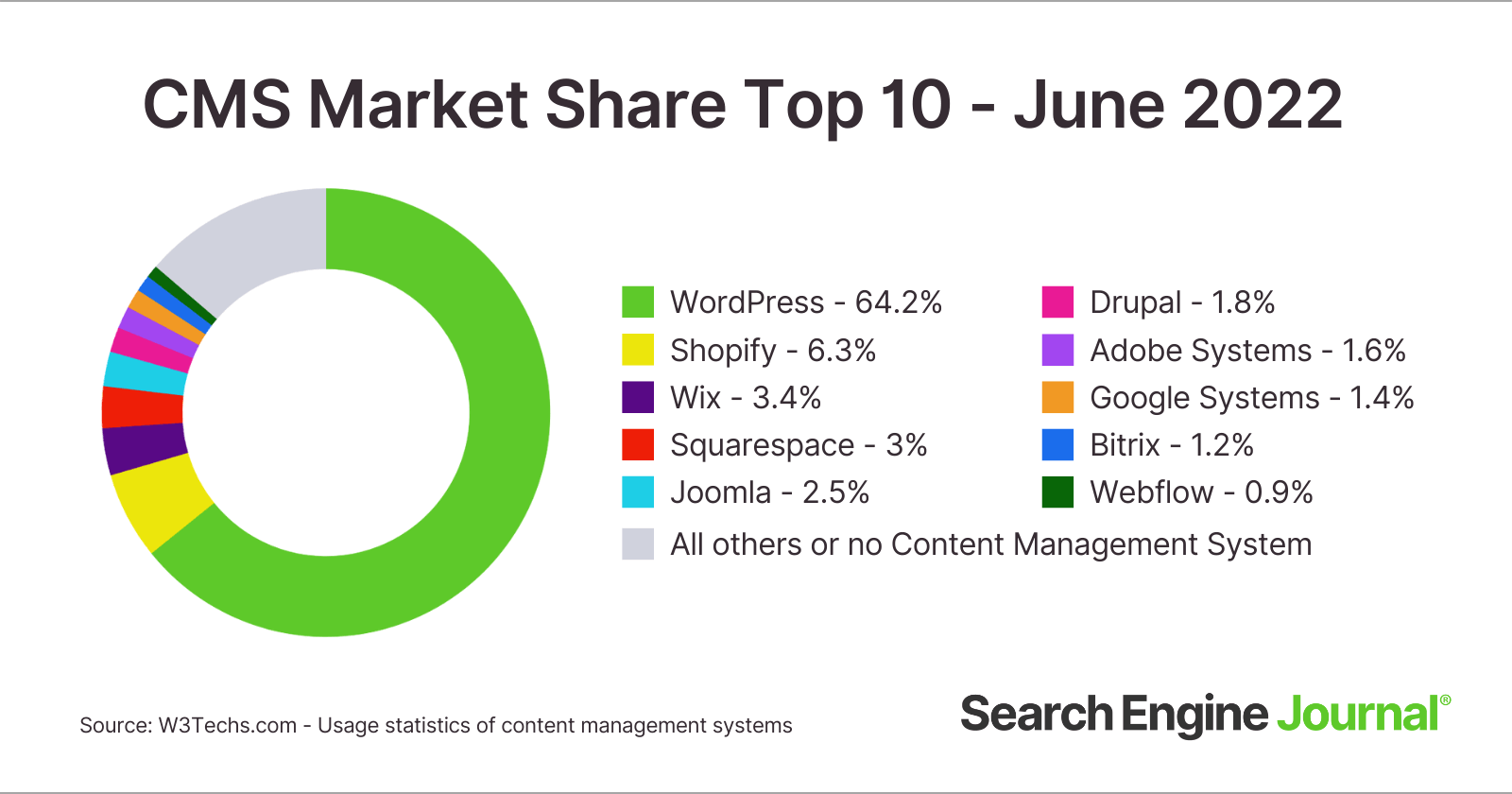
Joomla released its first version (1.0) in 2005, which was supported till 2009. It was a rebranded release of Mambo 4.5.2.3, where some bug fixes and security updates were done.
In this guide on Joomla testing, learn what Joomla is, the features and key components of Joomla CMS, and how to test Joomla websites using different methods.
Joomla templates for building intuitive websites
Joomla provides business, e-commerce, health, education, real estate templates, and many more. Here are some of the great Joomla templates you can use when designing your website:
- Restora is a predefined Joomla template that works best when defining layout requirements for a wide range of cafes and food-related businesses.
- Home is the right template solution for any land, residential, and investment property. This Joomla land layout can help you effectively manage property requirements.
- Decora is useful in the construction domain, where you can present a wide range of inside and outside plan thoughts, design elements, and everything related to creative imagination.
- Technology templates are used to build web pages based on technology trends.
- Rhythm is a flexible template that you can use for music enthusiasts, vocalists, performers, and music groups who are looking to improve their music business in the long run.
This is why Joomla is used extensively compared to other content management systems. The templates play a vital role where you can design the front end in a rapid time. If you do not like the look and feel of the website, you can install other Joomla templates from various sources on the internet.
Top features of Joomla
In this section of the Joomla testing guide, let’s look at the powerful in-built features of Joomla CMS.
- Content management: It helps create and publish content on the web browser. The content can be restructured and organized based on the user’s requirements. You can see the exact content and its structure before it goes online.
- User management: Joomla supports the creation of multiple user accounts. The administrator manages these accounts, where numerous user levels are supported.
- Media manager: Media manager in Joomla allows users to skip using FTP for uploading their media. The folders can be created so that media content can be easily categorized. The media can be easily embedded in the required pages to be viewed rather than downloaded every time.
- Search capabilities: It allows the user to search for appropriate information on the site. You can improve the existing search capabilities within Joomla by using smart indexing, advanced search, and auto-suggest functionalities.
- Support for templates: Templates help improve your website’s look and feel. You can also get templates from third parties and download them online. The templates do not impact the overall content structure of the website.
- Banner information: You can add or edit banner information on the website so the banner details can be easily customized based on your requirements.
- RSS: RSS stands for Rich Site Summary, where visitors can subscribe to the website content and updates.
Apart from providing excellent customer features, Joomla is one of the world’s most widely supported multilingual CMS platforms, supporting more than 70 languages. It also helps to provide much-needed scalability when you are handling small, medium, and large website projects.
With Joomla’s open-source community, you can get quick answers to technical queries. Apart from managing the website content, it is a great CMS for posting news, sharing information, and displaying images.
The Joomla platform has already provided support to millions of websites. But it does not mean you have to choose one particular reason when making a choice. The benefits are endless, and you can get your new website up and running in a speedy time. The future of Joomla as a powerful CMS looks promising.
There have always been challenges in making this CMS scalable. This is what Joomla developers are continuously trying to improve. They want the CMS to be lightweight and support scalability so that heavy traffic load can be managed easily.

Note: Run automation test of Joomla websites across 3000+ real environments. Try TestMu AI Now!
Advantages of Joomla
Here are some of the benefits that make Joomla a potent CMS tool:
- Joomla is simple when it comes to installation. It takes 10 to 12 minutes from downloading to having a working script on a server.
- It requires minimal expertise in coding as you have predefined templates with a graphical user interface for handling various design-related requirements.
- Joomla is well suited for building different types of websites but can still be used as a blogging platform. You can implement minor customizations without having to rely too heavily on extensions.
- It provides 8000+ extensions. These extensions are categorized into plugins, templates, components, languages, libraries, modules, packages, and according to different functions so you can achieve the required system performance.
- Joomla offers built-in search engine optimization tools that can be used readily. These tools include metadata creation, keyword planning, support for SEO-based friendly URLs, and menu creation.
- Joomla uses PHP scripting, the most common web development language.
- You are not required to worry about high licensing costs as this open-source platform.
Disadvantages of Joomla
Let us understand some of the disadvantages of using Joomla, which you should be aware of:
- Compared to WordPress, a notable disadvantage of Joomla is that it is more complex. The user interface can be complicated with too many functions, so there is a steep learning curve when using Joomla for the first time. You need to give yourself some time to familiarize yourself with the different features and functionalities.
- You can easily find plugins and themes in WordPress, but the extensions library of Joomla needs improvement in the long run.
- Media management in Joomla can be better as it has limited capabilities in managing images.
- Joomla does not support full customization, which means that if you go into too much detail, then there will be limitations that you can come across.
- Joomla-based websites are secure, but there can be risks if users do not follow proper security and risk management procedures.
There are compatibility issues due to regular CMS updates.
Key components of Joomla
Joomla components are the building blocks of the Joomla system. Once you install Joomla, core components are part of the system.
Here are some key elements related to Joomla:
- FrontPage components: This is used to display the contents on the front page. The contents shown can be customized based on user preferences.
- WebLinks: It allows the user to configure different link categories
- Banners: It will enable the Joomla website to create and display banners
- Search: This is a powerful component that provides search capabilities
- Tags: You can use it for segregating your articles based on the tags that are assigned
Apart from the core components listed above, Joomla supports some third-party components.
- JFBConnect: With the JFBConnect component, users can register with the Joomla website using their Facebook credentials.
- sh404SEF: This component helps to create search engine-friendly URLs for your Joomla content
- HikaShop: Using HikaShop components helps create a unique shopping experience by creating a shop and shopping cart for your Joomla website when working with an e-commerce domain.
There is a difference between Joomla modules and components. Joomla modules are different functionalities used to present information on your site. The components are full-blown applications that are usually more complex and help to improve the core functionality.
Joomla vs. WordPress
Let us try and compare the popular content management systems: Joomla or WordPress, and analyze which is the best based on different capabilities.
Common features
- Free and open source.
- Both of them are written in the PHP language.
- Support MySQL as their database management system.
- All of them use themes and templates.
- There are community-driven projects that are implemented.
Let us try and compare Joomla vs. WordPress based on the different features they offer.
- You can install WordPress in a speedy time, but the Joomla installation may not be that quick when compared with WordPress. But there are similar install steps for WordPress and Joomla.
- WordPress allows users to change the site appearance using themes with support for default themes. Joomla provides a wide range of templates and extensions. The extensions play a vital role in building a website from scratch.
- WordPress provides a strong user community where there are plenty of support options to choose from. Joomla provides a large user community where you can refer to the documentation that helps you start as a beginner. The forums, mailing lists, user groups, etc., can provide significant support in the long run.
When you try and compare two options, it all comes down to different factors that create an impact in the long run. Joomla comes with a lot of built-in features as compared to WordPress, which is excellent from a usability perspective for an end user. WordPress is easier to use with substantial global community support. Most non-developers find it easier to build their website requirements with WordPress than with Joomla.
Prerequisites before learning Joomla
These are some prerequisites that can help you learn Joomla quickly:
- Basic understanding of computer operations and databases.
- Understanding related different CMS features and functionalities
- Knowledge related to integrations if there are third-party apps that need to be supported
- Understanding other content management systems and tools.
The content and metadata of Joomla are stored in the MySQL database. Understanding the backend functionality can be much more challenging if you are unaware of databases. It is essential to know how CMS operates so you can easily understand the overall flow and navigation related to the websites being built.
Why perform Joomla testing?
To deliver the correct business value, performing end-to-end testing of Joomla websites is vital. Since it is an open-source content management system, it is highly prone to security vulnerabilities and attackers.
Here are the following benefits when you are performing Joomla testing.
- It helps to ensure that the security patches and updates are deployed perfectly.
- Ensure that the navigation and overall functionality related to the website are as per the customer’s requirements.
- They ensure that the non-functional requirements, such as response time, speed, and website performance, are validated and checked thoroughly.
- Validation and testing of different product features and enhancements delivered as part of the release.
It is always a good practice to perform Joomla testing before it is deployed in the actual production environment. It is recommended to validate and test your changes on the staging environment so that you are well aware of the deployment challenges that come along your way.
Check out this article on how to test Joomla sites for cross browser compatibility.
Note: Test your Joomla websites on a high-performing CMS testing cloud. Try TestMu AI Now!
Who performs Joomla testing?
Different teams work in close collaboration when doing Joomla testing. We can have development, security, and QA teams performing testing of Joomla websites because they are well aware of the overall functionality updates and changes. You can have a dedicated security team doing Joomla testing, as security is a crucial aspect of Joomla CMS.
Joomla testing can depend on the organization’s testing goals and objectives.
The developers can validate the code requirements to observe the exact system behavior. Once the development team gives the go-ahead, the QA team can perform the different testing levels along with the security team.
- Unit testing
- Integration testing
- Functional testing
- User acceptance testing
- Manual testing
- Automation testing
Tricks to check Joomla website speed and performance
There are scenarios when you are adding more and more extensions for your Joomla website. A significant challenge with site loading or performance can impact the overall response time.
Here are some tricks you can follow to improve the website’s speed and performance.
- Keep the site optimization into consideration right from the beginning.
- You can use site performance extensions.
- Constantly closely monitor the server requirements and choose the required server option that is Joomla friendly.
- You can use some industry-standard tools to validate the website. The tools recommended are.
- GTmetrix
- Google page speed
- Webpage test
Joomla testing using different methodologies
In this section of the Joomla testing tutorial, let’s explore the various methods through which you can test Joomla websites.
- Using Eclipse integrated development environment (IDE): You can perform Joomla testing using an integrated development environment (IDE) by installing the Java-based Eclipse IDE on Windows, macOS, or Linux workstations. You can follow the below steps to install Eclipse:
- Install Java making sure that you have a recent version of Java being used for installation.
- Next is downloading Eclipse IDE to ensure Java developers can use it.
- You need to configure Eclipse.
- Using Version Control Systems: You can use version control systems for performing Joomla testing. Some commonly used tools are:
- CVS
- Git
- Subversion
Version control systems help you track every change in the application code. This allows the developers to roll back changes and fix encountered errors.
- Automation testing of Joomla using Leapwork: You can perform Selenium automation of Joomla sites and applications regardless of the technology stack and plugins. The Leapwork automation platform helps you automate your testing requirements without executing a single line of code. You can build automation flows for CMS platforms like Joomla in desktop browsers and mobile devices. This automation platform provides seamless in-built integration with TestMu AI – a continuous quality testing cloud. Here are some of the top features of this platform.
- You can run web automation cases on any of the supported devices.
- It supports continuous delivery.
- You can automate your requirements across systems and environments.
- Testing Joomla Extensions Using Codeception: Codeception is a PHP testing framework that allows you to test your Joomla extensions without too many hassles. It supports the following testing types.
- System testing
- Unit testing
- Integration testing
Codeception supports the following features.
- Integration with Selenium WebDriver
- Data Cleanup
- Parallel execution of tests
- Joomla testing using cloud-based testing platforms: Agile is the new methodology to deliver high-quality software solutions where you deliver iterative solutions in quick release cycles. It means that you can ship your product requirements faster, making changes in the go-to-market strategy. This is where cloud-testing platforms like TestMu AI can help you perform Joomla testing at scale across different browsers, devices, and OS combinations and help you achieve faster go-to-market delivery.
In the next section of this Joomla testing guide, we will see how you can conduct online Joomla testing using the TestMu AI platform.
How to perform Joomla testing using TestMu AI platform?
When we talk about testing web applications and mobile apps, you have two standard testing approaches:
- Manual testing: Manual testing is a traditional approach where system requirements are validated using different test cases. The test cases are maintained in an excel sheet, and the testing team needs to move back and forth to record the testing observations.
- Automation testing: Companies realized that manual testing could not be the right approach considering the change in market and technology trends. This was when the focus shifted to Automation testing, where you automate your testing requirements using a standard framework and tools for performance optimization.
Automation testing is a preferred testing method where high-performance automation frameworks help you to experiment and innovate with your testing requirements. That is why Automation testing is here to stay for years to come.
Continuous quality testing cloud like TestMu AI helps organizations seamlessly manage manual and automation requirements using the cloud-based scalable infrastructure. Many tech giants, like Microsoft, Deloitte, Xerox, etc., rely on TestMu AI to execute their browser and app testing needs. It provides 3000+ combinations of real desktop and mobile browsers, indicating that customers have numerous options to perform their testing requirements efficiently.
Below are the different offerings of the TestMu AI platform for end-users.
- Online browser testing: You can perform live-interactive of your websites on an online browser farm of real mobile and desktop browsers. Also, get instant access to various latest and legacy browsers running across real Windows, macOS, Android, and iOS versions.
- Automation testing: Run end-to-end automated testing for web and mobile on a scalable and secure cloud grid. You can automate web testing using Selenium, Cypress, TestCafe, Puppeteer, Taiko, and Playwright. For mobile automation testing, you can leverage different app test automation frameworks like Appium, Espresso, and XCUITest.
- Real Devices Cloud: You can perform testing of web and mobile applications on real device cloud and get accurate testing results in real-world environments.
- HyperExecute: This feature provides a blazing fast end-to-end test orchestration cloud where you can perform lightning-speed test execution using cloud infrastructure.
- Test At Scale: With Test At Scale, you can streamline your entire pipeline from development to release. Get faster feedback on code commits, manage flaky tests, and keep the master green.
TestMu AI gives you the flexibility to perform Joomla testing of websites using 3000+ desktop and mobile browsers. You can perform end-to-end manual and automation testing of your Joomla websites using a scalable and reliable CMS testing cloud.
Subscribe to the TestMu AI YouTube Channel to get more such tutorials around test automation, Cypress test automation, Playwright automation, and more.

How to perform real-time Joomla testing?
You can perform real-time testing of your Joomla websites. It includes.
- Browser Testing
- Mobile App (Virtual) [or App Testing]
You can choose any of the above options based on your testing requirements. For demonstration, let’s perform real-time Joomla testing.
Follow the below steps to perform real-time Joomla testing on the TestMu AI platform.
- Sign up on TestMu AI and log in to your TestMu AI account.
- Go to Real Time Testing > Browser Testing.
- Enter the web URL, choose Desktop/Mobile, and select the browser, browser VERSION, OS, and RESOLUTION. Then, click START.
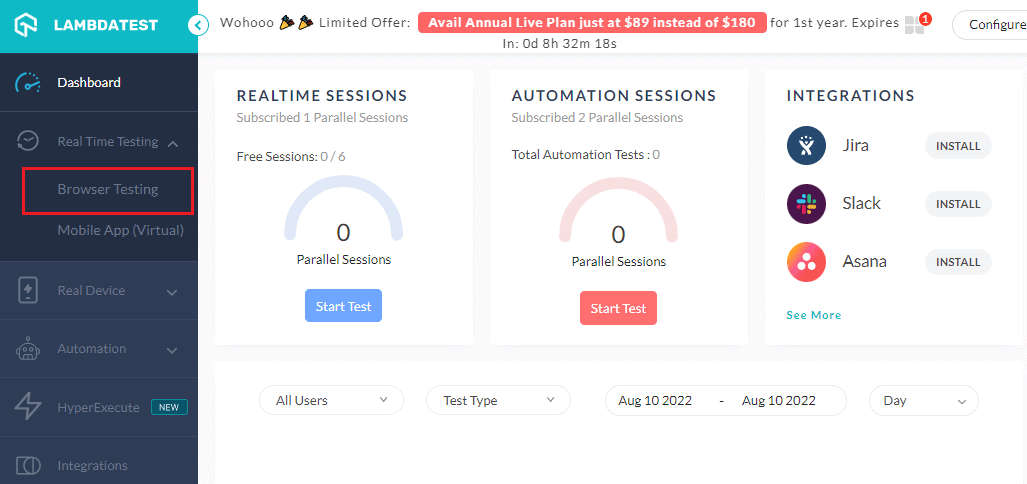
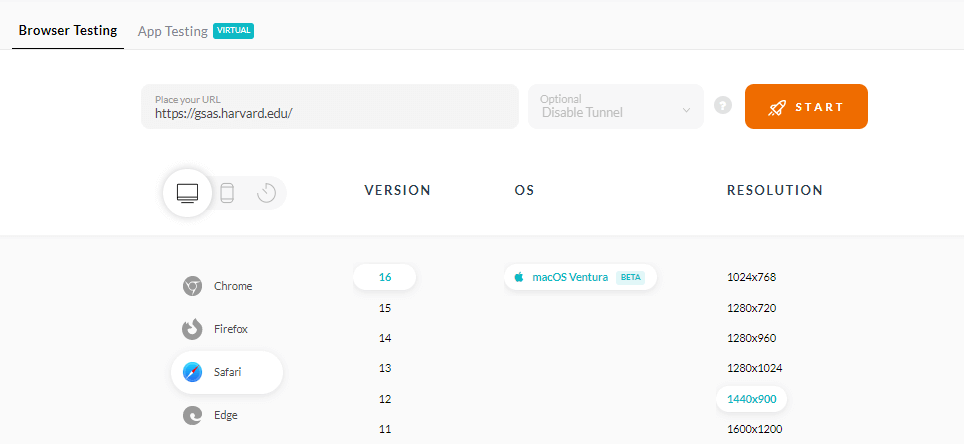
A cloud-based virtual machine will fire up, running real browsers and operating systems. Here you can perform real-time Joomla testing of your web applications.

How to perform Automated Joomla testing?
Apart from the Real Time Testing functionality, you can perform end-to-end automation testing for your Joomla websites. It is done by running automation tests at scale on your Joomla website on the test automation cloud, which is highly reliable and scalable. You can run Selenium, Cypress, and JavaScript-based tests on the automation cloud.
Below are the steps to run web automation of your Joomla websites.
- Sign up on TestMu AI and log in to your TestMu AI account.
- Go to Automation > Builds.
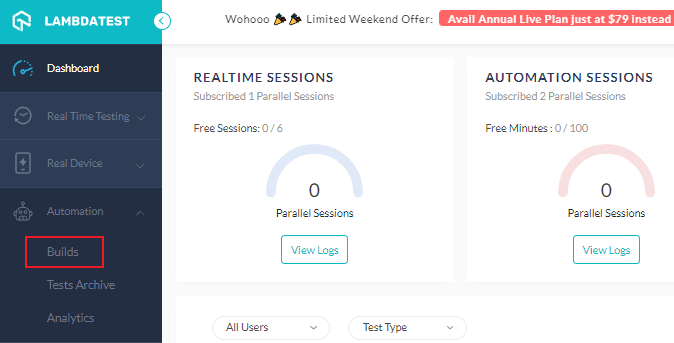
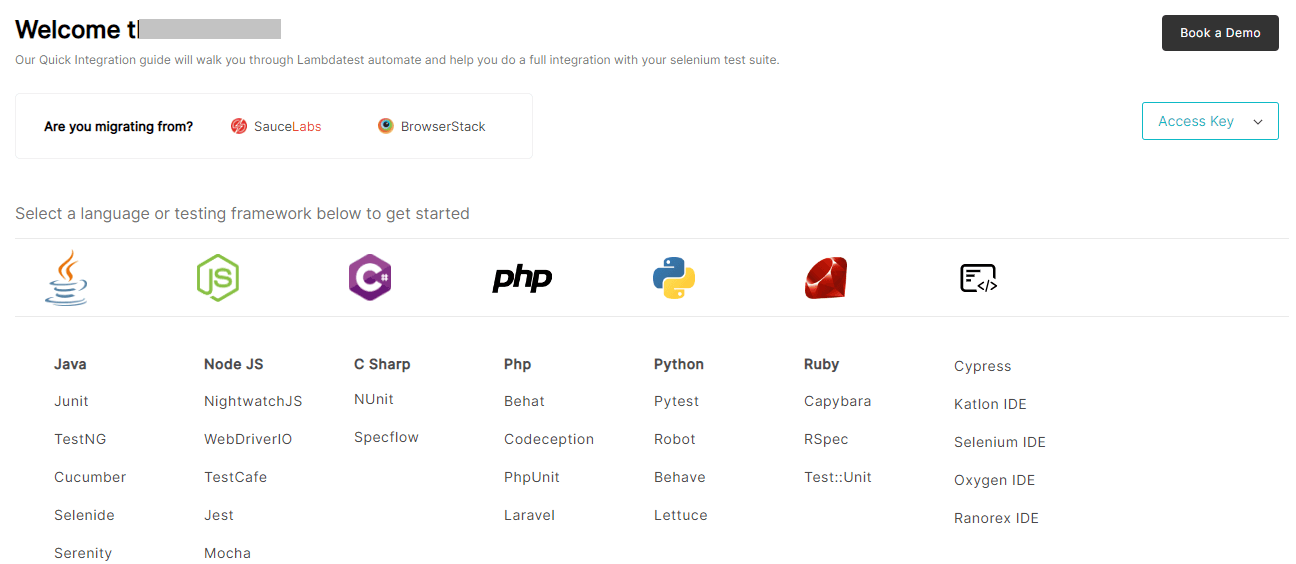
You can now choose your preferred programming language and frameworks to get started with Joomla automation testing. You can also migrate your test suites from different cloud testing platforms to TestMu AI.

Conclusion
In this Joomla testing guide, we discussed the different features and capabilities of the Joomla platform. When developing and performing Joomla testing, you can follow some of the suggestions that can lead to exceptional outcomes in the long run.
These include developing and testing locally, using the integrated development environment (IDE) for writing and testing websites, and employing a version control system to track project updates easily.
Cloud-based test orchestration and execution platforms like TestMu AI have transformed how organizations reinvent and evolve their testing strategies. That is why cross browser testing is commonly adopted by different leading organizations going forward.
You should try out the TestMu AI platform that provides multiple testing options for your Joomla websites. The aspects related to security are also tackled by a scalable and reliable TestMu AI testing cloud. That is why you will see the TestMu AI platform gaining much recognition and popularity for testing different CMS-related components and extensions.


Frequently asked questions
Did you find this page helpful?
More Related Hubs
TestMu AI forEnterprise
Get access to solutions built on Enterprise
grade security, privacy, & compliance
- Advanced access controls
- Advanced data retention rules
- Advanced Local Testing
- Premium Support options
- Early access to beta features
- Private Slack Channel
- Unlimited Manual Accessibility DevTools Tests