

Power Your Software Testing with AI Agents and Cloud
The Native AI-Agentic Cloud Platform to Supercharge Quality Engineering. Test Intelligently and Ship Faster.


- TestMu AI (Formerly LambdaTest)
- /
- Blog
- /
- GDPR Compliance Testing: What to Test and How to Test It
GDPR Compliance Testing: What to Test and How to Test It
GDPR compliance testing explained: what QA teams test, consent and data subject rights checks, GDPR-safe test data rules, and a requirement-to-test-case map.
Last Updated on:
GDPR compliance testing verifies that an application collects, stores, and deletes personal data the way the General Data Protection Regulation requires, from consent capture to erasure. DLA Piper's GDPR Fines and Data Breach Survey (January 2026) counts EUR 7.1 billion in fines since May 2018 and an average of 443 personal data breach notifications per day across Europe.[1]
This guide covers what GDPR compliance testing is, why it matters in 2026, what a GDPR test plan covers, and how to test consent flows, data subject rights, test data handling, and region-specific GDPR behavior.
Overview
To perform GDPR compliance testing, QA teams must verify consent capture, data subject rights, security controls, and test data handling using automated checks. Teams can run these cross-browser privacy and region-specific checks on TestMu AI to ensure lawful handling of EU personal data.
What does a GDPR compliance test plan need to cover?
- Consent verification: QA teams must test that no non-essential cookies or trackers fire before a user agrees, and that withdrawing consent is as easy as granting it.
- Data subject rights: Teams must verify that access, export, correction, and erasure requests complete end-to-end across all primary databases, caches, search indexes, and downstream systems.
- Security controls: Compliance testing requires verifying encryption in transit and at rest, access restrictions, and breach-response readiness under GDPR Article 32 and Article 33.
- Test data compliance: QA teams must ensure that no identifiable personal data sits in staging, CI, or local environments without a legal basis, using irreversible masking or synthetic data.
How do QA teams verify region-specific GDPR behavior?
- Region-specific testing: TestMu AI allows QA teams to verify region-gated behaviors by routing traffic through EU IP addresses and running cross-browser checks on its automation cloud across 3,000+ browser and OS combinations.
What Is GDPR Compliance Testing?
GDPR compliance testing is a set of QA checks that verify an application handles personal data the way the General Data Protection Regulation requires. It covers consent capture, data subject rights such as access and erasure, security controls, retention limits, and the personal data that sits inside test environments themselves.
GDPR compliance testing differs from a GDPR audit. Testing produces pass or fail evidence against the running software: the banner blocked trackers, the erasure request emptied every store, the export contained machine-readable data. An audit assesses policies, contracts, and records of processing. Auditors ask whether the program is sound; testers prove whether the software obeys it.
The scope is wider than production. GDPR Article 4 defines processing as any operation performed on personal data, including storage, retrieval, and use, and the regulation contains no exemption for non-production systems. A staging database seeded from production is processing personal data, which is why test data handling is part of the test plan, not an afterthought.
Why Does GDPR Compliance Testing Matter in 2026?
GDPR enforcement keeps growing: European supervisory authorities issued about EUR 1.2 billion in fines in 2025, and cumulative fines reached EUR 7.1 billion by January 2026.[1] A broken consent flow or an unmasked staging database is enough to trigger a complaint, an investigation, and a fine.
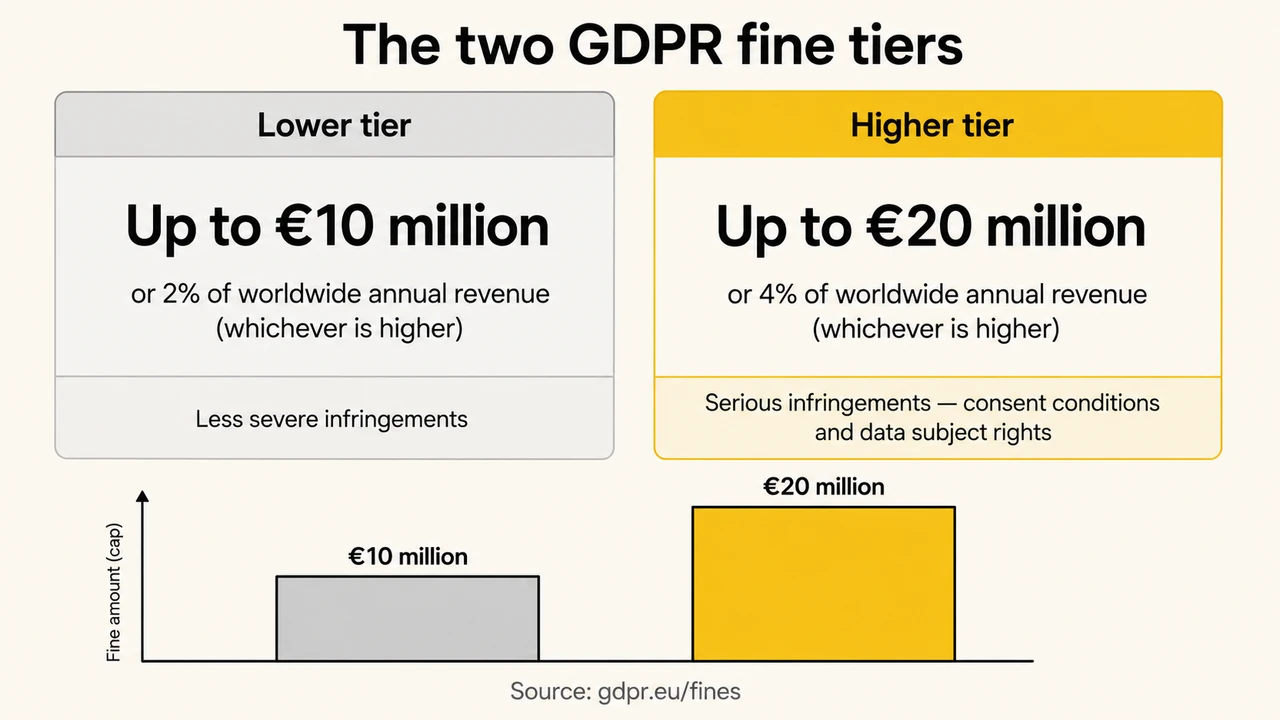
The fine structure has 2 tiers. Less severe infringements reach EUR 10 million or 2% of worldwide annual revenue, whichever is higher, while serious infringements, including violations of consent conditions and data subject rights, reach EUR 20 million or 4%.[2]
Those higher-tier areas, consent and data subject rights, are exactly the behaviors release-time QA checks exercise.
Breach volume is rising too. DLA Piper's survey reports a 22% annual increase in notified personal data breaches, the first time daily notifications have averaged above 400 since GDPR took effect.[1] Release-time GDPR checks catch the defects behind many of those notifications, and the results feed compliance monitoring after release.
What Should a GDPR Compliance Test Plan Cover?
A GDPR compliance test plan maps each regulation requirement to an executable check: consent capture and withdrawal, data subject rights, data minimization, security controls, retention and deletion, and breach response. Each area ties to a specific GDPR article, which gives every test report a direct audit trail back to the regulation.
| Requirement | GDPR Article | What to Test |
|---|---|---|
| Consent | Article 7, Recital 32 | No non-essential cookies before consent; banner starts unchecked; withdrawal path works and takes effect. |
| Data subject rights | Articles 15-20 | Access, export, correction, and erasure requests complete end to end within the response window. |
| Data minimization | Article 5 | Forms and APIs collect only the fields the stated purpose needs; optional fields are marked optional. |
| Security of processing | Article 32 | TLS on every endpoint, encryption at rest, role-based access to personal data, pseudonymization where applied. |
| Retention and deletion | Article 5(1)(e) | Expiry jobs delete or anonymize data on schedule; inactive-account cleanup actually removes records. |
| Breach response | Article 33 | Detection, escalation, and reporting complete inside the 72-hour window in a mock-breach drill. |
Two rows deserve exact wording. Valid consent must be freely given, specific, informed, and unambiguous, and Recital 32 states that silence, pre-ticked boxes, or inactivity do not constitute consent.[3]
For breaches, Article 33 requires notifying the supervisory authority not later than 72 hours after becoming aware of the breach, unless the breach is unlikely to create risk to people's rights and freedoms.[4]
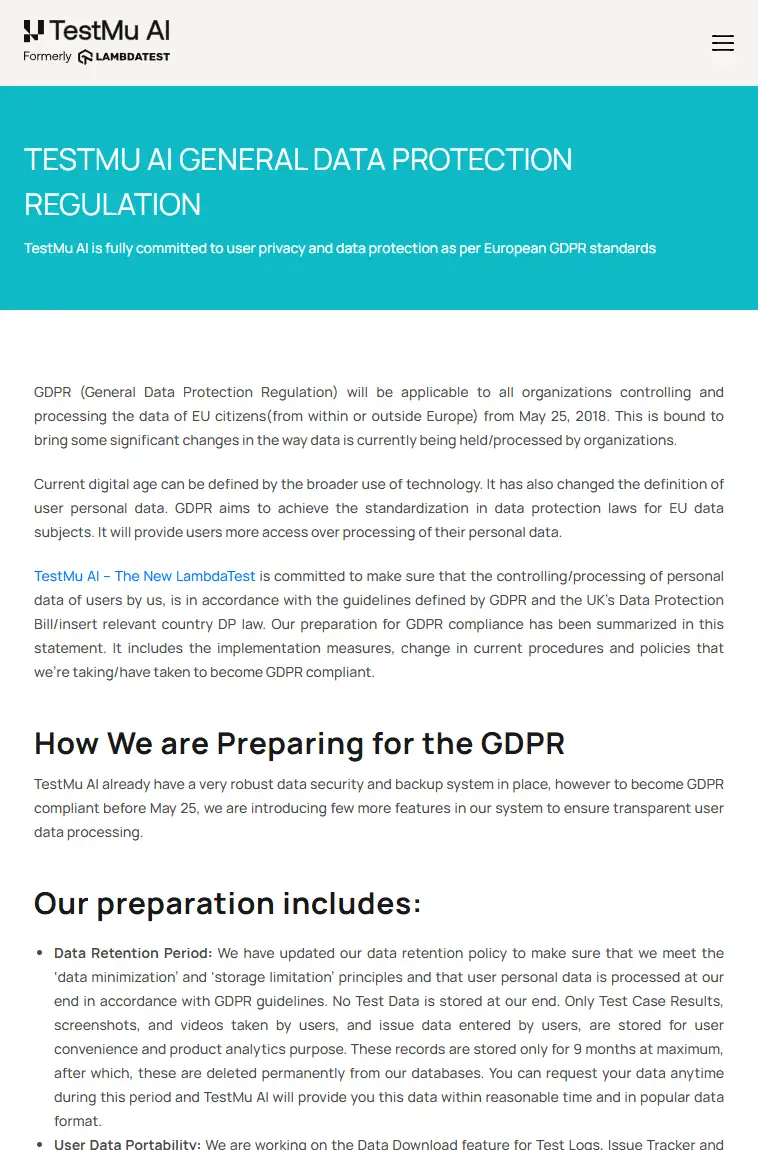
A practical source of expected behavior is the vendor's own published readiness statement. The TestMu GDPR compliance page, captured below, enumerates retention periods, user data deletion, portability, and audit controls; each such published commitment is a test oracle you can write an assertion against.
Article 32 checks overlap heavily with security testing, so reuse those suites instead of duplicating them.
How Do You Test Consent and Cookie Banners?
Consent testing verifies 3 behaviors: no non-essential cookie or third-party tracker loads before the user consents, the recorded consent state matches what the user chose, and withdrawing consent is as easy as granting it. All 3 checks run cleanly in an automated browser session.
The core mechanism is a before-and-after comparison. Open the page in a fresh browser context, capture every cookie and every outbound network request before touching the banner, and assert that only strictly necessary cookies exist and no analytics or advertising host was contacted. Then accept, re-capture, and diff the two snapshots. Playwright and Selenium both expose the storage and network hooks this needs.
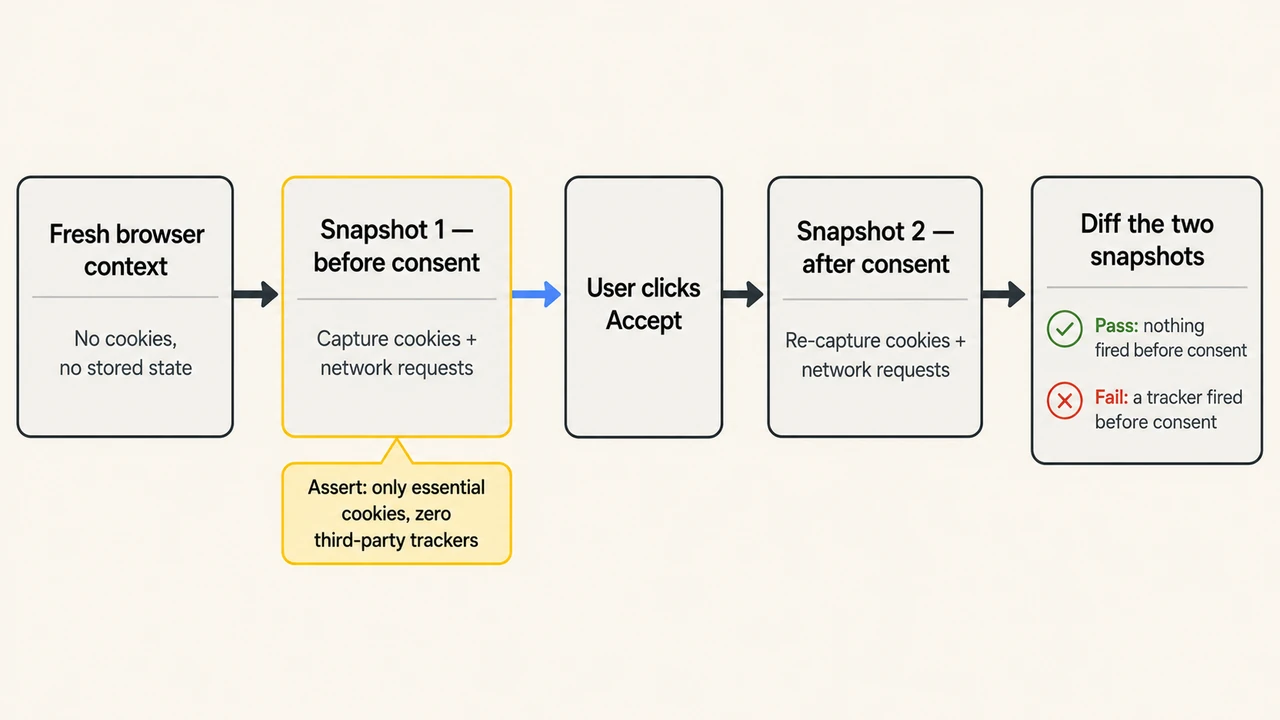
- Pre-consent state: Assert zero non-essential cookies and zero third-party marketing or analytics requests before any user action. This is the check most sites fail.
- Default choices: Assert every optional purpose starts unchecked. Recital 32 invalidates pre-ticked boxes, so a checked-by-default toggle is a defect, not a design choice.
- Withdrawal parity: Article 7(3) makes withdrawal as easy as granting. Count the clicks for each path; if granting takes 1 click and withdrawing takes 5 plus a support email, log a defect.
- Persistence: Reload and revisit after each choice. A rejected state that silently resets to accepted on the next visit is a recurring production failure worth a dedicated regression test.
One pitfall sits in the evidence itself: compliance runs need screenshots as audit proof, and JavaScript-heavy pages can screenshot before they finish rendering.
In my experience capturing the evidence for this article through a cloud browser session, the first viewport screenshot of a JavaScript-heavy page returned a blank band with no text, and only a full-page retry rendered completely. An unreadable capture proves nothing, so verify the render before archiving it.

Note: Run pre-consent cookie checks across 3,000+ browser and OS combinations with TestMu AI. Try it free!
How Do You Test Data Subject Rights?
Data subject rights testing verifies that access, export, correction, and erasure requests work end to end. Erasure is the hardest check: deleted data must disappear from the primary database, caches, search indexes, exports, and third-party processors, not just from the user interface.
Article 17 gives users the right to obtain erasure of personal data without undue delay, and gdpr.eu reads undue delay as about one month.[5]
That window makes erasure a workflow test, not a single API call: the request, the confirmation, the propagation, and the deadline all need assertions.
- Create a disposable account, then generate activity: a profile, an order or 2, uploaded files, and support messages.
- Request an export first and store it; the export defines the full data surface the erasure must later clear.
- Submit the erasure request and complete any confirmation step.
- Verify absence everywhere the export showed data: the UI, the API, a fresh export attempt, search results, and analytics events keyed to the user.
- Re-register with the same email address; recovered order history or a pre-filled profile means the deletion was a visibility flag, not an erasure.
The most common defect this catches is the soft-delete flag: the record vanishes from the UI but still returns through the API or a database export. Under Article 17 that state is a failure. Test at the data layer, because the UI is the one place erasure almost always looks correct.
How Do You Keep Test Data GDPR Compliant?
Test data is GDPR compliant when no living person can be identified from it. Anonymized data falls outside GDPR scope, pseudonymized data stays inside it, and raw production copies stay fully in scope. The compliant options are irreversible masking, synthetic generation, or strict pseudonymization with controls.
The legal line comes from Recital 26: pseudonymized data that could be attributed to a person by using additional information is still personal data, while data protection principles do not apply to information rendered anonymous so that the data subject is no longer identifiable.[6]
Ministry of Testing's guidance for QA teams draws the practical conclusion: personal data in test data is subject to the same rules and regulations as personal data in production.[7]
The trap is reversible data masking. Teams mask names and emails but keep a mapping table so support can trace a bug back to the real customer. That mapping table is exactly the additional information Recital 26 describes, so the masked dataset is pseudonymized, not anonymous, and every GDPR duty still applies to the staging copy.
In the Reddit thread Data Masking in Staging on r/devops, a developer posting as SnooSuggestions202 clones the production database into staging and randomizes fields like user emails and bank details. The developer then finds ProxySQL, which can mask columns at query time by rewriting the query, but reports that the match regex is hard to write for the complicated queries developers run. The lesson for GDPR testing is to check that masking is complete and irreversible on every column and query path before staging is used.
| Approach | GDPR Status | Choose It When |
|---|---|---|
| Irreversible masking | Out of scope if no re-identification path exists | You need production-shaped volumes and edge cases, and no one needs to trace records back. |
| Synthetic data | Out of scope; no real person behind any record | New features, load tests, and demos where realistic structure matters more than historical truth. |
| Pseudonymization | Still personal data under Recital 26 | A defect genuinely requires traceability; add access controls, logging, and a documented legal basis. |
| Raw production copy | Fully in scope; high-risk default | Avoid. Staging and CI usually have weaker access controls than production, which widens exposure. |
Verification belongs in the pipeline: after each refresh of staging data, run a re-identification probe that searches for real email domains, valid phone formats, and known production identifiers. Masking jobs fail silently on new columns, so the probe, not the job's exit code, is the compliance signal.

How Do You Test Region-Specific GDPR Behavior?
Region-specific GDPR testing verifies the behavior only EU users see: consent banners that appear for EU IP addresses, region-gated data flows, and localized privacy notices. The test session must appear to originate inside the EU, which makes IP geolocation control a hard requirement for the test setup.
This is where many GDPR suites silently pass while the product fails. Sites commonly gate the consent banner on IP geolocation, so a suite running from a United States office or data center never renders the EU banner path at all, and every consent assertion goes green against the wrong variant.
The mechanics build on how to test geolocation of websites and mobile apps: the checks only count when the session's apparent country, language, and locale match a real EU user.
Platforms like TestMu AI provide Real Device Cloud, which runs these region-gated checks on real Android and iOS hardware from inside the target geography. Key capabilities include:
- IP Geolocation: Route the device's network traffic through IP addresses associated with 170+ countries, so the app and any server-side logic that responds to the user's IP behave as if the device is physically in that country.
- Localization Validation: Combine GPS simulation with device locale settings to test language, date and currency formats, and region-specific legal disclosures such as privacy notices.
- Session Isolation: Each session runs in a fully isolated environment and the device is wiped between sessions, so no personal data from one test run persists into the next.
In automated runs, the same switch is a single capability: set geoLocation to a two-letter country code in the session options.
"lt:options": {
  "platformName": "Android",
  "deviceName": "Samsung Galaxy S24",
  "geoLocation": "DE"
}
You can follow the IP geolocation on real devices browser documentation to set up location-specific sessions.
Conclusion
GDPR compliance testing turns every requirement that matters to QA into an executable check: consent becomes a before-and-after cookie diff, erasure a data-layer absence test, retention an expiry-job assertion, and test data a re-identification probe.
Start this week with the pre-consent cookie audit on your highest-traffic entry page, then add the end-to-end erasure check, and run both from an EU location on TestMu AI so the region-gated paths actually execute.
The enforcement direction makes the habit worth building: DLA Piper counted 443 breach notifications per day in its January 2026 survey, a 22% jump in a single year.[1] Teams that test privacy behavior per release find these defects before a regulator, or a user complaint, does.
Citations
- [1] DLA Piper GDPR Fines and Data Breach Survey - DLA Piper (January 2026)
- [2] What are the GDPR Fines? - GDPR.eu
- [3] GDPR Consent Requirements - GDPR.eu
- [4] Article 33: Notification of a Personal Data Breach - GDPR.eu
- [5] Everything You Need to Know About the Right to Be Forgotten - GDPR.eu
- [6] Recital 26: Not Applicable to Anonymous Data - gdpr-info.eu
- [7] Using Personal Data In Test Safely: How To Comply With the GDPR - Ministry of Testing, Ioan Solderea
Note: AI assistance was used in researching and drafting this article. Harish Rajora (Software Developer 2 at Oracle, expertise in Software Testing and Web Testing) verified every statistic, link, and product claim against primary sources before publication, following our editorial process and AI use policy. Technically reviewed for GDPR testing accuracy by Mayank Bhola. Sources cited are the official GDPR text and GDPR.eu.
Author

Harish Rajora
Blogs: 100


Harish Rajora is a software developer at TestMu AI with over 6 years of hands-on experience in Python and cross-platform application development across Windows, macOS, and Linux. He has authored 800+ technical articles and worked on large-scale projects, including GenAI applications and core engineering features used by millions. Harish has led DevOps initiatives building CI/CD pipelines with Jenkins, AWS, GitLab, and GitHub, and holds an M.Tech in Software Engineering from IIIT Allahabad.
Reviewer

Mayank Bhola
Reviewer
Mayank Bhola is Co-Founder and Head of Products at TestMu AI (formerly LambdaTest), where he leads the entire product portfolio across KaneAI, Kane CLI, HyperExecute, SmartUI, the Real Device Cloud, Accessibility, and other software testing product lines. As an early Lead Architect he designed and built the company's flagship Tunnel technology from scratch, created the React-based automation platform, and architected the data-intensive pipelines and FAAS services that scale it. He brings more than 10 years of experience in software development and product engineering, with earlier roles as Head of Technology at Juggernaut Books and Senior Software Engineer at PressPlay TV and Zomato. Mayank holds a B.Tech in Computer Engineering from JIIT Noida.


GDPR Compliance Testing FAQs
Did you find this page helpful?
More Related Blogs
TestMu AI forEnterprise
Get access to solutions built on Enterprise
grade security, privacy, & compliance
- Advanced access controls
- Advanced data retention rules
- Advanced Local Testing
- Premium Support options
- Early access to beta features
- Private Slack Channel
- Unlimited Manual Accessibility DevTools Tests