

Next-Gen App & Browser Testing Cloud
Trusted by 2 Mn+ QAs & Devs to accelerate their release cycles


On This Page

Webinar: Democratize Automation to Build Autonomy and Go-To-Market Faster [Experience (XP) Series]
Unlock market agility with Vadeesh Budramane, Founder & CEO at AlgoShack. Join the webinar on Democratizing Automation for Autonomy and rapid market entry.

Yash Bansal
December 19, 2025
The paradigm of business operations is undergoing a profound shift with the theme “Democratize Automation to Build Autonomy and Go-To-Market Faster.” This transformative approach signifies a departure from traditional silos, aiming to make automation accessible to a broader spectrum within organizations.
By democratizing automation, organizations empower diverse teams to integrate automated processes into their workflows, fostering a culture of autonomy. This paradigm shift optimizes internal operations and plays a pivotal role in expediting the journey to market, a critical factor in today’s fast-paced business environment.
As organizations grapple with the complexities of the digital age, this webinar provides a roadmap for seamlessly integrating automation strategies across departments, from development to marketing. The goal is to create an environment where automation is not confined to a specialized few but becomes a democratized tool that fuels innovation and accelerates go-to-market strategies.
By embracing this approach, businesses can enhance their adaptability, respond swiftly to market dynamics, and position themselves as industry leaders in an ever-evolving landscape.
Watch this webinar episode for an insightful exploration of how democratizing automation can redefine your organizational dynamics, cultivate autonomy, and propel your endeavors to market faster than ever before. So, without ado, let’s dive deep.
About TestMu AI XP Series: Webinar & Speaker
TestMu AI Experience (XP) Series includes recorded webinars/podcasts and fireside chats featuring renowned industry experts and business leaders in the testing & QA ecosystem. In this episode of our XP series webinars, a distinguished speaker, Vadeesh Budramane, Founder & CEO of AlgoShack, discovers the impact of democratizing automation and leveraging LowCode/NoCode platforms.
With 33+ years in product engineering and innovation, Vadeesh formerly served as a Senior VP at Sutherland Global Services and Director at CSC India.
A pioneer in launching products, like Lorenzo with NHS, Vadeesh has a track record of building platforms in analytics and consumerism, showcasing strategic acumen and P&L expertise. In his extensive senior leadership roles, he’s orchestrated global teams and strategic engagements and created substantial value across diverse industries.
Digital Transformation is Pushing the Boundaries
Vadeesh highlights that software has become the key differentiator for businesses. With such a gig economy, every business is turning into a digital business today and trying to engage with customers in newer ways. There is more satisfaction happening now than before, and machine learning is becoming more of a reality.
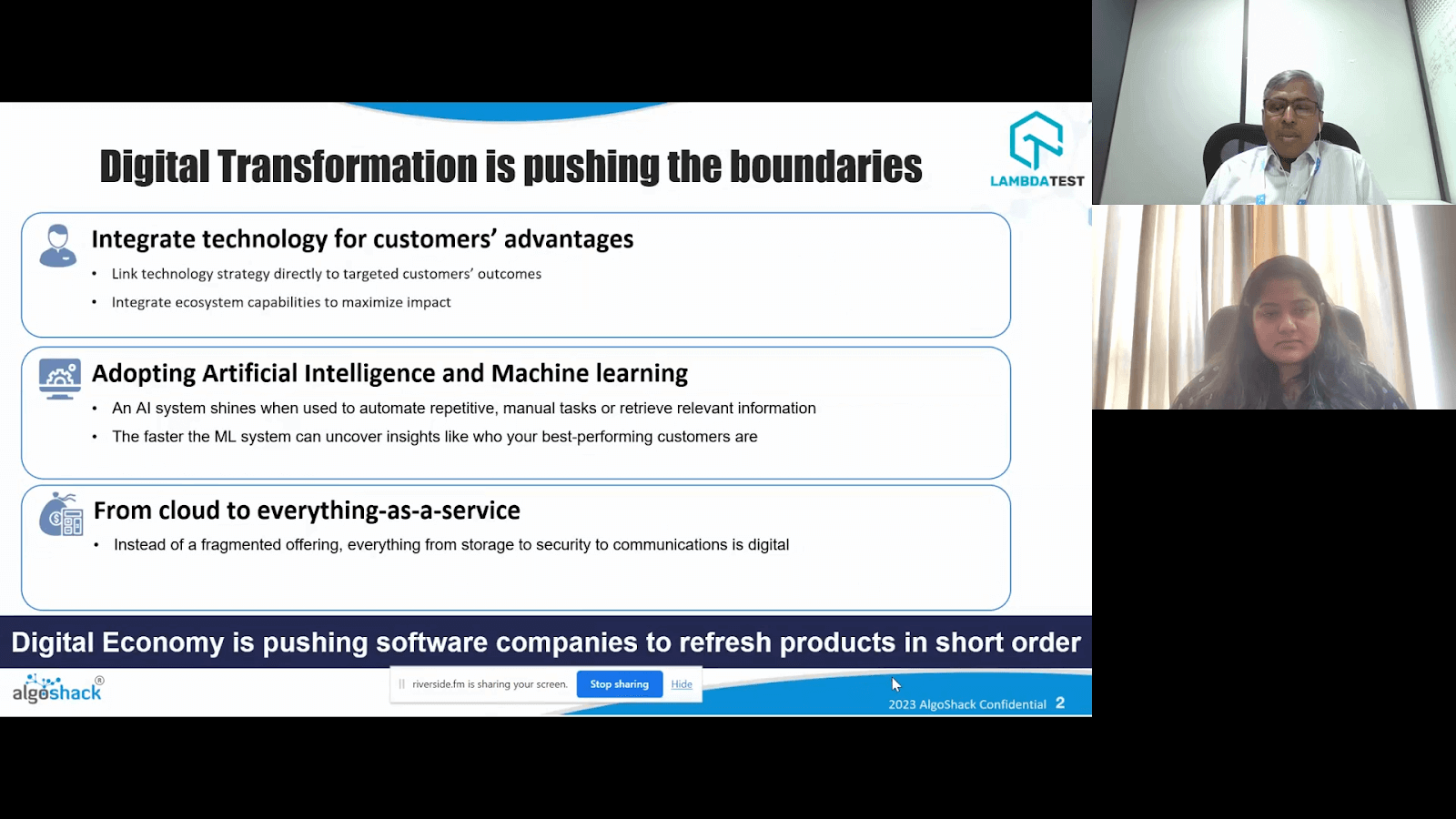
Under these circumstances, with this backdrop, what’s happening with software companies is that they are under tremendous cost-time pressure to take their products to market faster in quick succession. As we all know, one-third of software development effort is in testing or test automation, which becomes very critical due to manual resource-intensive, time-consuming.
Test Automation Challenges
There are several test automation challenges; a few are listed below:
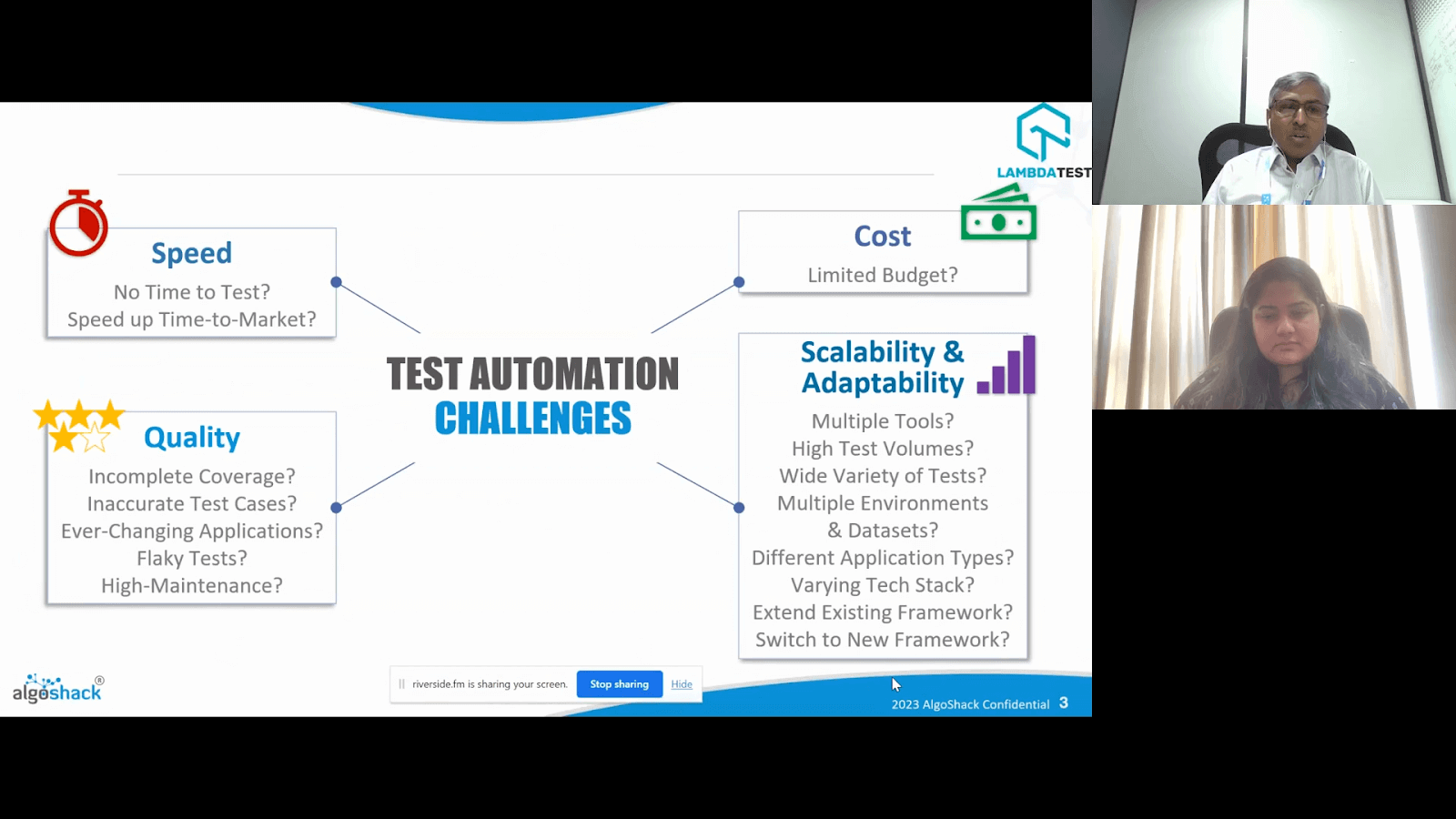
- Speed: Achieving rapid test execution is a common challenge. As test suites grow, the time taken for comprehensive testing can significantly increase, impacting the overall speed of the development cycle.
- Cost: Test automation often incurs initial setup costs and requires ongoing maintenance. Balancing the upfront investment with long-term benefits while avoiding over-reliance on expensive tools is crucial for managing costs effectively.
- Quality: Maintaining test quality is essential. Automation can sometimes lead to false positives or inadequate coverage. Ensuring that automated tests align with real-world scenarios is critical for reliable and high-quality testing.
- Scalability and Adaptability: Scalability challenges arise when extending automated testing to accommodate growing applications or diverse environments. Ensuring adaptability to changes in the application’s structure or technology stack is key for sustainable test automation practices.
Evolution of Test Automation Frameworks
In a comprehensive exploration of automation testing frameworks, Vadeesh delineates the evolution from the simplistic yet limited record and playback frameworks to the advanced era of AI-driven, Full-Stack frameworks.
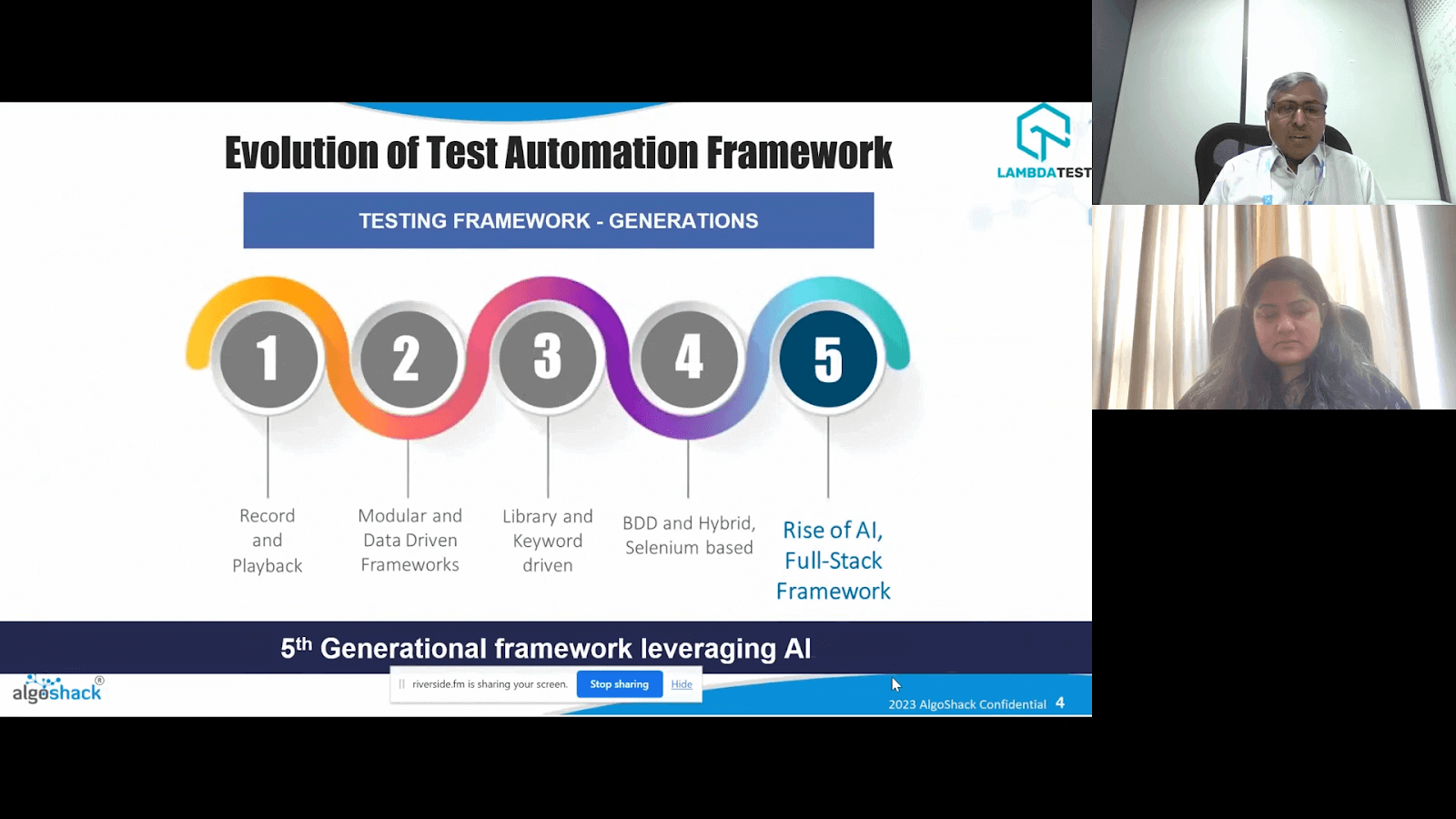
- Record and Playback Frameworks: Vadeesh emphasizes that during the early era of Test Automation with Record and Playback frameworks, testers used to record interactions and play them back, which was simple and easy to use, but also with some limitations such as scalability and maintenance.
- Modular and Data-Driven Frameworks: Vadeesh discussed the evolution towards Modular and Data-Driven frameworks that indicate a shift to more organized and reusable test components, enhancing maintainability and allowing for efficient test data management.
- Library and Keyword-Driven Frameworks: These frameworks enable testers to use pre-defined libraries and keywords, simplifying script creation and maintenance.
- BDD and Hybrid, Selenium-Based Frameworks: Vadeesh mentioned that as we move towards business-readable tests and a blend of different frameworks, we offer flexibility and alignment with modern development practices.
- Rise of AI, Full-Stack Frameworks: Vadeesh highlighted how Artificial Intelligence enhances test automation capabilities and the emergence of frameworks that cater to the complexities of full-stack applications, providing a holistic testing approach.
Test Automation Trends
Vadeesh highlighted that considering current trends, there are two key aspects: one is low code/no code, and another one is leveraging machine learning. When we talk about low code/no code, it doesn’t mean no code as no script. It’s about scripts but not spending time delivering those scripts. In other words, there are no manual script efforts, but it’ll have scripts in the technology of one’s choice. It could be Java, JavaScript, TypeScript, or C#. It could be any tool you are familiar with, such as Selenium, Appium, Cypress, or Playwright.
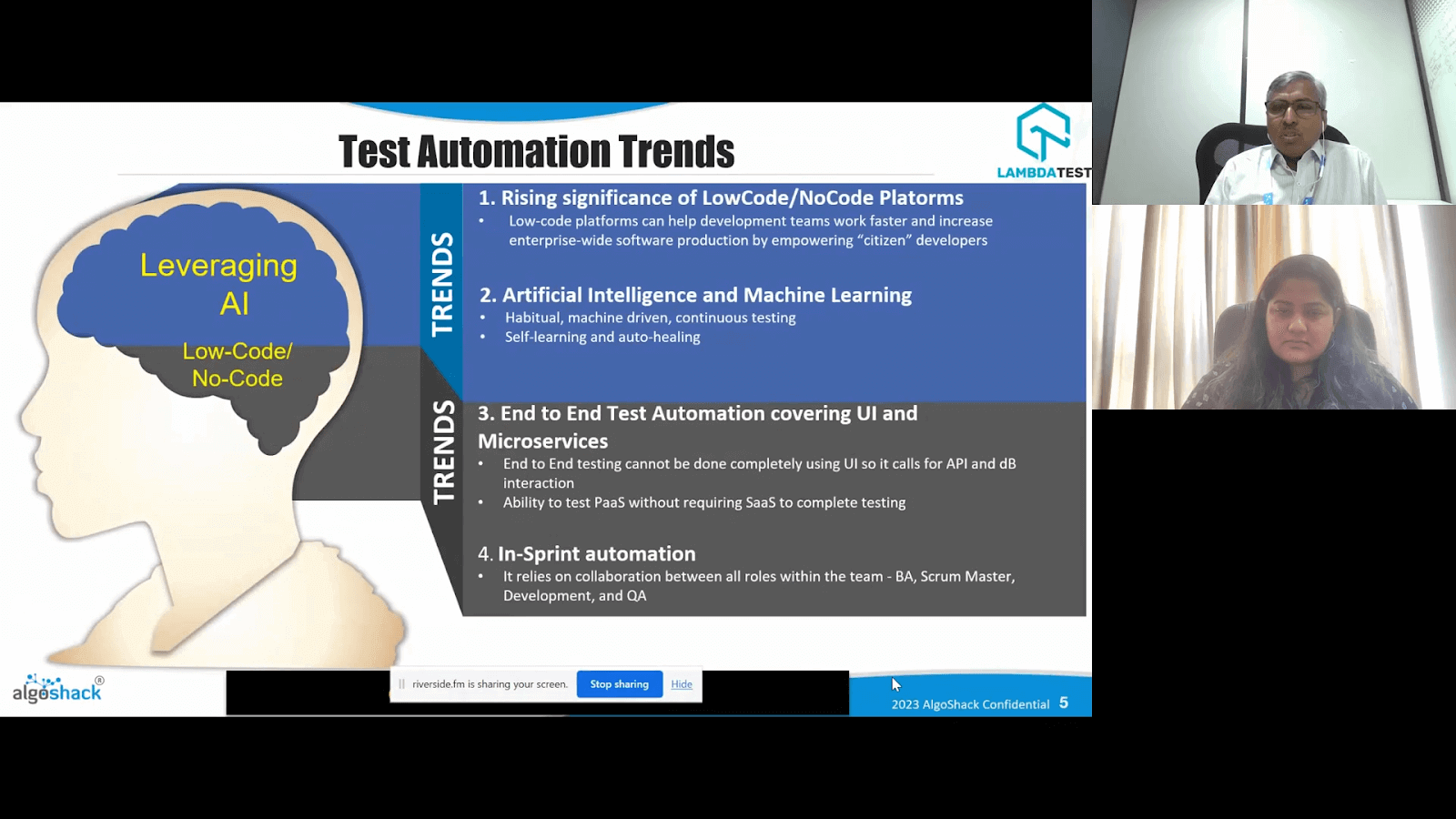
The other key trend is Artificial Intelligence and Machine Learning and their application to help with habitual continuous testing. Testing or the test scripts that are self-healing or auto-healing so that you can truly have autonomous testing. The third trend is to make test automation unified and comprehensive, not only covering UI testing but also testing microservices and web services.
Rise of Low Code/NoCode Platforms
Vadeesh mentioned that developers could automate testing within a sprint with low code/no code platforms. When developers contribute to testing, the silos in test creation get removed. In this process, testing becomes a lot more effective. Likewise, it empowers manual test engineers to automate testing. Here are some advantages of low code/no code platforms:
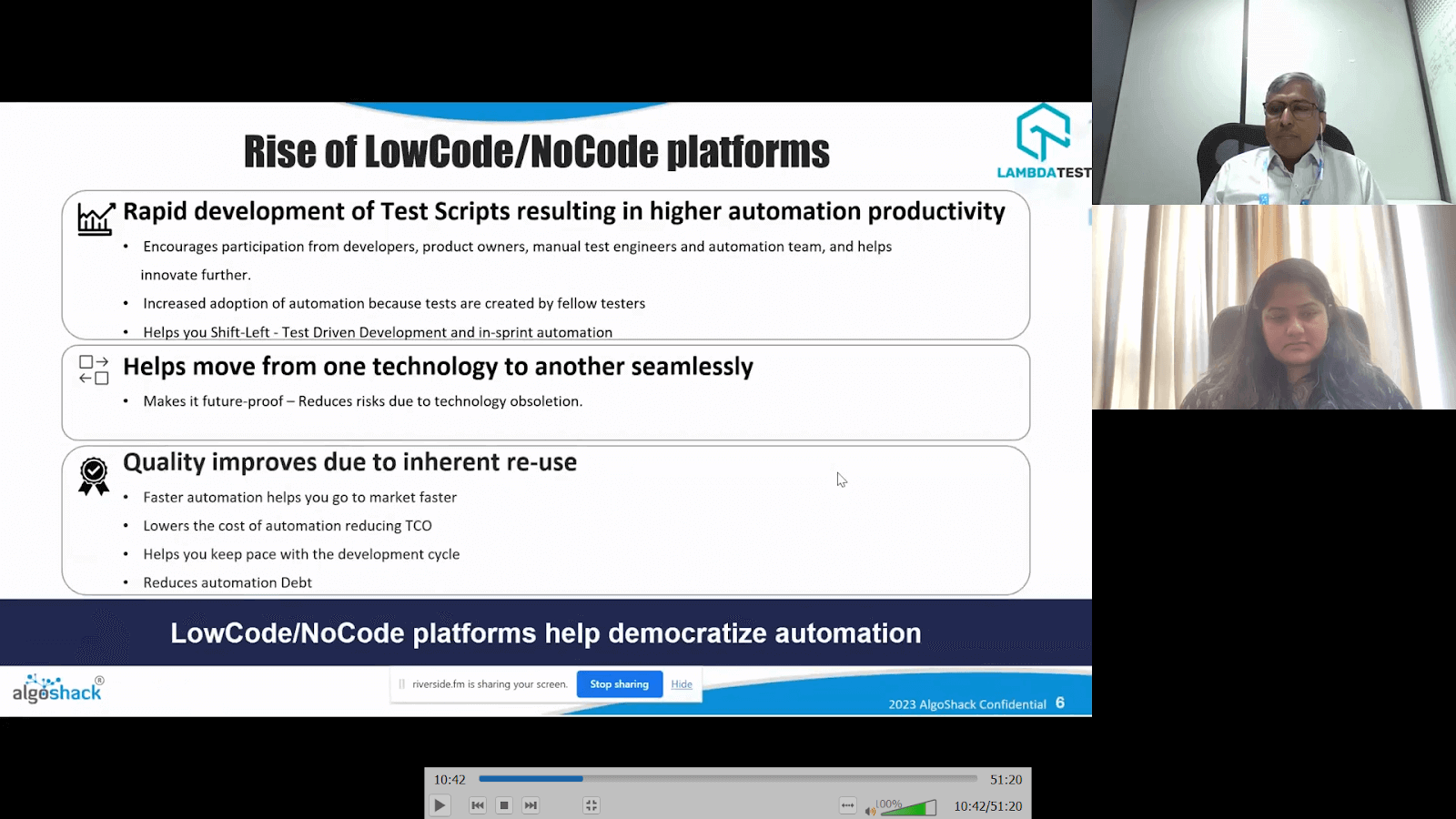
- Rapid development of test scripts resulting in higher automation productivity
- Helps move from one technology to another seamlessly
- Quality improves due to inherent re-use
Rise of Artificial Intelligence
Vadeesh underscores the pivotal role of Artificial Intelligence (AI) in revolutionizing test automation. In terms of speed, AI-driven automation enables faster test execution by optimizing test case selection and execution sequences, and the concept of self-healing can intelligently identify and rectify issues during test runs, contributing to improved reliability and robustness.
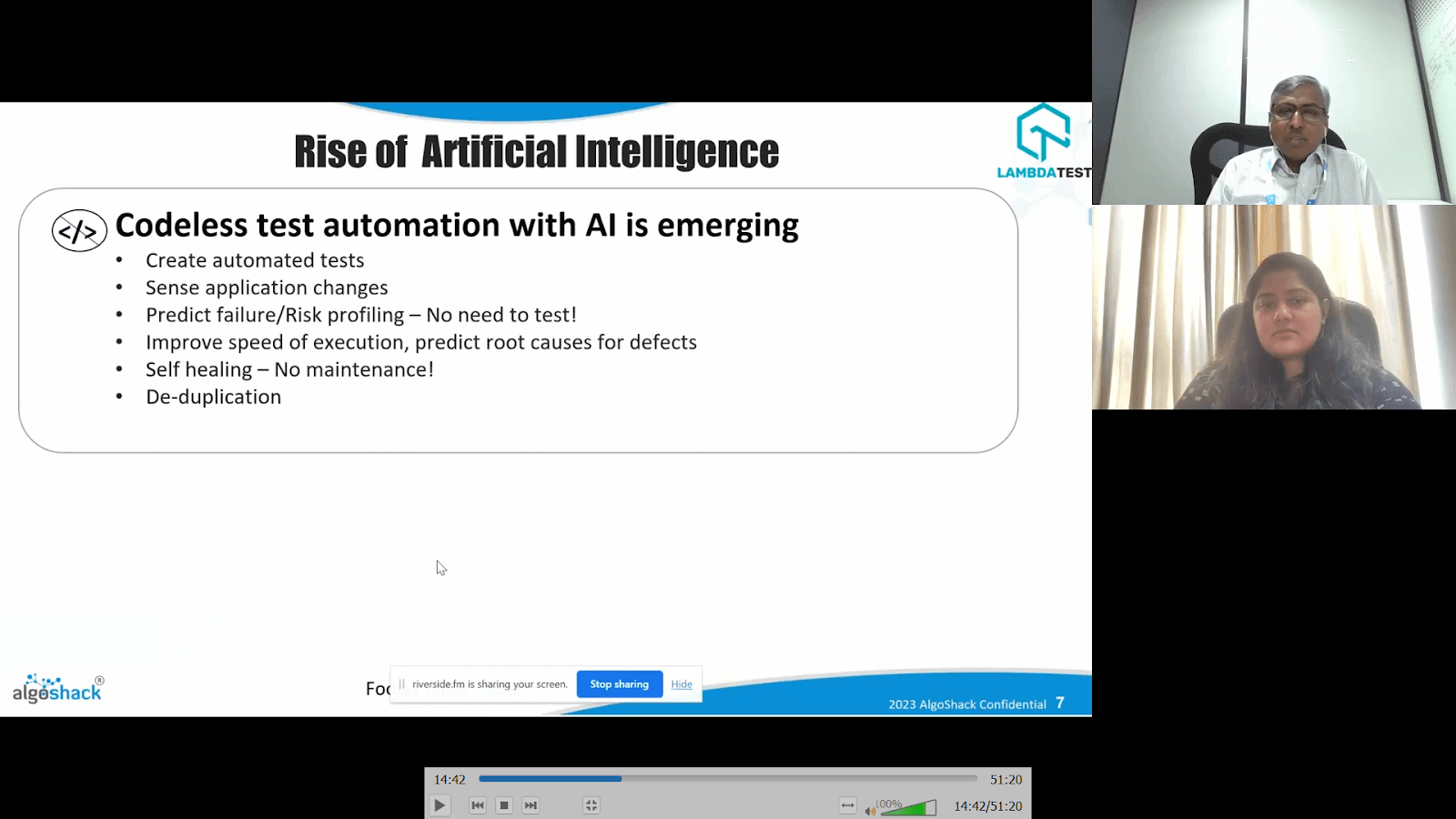
Moreover, it is about AI’s de-duplication capabilities and how it intelligently manages and eliminates redundant test scenarios, streamlining the testing process and enhancing efficiency.
Q&A Session
Q: How does slow and siloed system design and test creation impact the ability to meet tight deadlines and deliver software products to market faster? Is the democratization of test automation the only solution?
Vadeesh: Yeah, there has been very little collaboration regarding the automation of tests within a sprint cycle. That is because, by design, there would be more developers in a scrum team and fewer testers, and the focus is on developing and not so much on test creation, certainly not on automation testing.
So, the test creation process is slower, and the automation process is slower, resulting in significant quality challenges and a lot of tech debt. In that case, you have to automate testing downstream, which used to be the situation, but then, with this democratization, such tools now make test automation very easy, fast, and quick.
So, in me, democratization means removing barriers. It’s about inclusivity, about making things a lot more comprehensive, more effective, more efficient. It’s about reducing the need to have more and more technical skills. It is about leveraging functional people to their fullest potential. Obviously, it’s all for many issues that resulted in slowness and a siloed approach that increased the cost of quality in the past.
Q: How can organizations, especially enterprises, ensure the automated testing process remains compliant with industry regulations and quality standards while adapting to customized business processes?
Vadeesh: You know, when we approached some of the regulated industry segments, such as medical devices, they expected a significant degree of transparency. They would not read testing as a black box, they will not read automated scripts as a black box, and they will want to review automated scripts. They have to be validated before they are executed. Because the reports produced by automated scripts must be submitted to the FDA for regulatory reasons. So, you have to validate the scripts. So, you can’t say that my scripts are proprietary.
There are guidelines for reports as well. What logs to go, what screenshots to attach, where to have video clippings, what must be verified, and to what degree do you have to verify them? So everything is specified; you can’t take chances. So you have to cater to such requirements; only then would a low code/no code platform be successful in regulated industry segments.
Q: How do you balance standardization and customization when democratizing automation, especially in medical industries with unique requirements?
Vadeesh: If you are looking to automate testing of a production floor, I think standardization by way of having BDD. It is common no matter what. There may be some business logic very specific to a particular application they may not even want to part with. They may not even want to share that with anyone. So, the application user knows that logic best and should be able to automate that edge case on his own. That is where I call it low code, no code.
Q: Can you highlight how TestMu AI accommodates customizations and the ability to work with various tools and technologies to meet various requirements?
Vadeesh: Yeah, I’m very excited by TestMu AI offering HyperExecute – an enterprise test execution environment where you can execute scripts, no matter what type of application. It could be a web application, mobile application, desktop-based application, or hybrid application.
TestMu AI solves, and that capability is greatly enhanced with HyperExecute with an enterprise execution environment. Hence, TestMu AI helps with the democratizing of testing and test automation. It helps with hyper-automation. It helps with continuous test execution, or in other words, autonomous testing.

Austin Siewert
CEO, Vercel
Discovered @TestMu AI yesterday. Best browser testing tool I've found for my use case. Great pricing model for the limited testing I do 👏
2M+ Devs and QAs rely on TestMu AI
Deliver immersive digital experiences with Next-Generation Mobile Apps and Cross Browser Testing Cloud

Final Thoughts on the Webinar: Enjoyed It?
As we wrap up our discussion on “Democratize Automation to Build Autonomy and Go-To-Market Faster,” I sincerely hope this webinar has provided valuable insights into the transformative world of automation and its role in expediting market strategies. If you’ve enjoyed this blog, please watch the full webinar for a more in-depth exploration.
Watch for future sessions in the TestMu AI Experience (or XP) Series. To stay informed about upcoming webinars, testing challenges, and industry insights, subscribe to our newsletter, Coding Jag. Until our next interaction, embrace the testing journey, stay informed, and continue striving for excellence in the dynamic realm of digital innovation.
#TestMu AIYourApps❤️


Did you find this page helpful?
More Related Hubs
TestMu AI forEnterprise
Get access to solutions built on Enterprise
grade security, privacy, & compliance
- Advanced access controls
- Advanced data retention rules
- Advanced Local Testing
- Premium Support options
- Early access to beta features
- Private Slack Channel
- Unlimited Manual Accessibility DevTools Tests