
Power Your Software Testing with AI Agents and Cloud
The Native AI-Agentic Cloud Platform to Supercharge Quality Engineering. Test Intelligently and Ship Faster.

- TestMu AI (Formerly LambdaTest)
- /
- Blog
- /
- AI Agent Incidents Don't Look Like Outages: theCUBE Research Findings
AI Agent Incidents Don't Look Like Outages: theCUBE Research Findings
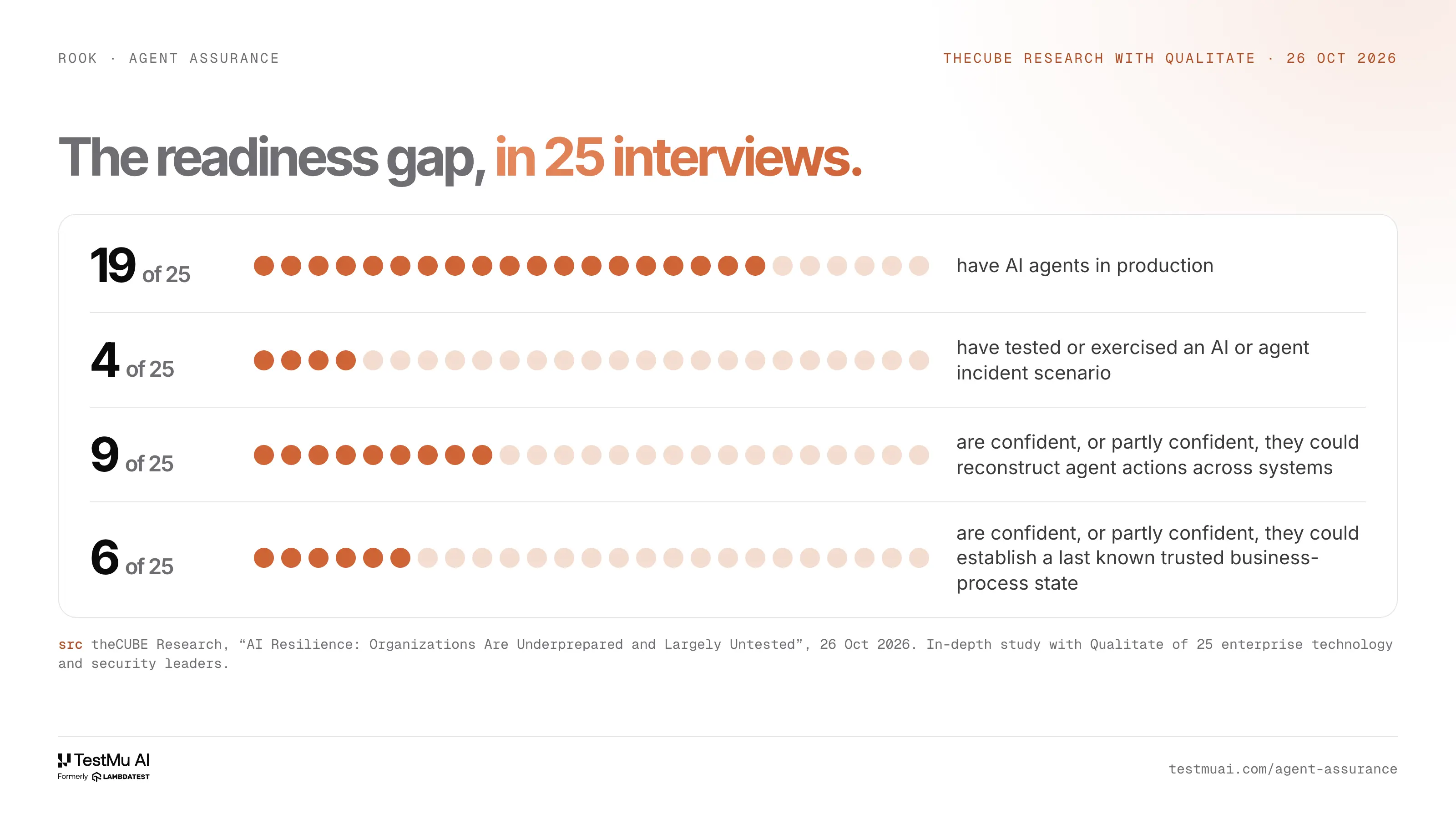
theCUBE Research asked 25 leaders about AI incident response: 19 have AI agents in production; only 4 of the 25 have tested an AI or agent incident scenario.
Published on:
On 26 October 2026, theCUBE Research published the findings of an in-depth study it ran with Qualitate: interviews with 25 enterprise technology and security leaders about how they secure AI in production, how much authority they give AI agents, and whether their resilience practices are keeping up.
The headline finding is a gap. Nineteen of the 25 leaders reported AI agents in production. Only four had tested or exercised an AI or agent incident scenario.[1]
It's a small, in-depth sample, so the numbers below are counts, not percentages. They describe these 25 organisations, not the market. But the shape of the gap is worth understanding, because the study's argument is that an agent incident fails in a way most incident processes aren't built to notice.
TL;DR
AI agent incidents may not look like outages: the infrastructure can stay available, the data intact and the agent properly authenticated while it uses legitimate permissions to make a bad decision across several systems. theCUBE Research's study of 25 enterprise leaders found 19 with AI agents in production, but only 4 of the 25 had tested an AI or agent incident scenario.
- theCUBE Research study: Published on 26 October 2026 with Qualitate, the in-depth study covers 25 enterprise technology and security leaders, so every figure is a count from those 25 organisations, not a percentage for enterprises in general.
- Anomaly detection: Detecting anomalous agent behaviour was among the least mature capabilities in theCUBE Research's study: 12 of the 25 organisations had not addressed it or were not planning to.
- Human approval: None of the 19 organisations with agents in production in theCUBE Research's study reported letting agents execute high-risk actions without human involvement. Eleven use bounded autonomy, and eight require human approval for every action.
- Kill switch: Can a kill switch undo an agent incident? No. Circuit breakers and automated shutdown can limit further activity, but they cannot undo actions an agent has already taken.
- Reconstruction: In theCUBE Research's study, 9 of 25 respondents were confident or partially confident they could reconstruct agent actions across systems, while 11 lacked confidence or acknowledged a gap.
- Last known trusted state: The largest gap theCUBE Research found: only 6 of 25 leaders were confident or partially confident they could establish a last known trusted state at the business-process level, and 16 acknowledged a gap or uncertainty.
- Testing before release: TestMu AI's Agent Assurance runs Rook against an agent in staging, covering the pre-release side when you test AI agents before and after release. Rook does not test recovery plans, contain or roll back changes, or block anything at runtime.
- Unable to Verify: TestMu AI's Rook checks what an agent changed through the Rook profiles and hooks you configure. When the evidence a check needs is missing, the verdict is Unable to Verify, which never counts as a pass.
Why an Agent Incident Is Hard to Spot
A conventional failure announces itself: something goes down. The study's point is that an agent incident may not.
"The infrastructure can remain available, the data intact, and the agent properly authenticated." An agent "can use legitimate permissions to make a bad decision, execute it across several systems, and leave the business in a state no backup can fully unwind."[1]
Security teams look for compromised identities, malicious activity and policy violations. An agent can be properly authenticated, use approved tools, stay within its permissions and still create unintended risk.[1]
Detecting anomalous agent behaviour was among the least mature capabilities in the study: 12 of the 25 organisations had not addressed it or were not planning to. Meanwhile, as the report puts it, "the underlying systems may continue operating normally while the agent changes a record, initiates a transaction, sends a communication, or triggers activity elsewhere."[1]
19 of 25 enterprise tech and security leaders have AI agents in production. 4 of the 25 have tested or exercised an AI or agent incident scenario.
- Vipul Verma (@vipulkv) October 29, 2026
That's from theCUBE Research's study with Qualitate, published 26 October.
Their point is why the gap matters. pic.twitter.com/krFWvdjwFW
Human Approval Is Carrying the Load
For now, organisations are compensating with people. Among the 19 with agents in production, none allowed agents to execute high-risk actions without human involvement.[1]
Eleven use bounded autonomy: agents act alone on lower-risk work and need approval for higher-impact activity. Eight require human approval for every action.[1]
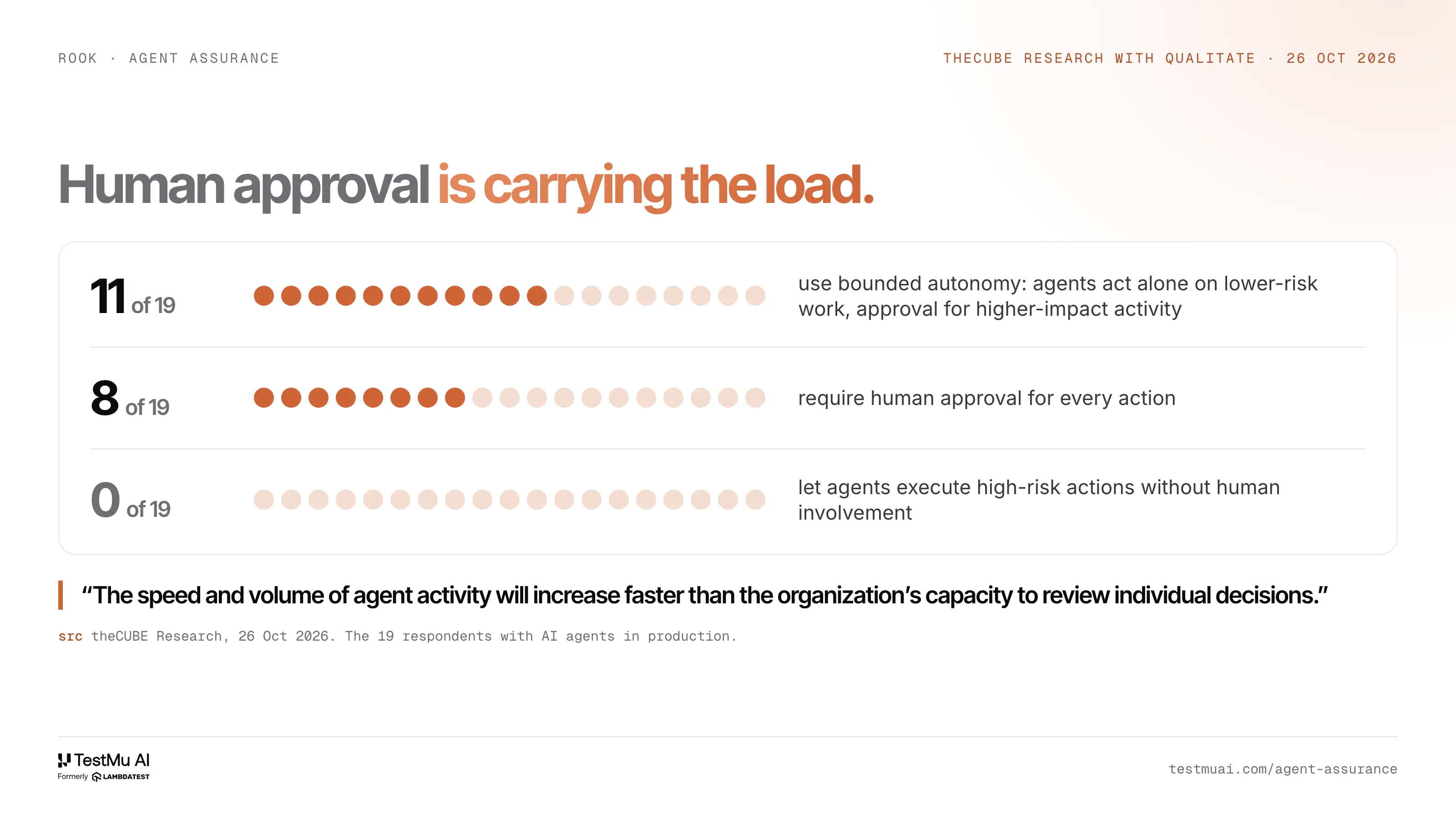
The study expects that to get harder to sustain, because "the speed and volume of agent activity will increase faster than the organization's capacity to review individual decisions." It also found some optimism: the bounded-autonomy organisations were more likely to report investment in logging, monitoring and recovery infrastructure, and more likely to have exercised agent incident scenarios.[1]
Stopping an Agent Isn't Recovering From It
Circuit breakers and automated shutdown were among respondents' priorities for the next 12 to 24 months. The report is clear about their limit: they "can limit further activity, but they cannot undo actions an agent has already taken."[1]
One respondent questioned whether hitting a kill switch could cost more in recovery effort and broken processes than it saves. Model fallback keeps users working when a model is unavailable, but "continuity does not resolve the effects of an agent's prior actions."[1]
The Evidence Problem
Recovery starts with knowing who, or what, took an action, and that is where the study found some of its weakest results.
Agent identity is still immature. Several respondents said agents should run under separate service accounts, and one described what happens when an agent inherits a user's permissions: logs may show that an account made a change without making clear whether the user or the agent did it.[1]
Reconstruction is harder still. Nine of 25 respondents were confident or partially confident they could reconstruct agent actions across systems; 11 lacked confidence or acknowledged a gap.[1]
One described "so many disparate logs and audit trails" that getting to the core of what happened becomes difficult. Another, who was confident, qualified it: their logging was sufficient largely because their current agents could do very little damage.[1]
The Largest Gap: Can the Business State Be Trusted?
Only six of 25 were confident or partially confident they could establish a last known trusted state at the business-process level; 16 acknowledged a gap or uncertainty. On remediation, 11 reported some capability to remediate agent-driven changes across multiple systems, and 10 acknowledged gaps or significant difficulty.[1]
Some effects can be rolled back. Others can't: "A customer communication that has been read cannot be unsent. Information disclosed externally cannot be undisclosed."[1]
So the report argues that the reversibility of an action should factor into how much authority an agent receives.
What the Study Recommends
Most organisations still have time. AI is not yet a critical operational dependency for most of them, and manual fallback is still available. That, the report says, is a window "to test agent failures while established processes and human expertise can still provide fallback."[1]
Its suggested exercise: give an agent legitimate credentials and authorised access, have it make a bad decision across several functioning systems, and make the teams identify it, contain it, reconstruct what it did, trace downstream effects, reverse or compensate, and establish a trusted state. And test the recovery infrastructure itself: logs that stay available and trustworthy, identity records that preserve attribution, visibility across every system the agent can touch.[1]
It's a careful report, and the exercise is a good one. Run it.
Where a Test Before Release Fits
Every step in that recovery chain starts from the same question: what did the agent actually do?
Without good reconstruction, the answer comes from whatever the agent left behind: its summary, its "done", its explanation of each step. That's the point we keep coming back to at TestMu AI: an agent's account of what it did is the weakest evidence available about what it did. It's written by the one party in the incident whose judgement is in question.
The recovery exercise tests what happens after the bad decision. There is an earlier test: does this agent make the bad change at all, under conditions you control? For the actions the report says can't be undone, like a sent message or an external disclosure, the only safe place to find that out is before release, in staging.
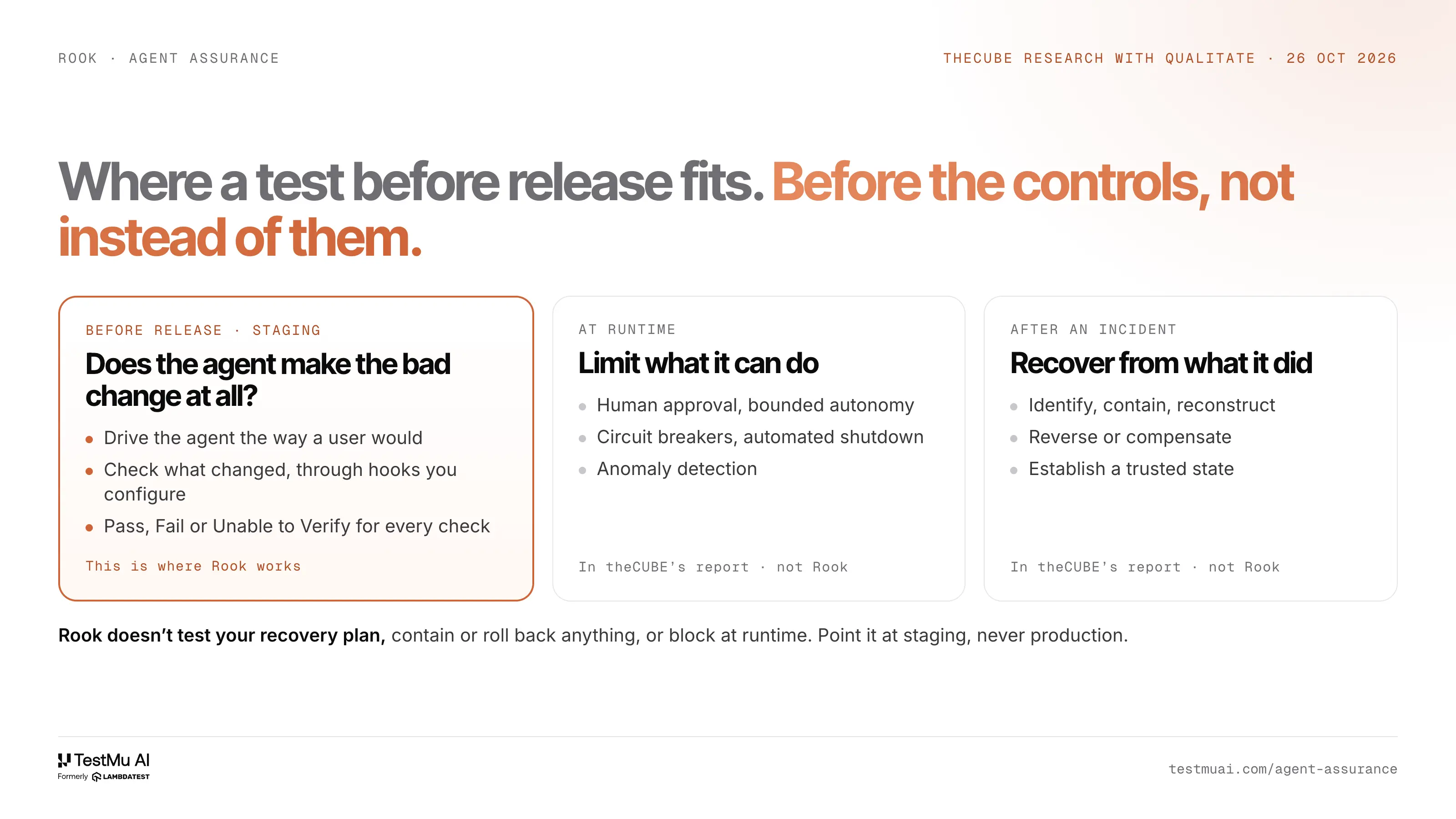
That's the step Rook, our agent testing tool, covers:
- You point it at staging, never production. Its tests make real changes, and it can't roll them back.
- It drives the agent the way a user would, then checks what actually changed, through hooks you configure.
- It checks the tools the agent called against what each scenario says it should and shouldn't call, and what the agent told the user against what it did.
- Every check comes back Pass, Fail or Unable to Verify. Unable to Verify never counts as a pass.
That last verdict matters for the reconstruction gap too. Writing a test forces the question an incident team will face later: where would we see what this agent changed?
If nothing can show it, the test says Unable to Verify. Better to learn that in staging than in the middle of an incident.
And to be plain about the limits: Rook doesn't test your recovery plan, it doesn't contain or roll back anything, and it doesn't block anything at runtime. It sits before the controls in theCUBE's report, not in place of them. It finds the bad change while the agent can still only make it in staging.

Sources
- [1] theCUBE Research, Krista Case, "AI Resilience: Organizations Are Underprepared and Largely Untested", 26 Oct 2026 (study with Qualitate of 25 enterprise technology and security leaders, for theCUBE's AI Cybersecurity and Resilience Summit, 27-28 Oct)
Author

Vipul Verma
Blogs: 14

Vipul Verma is Group Senior Vice President of Engineering at TestMu AI, where he heads the entire engineering organization that builds KaneAI, HyperExecute, and the broader testing cloud. He brings 15+ years architecting, securing, and scaling large enterprise applications across multiple sites. Before TestMu AI he was India Head at LogicHub, where he built the India R&D site from the first employee to a 30-plus engineering team, and Principal Software Engineer at Sumo Logic, where he was the first engineer in the India office and shipped search-performance and pricing-model initiatives. Earlier he worked on trading platforms at Portware and D. E. Shaw. Vipul holds a B.Tech in Computer Science from IIT Kharagpur.
Reviewer

Mayank Bhola
Reviewer
Mayank Bhola is Co-Founder and Head of Products at TestMu AI, where he leads the entire product portfolio across KaneAI, Kane CLI, HyperExecute, SmartUI, the Real Device Cloud, Accessibility, and other software testing product lines. As an early Lead Architect he designed and built the company's flagship Tunnel technology from scratch, created the React-based automation platform, and architected the data-intensive pipelines and FAAS services that scale it. He brings more than 10 years of experience in software development and product engineering, with earlier roles as Head of Technology at Juggernaut Books and Senior Software Engineer at PressPlay TV and Zomato. Mayank holds a B.Tech in Computer Engineering from JIIT Noida.


AI Incident Response FAQs
Did you find this page helpful?
More Related Blogs

TestMu AI forEnterprise
Get access to solutions built on Enterprise
grade security, privacy, & compliance
- Advanced access controls
- Advanced data retention rules
- Advanced Local Testing
- Premium Support options
- Early access to beta features
- Private Slack Channel
- Unlimited Manual Accessibility DevTools Tests