

Next-Gen App & Browser Testing Cloud
Trusted by 2 Mn+ QAs & Devs to accelerate their release cycles


Key Elements of an Effective Test Automation Strategy
This test automation strategy explains what is automation test strategy & how to build a successful test automation plan by focusing on key elements of test automation strategy.

Swastika Yadav
December 28, 2025
Software Testing has become a non-negotiable, if not the most crucial, aspect in software success as the world seeks software/applications for everything. Over the past years, Test Automation has proved to fasten the software development life-cycle. An effective test automation strategy establishes the foundation of success for a software.
A user has a lot of expectations from any software application. Creating an application or software and then releasing it to the public is not a piece of cake. What if it has bugs, fails, does not work as expected? To make things worse, it can face security breaches. To ensure flawless working and security of the software application, automation testing is required.
By incorporating an effective test automation strategy, you can ensure a bug-free application. But, how to implement that? One may think of hiring more testers and moving forward with manual testing instead. But, hiring more testers isn’t cost-effective. Second, manual testing alone can’t possibly figure out all the scenarios or test functionality as deep as automation testing.

According to the statistics above, 42.5 percent of firms consider automation testing to be an important part of their quality assurance process. So, if you are testing applications manually, you can consider switching from manual testing to automation testing.
Hence, automation testing emerges as a definite inclusion in a software development life cycle. As the software and the team level up, an unchallengeable need for the right automation testing tool and test automation strategy arises. This article will demonstrate some of the key elements of an effective test automation strategy.
What is Test Automation Strategy?
A test automation strategy is a roadmap for how automated testing will be implemented in a software development process. It outlines the approach, tools, and practices that will be used to automate tests, with the goal of making the testing process more efficient, reliable, and effective.
Test automation enhances your processes, saves you time and money, and leads to higher-quality software. However, you can’t just dive in and expect the automation to deliver the results you desire. If you want your releases to run successfully, you’ll need a clear strategy in place. All the benefits of automation testing may backfire without a test automation strategy. Hence, in order to inculcate automation testing and get a robust, better-planned development life cycle, one needs an effective test automation strategy. Let’s discuss the key elements of an effective test automation strategy in detail.
Strategy for a successful test automation
In automation testing, a cost-effective test automation strategy with a results-oriented approach is always the key to success. An effective test automation strategy will assist businesses in keeping up with the market and avoiding major technological failures. Automation testing strategy also incorporates the use of tools and pre-written scripts to perform tests at various levels.
Check out this video for an in-depth exploration of Test Automation Strategy building.
Planning the development life cycle with a strategic test automation can boost the success rate of software. The strategy towards test automation should be result-oriented, defining all the key metrics of the software.
The purpose of a test automation strategy is to find, communicate, and audit the risks, defects, and even the capabilities of the software being tested. For an effective test automation strategy, one must understand its life cycle. Let’s explore more!
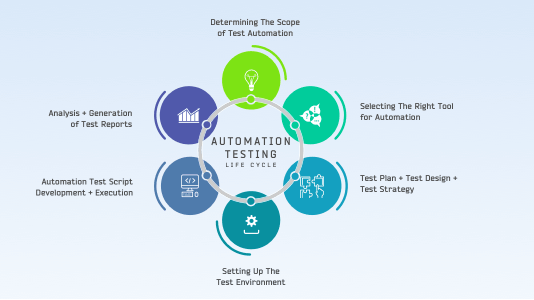
The automation testing life cycle mentioned above is nothing but a list of key elements to an effective test automation strategy. So let’s have a clear view.
Also Read – Top 9 Challenges In Automation Testing [2022]
Run Selenium, Cypress, and Appium tests on TestMu AI to scale with the demand of your website and web apps.
Key elements of an effective test automation strategy
An effective test automation strategy provides a comprehensive, reusable, and sustainable framework for the entire software development cycle. In this section, I will focus on some key elements of an effective test automation strategy.
A goal-oriented strategy
We all plan and strategize when we have a goal to achieve. Without a goal or an endpoint, one cannot prepare a strategy. Similarly, an organization or a team works on a software with a goal to achieve. Strategies are developed in order to reach the goal.
The test automation strategy must result in the desired endpoint. Decide on objectives that are achievable. With that in mind, building the testing strategy to achieve the objectives becomes easier. As they say, Destination then Route!
Automation Feasibility Analysis is the first step of the test automation life cycle. It is not possible to automate every software test. As a result, do an automation feasibility analysis to determine which tasks can be automated and which testing scenario you should not automate. For example, you can consider the following aspects to automate –
- Testing across multiple interfaces and devices.
- Repetitive test cases such as login and entering OTPs, captcha.
- Processes working on multiple inputs, such as filling forms to test validations.
- Tasks that are time-consuming and difficult to test manually.
- Asynchronous or Batch processes that are time-bound.
Automation feasibility analysis analyzes all such scenarios. Basically, it is about figuring out – What tests can be automated?
When the functionalities to be tested by automation are defined, one can decide the right tools and strategy to inculcate. This brings us to land with an effective test automation strategy.
Defining the test approach
After analyzing the result, when a user wants to achieve and know the possible test cases to automate, the next step is to plan the approach. Let’s say you have an idea of what must be done, and all you have to do now is figure out how to get there. In this case, the first step is to figure out:
- What needs to be included in the automation test?
- How is the team planning to execute the automated tests?
Defining the test approach includes allocating the right framework and deciding on proceeding with various testing types. It also includes deciding on the execution order of multiple testing types, such as integration testing, unit testing, etc. This is where the Automation Testing Pyramid comes into the picture. The testing pyramid guides to choose all possible tests to include in the test automation strategy and the order of execution.
Strategizing the execution of different tests, their frequency, role, and time results in better and more accurate outcomes. For example, assume you have developed software that includes a login page. You have used form validations to receive standard inputs from the user. Now, at the time of testing, how will you proceed? What tests will you include?
This shows the importance of automation testing and the correct test approach. It also covers various test case design elements. But before that, setting up a test environment takes higher priority. However, one must know what to test and the respective test plan.
Setting up tools and test environment
Not having the right set of tools/frameworks and moving forward without a test automation strategy takes a toll on them. Although automation testing highly benefits a software development life cycle, sometimes it becomes tedious to choose the right set of tools.
But, how to choose the right set of tools?. With some considerations, one can easily choose the right automation tool for themselves. However, choosing a test automation tool involves the analysis of budget, requirements, team experience, etc. Below are the points one should keep in mind while choosing the tool for test automation strategy.
- Decide the type of framework and toolThe market is full of test automation frameworks varying in the form of commercial, license, and open source. You can decide on the best test automation frameworks based on your preference and budget and classify them based on applications you are willing to test, e.g., web testing or mobile app testing.
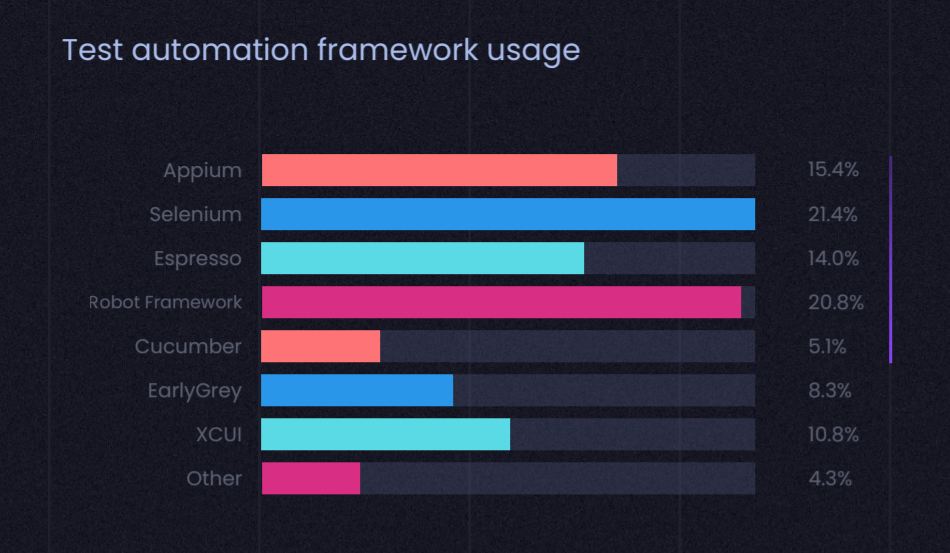
For example, Selenium is the most preferred test automation framework when it comes to web automation, with 21.4% of the organizations preferring it over other frameworks under the same category. For mobile app testing, Appium leads the table, with 15.4% of organizations preferring it.
Looking to automate mobile apps on real devices, check out our video below –
- Consider the testing team
The project team also consists of testers, the people who are eventually going to use the test automation tool. It is important to consider the experience and size of the testing team. It is crucial to choose an easy tool for the testing team to use and handle.
It is highly important to choose a tool with which the testers feel compatible. Different testers have different experiences and tech stack choices. Considering the diversity in the team, it is important to choose a way that benefits all. Also, the testing team must sync with the chosen test automation tool.
- Budget
What’s the budget? How much can you spend on automation testing? To be honest, financial restrictions are the most influential factor in such selections. However, because there are both free and paid tools, you can choose the one that best fits your needs and budget.
According to industry trends, the market size of Automation Testing crossed the $15 Billion mark in 2020. A few years back, organizations and teams spent not more than 15-20% of their budget on testing. But today, the numbers have risen to 30-45%. Most of the teams focus on automation testing; hence the investment keeps increasing. However, it is not mandatory to spend half of your budget on testing only!
If planned well, the average cost of automation testing falls lesser than manual testing at an organizational level. Maintenance cost, renewal/buying cost, training cost of the testers, etc., are the costs to be considered. Hence, it is better to calculate the ROI of automation testing besides deciding on the budget.
There may be a few more points to consider, at a personal or organizational level, while choosing a test automation tool. However, as discussed in the previous section, picking the correct set of tools is the third phase in the automation testing life cycle.
If you’re concerned about the financial impact of toll testing, don’t be. TestMu AI can cut this ratio down by a great margin. TestMu AI has a bunch of plans that cover various testing requirements. Pick a plan that matches your needs, get the best automated browser testing environment, and save your pocket! You pay only for what you use.
Since a software is to be used on various platforms, it’s always better to choose the tool type that supports testing on most of the platforms and environments.
Choosing a cloud-based infrastructure platform like TestMu AI gives you access to more than 3000 real devices running on real operating systems to perform automation testing. In addition, this platform allows users to test public or locally hosted web apps on various browsers, operating systems, and devices.

Plan and research as to which tool can help you achieve better results, code and test coverage, prove to be the most cost-effective. Considering all the points, choose the one as per the requirement.
Designing test scripts and writing test cases
From the first three points, you can decide on the right set of automation tools based on your team’s compatibility, budget, software requirements, and test approach. The fourth key element of an effective test automation strategy is to design the test cases and test scripts.
People often confuse test cases with test scripts. Let us first establish the clear difference between both. What is a test script? Test Script is a program that tests a certain functionality automatically. Test scripts are generally written using a set of commands and some programming. If you are new to automation and wondering how to write your first test script, you can refer to the article on how to write test scripts in Selenium to know more.
What are test cases? Test Cases can be defined as a set of documents that consist of prerequisite conditions, test data values, expected set of results, etc., to carry out automation tests. For each functionality, a separate test case or a set of test cases is required. Each test case is designed to thoroughly test the functionality and pinpoint a bug or defect, if there is any.
A test case consists of several parameters, such as test case ID, description, steps, test data, expected result, test scenario, etc. The clearer and crisp the test cases, the easier it is to test and produce the desired outcome. There are some guidelines to design and write effective test cases; a few of them are listed below:
- As every test case is designed based on a template, it is always the best practice to produce a template that can be used in multiple projects and scenarios. Furthermore, it cuts down a considerable amount of time and effort in the future.
- As the team consists of many people, it is better if the test cases designed are easily understandable and to the point, as none wants to read heavy and baggy documents.
- Write test cases using the flow of software and end-user in mind.
In case you have zero experience in writing test cases or test scripts, you can always refer to the test cases from other past or ongoing projects.
Also read: Best Practices to Follow in Test Automation – TestMu AI
Test execution plan
After writing the cases, it is very important to plan the executions. Knowing when and how to perform automation tests is as important as writing the test cases. Devising a test execution plan includes inculcating top CI/CD tools like Jenkins, defining the steps in which test executions are to take place, and setting up version control.
TestMu AI, as a testing platform, has the feature to integrate various version-control systems along with your CI/CD pipeline. You can set up any of your favorite version control systems with TestMu AI and perform live testing.
It is very important to know the execution priority, as in, execution of individual test cases must take place first, then integration and regression testing should take place. Finally, every change and deployment must be followed by regression testing to confirm the changes are valid and working as expected.
Moreover, a few steps may be taken in or out depending upon the project requirements. Hence, after setting up the test automation tools and writing the test cases, a test execution plan must be devised to achieve the desired testing process and result.
It is better to plan the text execution in alignment with the software development life cycle.
Result and documentation
An effective test automation strategy is incomplete without a final touch. As a result, the findings of an automation test determine if functionality or software is working as expected. If it is, voila! Move it to the next step. What if tests fail or catch a bug?
In case the test produces a bug or a defect, there needs to be a proper flow of how it is to be solved or to whom it is to be assigned for further steps. It becomes much easier to handle when proper documentation is done.
A complete end-end documentation includes the test cases, list of tests to be done for functionality, results, result-analysis, assigner, assignee, workflow, etc., in the documentation. The process of including automation testing in a project may seem a bit tedious, but it is proper documentation and decision-making that get the job done better.
Also read – Top reasons for test automation failure
Conclusion
The first-time setup and planning of test automation may have loopholes and may also feel like a hectic task, but as time passes and things are learned, pieces fall into place! Once the initial steps are taken, automation testing can generate massive returns for you.
TestMu AI is the tool that gets your job done faster and easier. Along with supporting 35+ automation frameworks and all Selenium versions, it gives you the ability to conduct automation tests on an online device farm of 3000+ browsers and various operating systems.
Moreover, you also get to perform test automation on your real devices. Be it desktop or mobile, Windows, iOS, or Android. With the cross-browser testing feature of LamdaTest, you can perform tests on a wide range of browsers, browser versions, devices, and operating systems.
Do these terminologies, or the test automation process in general, overwhelm you? No worries, TestMu AI also provides 24×7 support. Try TestMu AI with a free testing session now!



Frequently asked questions
Did you find this page helpful?
More Related Hubs
TestMu AI forEnterprise
Get access to solutions built on Enterprise
grade security, privacy, & compliance
- Advanced access controls
- Advanced data retention rules
- Advanced Local Testing
- Premium Support options
- Early access to beta features
- Private Slack Channel
- Unlimited Manual Accessibility DevTools Tests