

Next-Gen App & Browser Testing Cloud
Trusted by 2 Mn+ QAs & Devs to accelerate their release cycles


Simplifying Testing with Predictive QA and Test Intelligence
How AI-led software testing intelligence will further streamline the SDLC saving organizations millions, and other key benefits of test intelligence.

Nishant Choudhary
December 24, 2025
Test automation is a value goldmine for software engineering teams. Of course, you need to know how to squeeze value out of it. A recent Forrester study concluded that with test automation enterprises saw an ROI of 162%, and unlocked an NPV of $4.69Mn. It was also observed that embracing test automation resulted in an 80% reduction in bugs shipped to the production environment. Wait, wouldn’t your eyes brighten up and sparkle if I told you that software testing automation is getting new superpowers? Yeah, that’s true. Soon, we shall enter an era of Test Intelligence, aka AI-native end-to-end intelligent software testing.
I’m not sure whether your eyes glitter or not, but if you care about the impact of software testing on the business bottom line, you will glee knowing the value AI software testing tools will unlock for your engineering team(s).
Read this blog post to understand-
- What’s Test Intelligence?
- How will Test Intelligence influence software testing and software development?
- How can you prepare yourself to leverage Test Intelligence to gain a substantial competitive edge in the market over competitors?
Are Engineers Using AI for Software Testing?
According to Stack Overflow Development Survey 23.87% of development teams are using AI for software testing.
That does not sound like an exciting number. But numbers don’t often paint the complete picture. Do they? They don’t. Especially, when they are looked at in isolation.
AI developer tools are embraced with open arms by developers across the software development lifecycle (SDLC). From code generation to debugging, documentation, reviews, software testing, deployment, and infrastructure monitoring, AI is ubiquitous across SDLC.
- 82.55% of developers already use them to generate code.
- 48.89% of software engineers use AI tools to debug their code
- 34.37% use them to document the code and whatnot.
Why is there a lower adoption for AI software testing tools?
Well, it’s not “lower adoption”, instead you can call it an imbalance between demand and supply. The stats for AI software testing tools adoption are low because not many mature and effective products have yet made it to the market. The AI software testing stack is still in its early stages. They are continuously evolving. LamdaTest’s Test Analytics & Test Intelligence are one of the first few to the market, leading from the front. Hence, the number of dev teams using AI software testing tools is fewer.
However, there is a huge desirability and demand for AI tools in software testing. A whopping 55.17% of software engineers expressed interest in using AI tools for software testing. The most desirability among all other use cases of AI in software development.
Now, that paints a clear picture. AI presents a huge opportunity for all software testers, aka quality assurance (QA) engineers.
From increasing the productivity of software testers to improving the accuracy of the test cases these professionals write, the overall test coverage, and the reliability of tests (bye-bye flaky tests), the use cases of AI in software testing are ample.
However, the demand-supply gap needs to be bridged. And that’s exactly what TestMu AI’s Test Intelligence tool is for. Test Intelligence will equip all the QA & software testing engineers across the world with the most intelligent testing software powered by advanced AI algorithms. Continue reading to understand what Test Intelligence is, what to expect from it, and how to lead with automated software testing.
Why Test Intelligence?
Testing is integral to SDLC. Traditionally, software testing was done manually, where QA professionals would test software hands-on to identify issues and loopholes. It was an excruciatingly slow process. Hence, manual testing was a big bottleneck crippling the pace of software development. The software engineering needed a way where QA can be done at the pace of development. Maybe, faster.
That led the way to automation testing frameworks like Selenium, Appium, Cypress, etc. To a large extent, these software testing frameworks did solve the pain points of manual testing. But with the increasing complexity of software projects in terms of ever-increasing features and ever-evolving design, the complexity of writing test cases using these frameworks increases too. Especially for projects that are fluid and dynamic i.e., applications that change a lot over a short period, automation testing is not enough to ensure flawless functionality, usability, scalability, and security.
Of course, you can scale the QA team, but then it will be a cost center for you. So, the question is “What’s the solution?” Test Intelligence.
What’s Test Intelligence?
Software testing teams often fall short when it comes to matching the pace with software development, to tick what the current market demands. Though cloud testing overcomes the challenges of infrastructure limitations that slow down QA teams, it’s not a panacea to the other challenges. Flaky tests, time-taking RCA, insufficient test data, and continuous UI testing challenges slow down even the best of the QA teams.
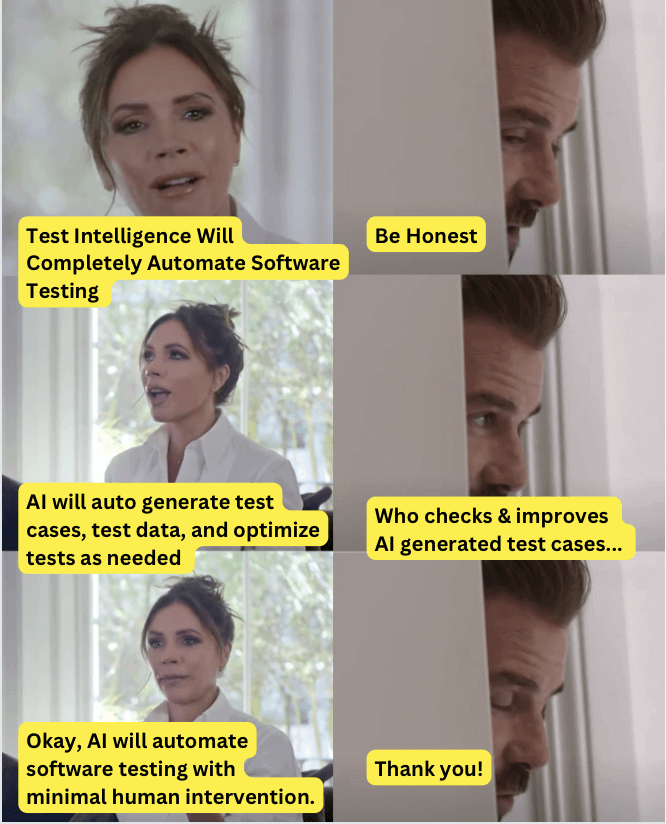
However, the good news is that all this is about to change with Test Intelligence. Soon, the ball will be back in the court of developers. It will be up to them to decide whether they want to go at a breakneck speed or release software slow to the market.
The AI promise for the software testing community (also for DevOps and SRE) is that AI will minimize application outages, cut costs, and decrease the load on support by intelligently testing software on its own, with minimal human intervention required.
That’s Test Intelligence. Much like the concept of driverless cars.
Test Intelligence won’t just make software testing operationally efficient & effective, but way faster than before. Hence, teams will be able to ship reliable software faster and scale with confidence.
Cool … but how does Test Intelligence deliver on its promises?
The Nuts & Bolts of Test Intelligence
This is how Test Intelligence speeds up the operational efficiency and efficacy of software testing teams. Test Intelligence goes beyond test case generation or test data generation.
- Intelligent code analyticsThe sophisticated ML algorithms will analyze application code changes as soon as a developer raises a merge request i.e., when the code is pushed to the CI/CD pipeline.
- Assess the Impact of the code changesAI-native Test Intelligence capabilities of the software testing tool will try to observe the changes in the codebase and determine its impact on the UI and the overall functionality of the application.
- Identify test case scenariosNext, Test Intelligence zeroes in on different scenarios that need to be tested to ensure that the new code works as expected without introducing any bugs or vulnerabilities. The algorithms are designed to carry this out comprehensively keeping in mind the application’s ‘historical data’ i.e., interdependencies between different application components, 3rd party APIs, integration with other applications, as well as adherence to compliance and regulations.
- Test case generationAccordingly, Test Intelligence automatically generates relevant test cases including positive and negative scenarios, boundary cases, and edge cases to validate the new code changes and functionality.
- Test data generationThereafter, AI also generates the dummy test data that are needed to execute the generated test cases.
- QA reviewLikely at this point, a human QA engineer will review the AI-generated test cases and test data to identify any anomalies. If changes are desired, they can be made either manually, or generative AI capabilities of Test Intelligence software can be harnessed to make the modifications in generated test cases & test data.
That’s not all. It’s just one part of how Test Intelligence will speed up the operational efficiency and efficacy of software testing teams. Test Intelligence goes beyond test case generation or test data generation.
- Test case risk profiling & prioritizationTest Intelligence is AI-native and is very effective at assessing the risks associated with specific changes in the code. When used in tandem with historical application data, user behavior data, and ticket data, Test Intelligence can also predict-
- How does a new feature influence user behavior? Which components may get used more over time? What load will be there on specific application components?
- What are the latest challenges that users are facing?
- What could be the impact of an issue or vulnerability on the bottom line?
- Flaky testsTest Intelligence can also address the challenges of flaky tests and slow error RCA. It analyzes the error logs on the go and identifies flaky tests with unparalleled efficiency.
- Self-healing testingTest Intelligence not only predicts or detects anomalies and inconsistencies, or classifies them, but also exhibits self-healing behavior. For example, if there is an instance of flaky tests, Test Intelligence can modify the script to fix it with zero to minimal human intervention. Thus, it exponentially reduces the efforts that go into software testing and streamlines the entire process.
- Cross-platform consistencyThe best part, AI unlike humans is not limited by their ability to consciously process the data. Humans may falter at predicting issues across application environments and ensuring consistency across environments. But AI excels at the very thing.
With the rise of AI in testing, its crucial to stay competitive by upskilling or polishing your skillsets. The KaneAI Certification proves your hands-on AI testing skills and positions you as a future-ready, high-value QA professional.

Benefits of AI-led Predictive Software Testing
Here are some of the potential benefits of AI based predictive testing:
- Security: Unearths bugs early in the software development lifecycle, before they become a headache.
- Testing Efficiency: Enables QA teams to walk shoulder-to-shoulder with the development team by unlocking an unprecedented pace of testing software applications on the go. Thanks to auto test case generation, comprehensive test coverage, and test data generation.
- Accelerate Product Delivery: Helps developers stick to the product backlog cadence, and deliver new features on time to the market with faster (real-time) feedback. Hence, enabling startups & enterprises to grab the market opportunity before competitors.
- Improved Product Quality: Quickly eliminates issues in applications that are spoiling the user experience for customers by auto-generating test cases and analyzing the tickets raised.
- Improved Consistency Across Environments: Connects the test reports from different application environments, and identifies any inconsistencies, to fix them before they trouble users.
- Improved Maintenance & Reliability: Reduces test flakiness, and automatically tests the applications for edge cases, boundary cases, and positive & negative scenarios.
- Self-healing Testing Infrastructure: Improves the accuracy of software testing with auto-detection of flaky tests, and accordingly sanitizes the script to overcome the issue.
- Developer Productivity, Resource Utilization, and Costs: Minimizes test case duplication and unnecessary runs, thus saving a lot of time for development teams, and minimizing costs that would have been otherwise wasted on deploying resources for those unnecessary test runs.
Summing it up!
Going forward, to keep innovating at a good pace in the AI age, Test intelligence-powered cloud software testing platforms will help software teams test software applications at lightning speed with auto test cases & test data generation, test execution, test analysis, test case maintenance, and self-healing capabilities. In fact, software testing platforms will need to evolve to automate not just the testing scripts generation & execution, but also automate testing infrastructure provisioning, orchestration, and infrastructure management with zero to minimal human intervention, while optimizing for low cost & high performance. Explore more about TestMu AI’s Test Intelligence.



Did you find this page helpful?
More Related Hubs
TestMu AI forEnterprise
Get access to solutions built on Enterprise
grade security, privacy, & compliance
- Advanced access controls
- Advanced data retention rules
- Advanced Local Testing
- Premium Support options
- Early access to beta features
- Private Slack Channel
- Unlimited Manual Accessibility DevTools Tests