

Power Your Software Testing with AI Agents and Cloud
The Native AI-Agentic Cloud Platform to Supercharge Quality Engineering. Test Intelligently and Ship Faster.


- TestMu AI (Formerly LambdaTest)
- /
- Blog
- /
- 10 Key Strategies to Help Startups Manage a High Ratio of Developers to QA
10 Key Strategies to Effectively Manage Developer-QA Ratio Challenges in Startups
How many testers should a startup hire? In this article, we’ll discuss how startups recognize signs of strain & share 10 ways they can deal with high developer-to-QA ratios.
Last Updated on:
Startups operate in a high-stakes environment. Digital-native startups, in particular—innovate, go to market, and scale quickly with limited resources. They’ve compressed the duration required for product design and development, expediting its availability to customers.
Speed to market is top of mind for these startups who are driven by a sense of urgency, owing to the limited amount of capital that they operate with. Considering the speed at which startups bring new products to the market, testing is critically important to their success. Many startups also partner with experienced QA outsourcing companies to scale testing efficiently without rapidly expanding internal QA teams.
In today’s ‘release early, release often’, Quality Assurance (QA) is a vital function. The success of software development endeavors hinges on seamless collaboration between QA and development teams. Startups navigate a landscape marked by constant change, making it challenging to pinpoint the precise number of testers required within their teams.
According to our recent survey, medium and large organizations reportedly have 1 to 3 QA Engineers per 10 developers. Smaller organizations have a higher ratio of developers to QAs. Over 25% of startups have less than 1 QA per 10 developers.
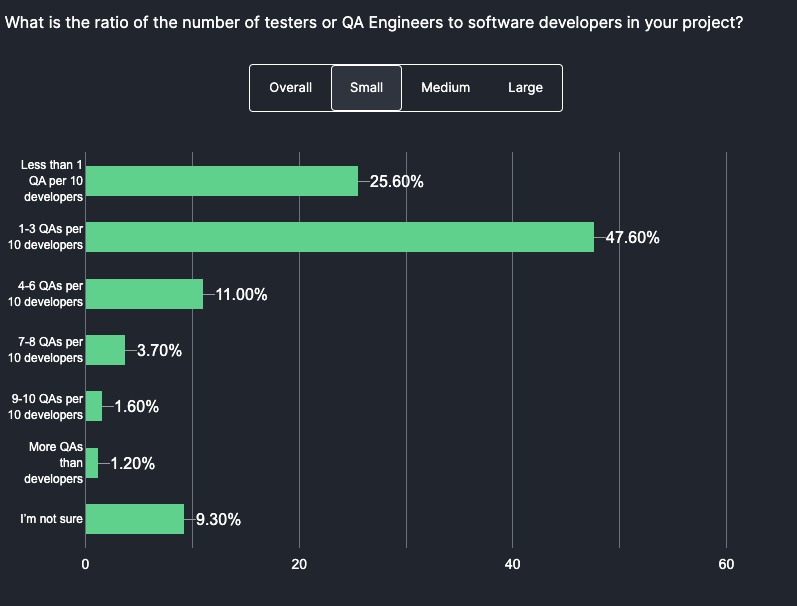
In this article, we give you a lowdown of 10 key strategies tailored for small teams in startups to help address higher developer-QA ratios effectively and increase output as well as QA team job satisfaction levels.
Importance of Developer-To-QA Ratio
Most smaller organizations deal with resource constraints with more generalist roles than specialist ones. According to PayU, 14% of startup failures can be attributed to team-related shortcomings. Despite the absence of a one-size-fits-all solution, understanding the developer-to-QA ratio is pivotal for startups aiming for efficient testing processes.
Even with a proficient and capable product team, the occurrence of software bugs is an unavoidable aspect of development. As such, the imperative of testing becomes paramount, offering a means for startups to ensure the delivery of high-caliber software and identify potential flaws before end-users encounter them.
Startups must base their testing team’s needs on factors like code production rates, release frequency, and testing requirements. The developer-QA ratio serves as a guideline but startups must consider the variability in developer and QA capabilities and the complexity of features being developed. The amount of code produced and the rate at which they released it is another important aspect to factor in.
Consider how often your developers release code. How long does it take them to test each unit? This will help you understand what your testing queue looks like. Our survey shows that smaller organizations with agile teams have a higher frequency of releasing features daily and weekly.
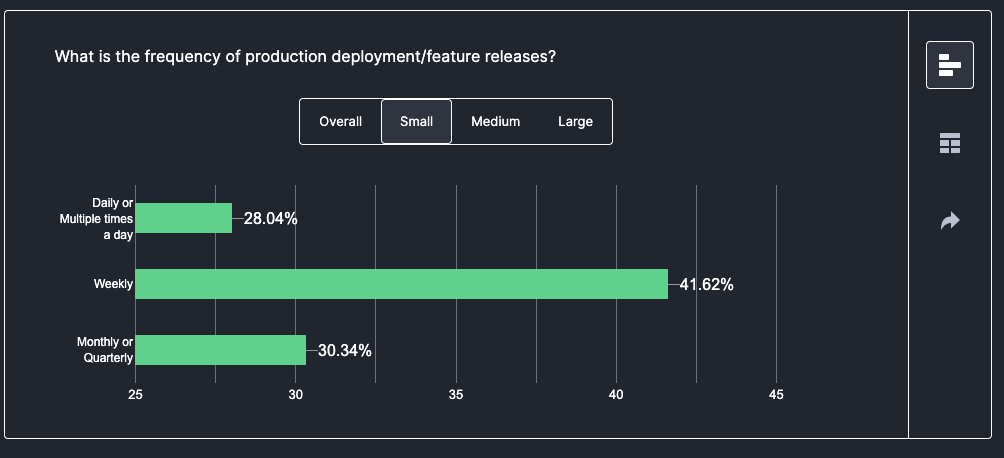
That said, not all developers and QAs are the same. Similarly, not every feature or bug is created equal. This is why you can test some releases in just a few hours, while others may take as long as a few weeks. Balancing the ratio ensures adequate testing coverage while maintaining agility in development cycles.
Signs of Strain on Startup Teams
A significant number of QA teams in startup companies have a high developer-to-QA ratio. Although the ratios may vary from one organization to another, 10 developers for every 1 tester creates a gap that is far from optimal for most teams.
We’re listing some of the primary signs that indicate inefficiencies and strain within the QA team, affecting product quality and team morale.
- Delayed deployments: With release timelines only getting shorter, smaller teams struggle to keep up. Many teams face delays in releasing products due to testing constraints, especially when developers make last-minute changes. This results in sacrificing time-to-market.
- Un-tested software is shipped: A clear indicator of strain for small startup QA teams is the shipping of untested software. This shows that these teams are overburdened and are facing challenges in adequately testing the software before the release. This could be due to various constraints such as limited resources, time pressure, and possibly, an overwhelming workload.
When QA teams are under strain, they may struggle to execute comprehensive testing protocols, leading to the inadvertent release of untested software. This reflects the urgent need for additional support, resources, and streamlined processes within the QA department to ensure thorough testing.
- High turnover: Is another tester leaving your QA team? High turnover often happens when testers feel they’re just firefighting without meaning. Testers feeling overwhelmed and undervalued may lead to high turnover rates within the QA team, impacting team stability and morale.
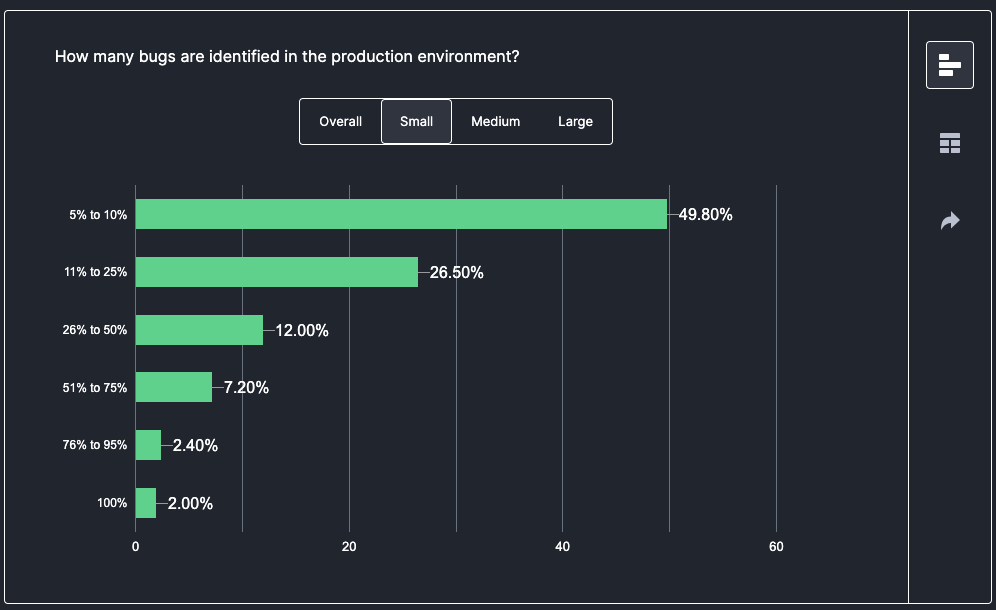
- Declining product quality: When startup teams have low bandwidth or limited resources to perform their role well, bugs start to leak into production resulting in frequent hotfixes and an unhappy user base.
- Incomplete test automation: Insufficient resources and time constraints prevent QA teams from completing test automation during development cycles, resulting in manual testing overload and compromised testing coverage.
- Long working hours: Short-staffed QA teams often work long hours or weekends to meet testing deadlines, risking burnout and compromising work-life balance.
10 Key Strategies for Small Teams in Startups to Increase Efficiency and Output
Before we dive into the strategies, it is important to understand the quality goals and risk tolerance of your project. Given how most projects today demand a high level of quality with minimal risk, a higher QA-to-Dev ratio is needed to ensure thorough testing and validation.
Here are 10 key strategies to help smaller teams in startups deal with high developer-QA ratios:
- Encourage a culture of feedback: Foster a workplace culture where constructive feedback flows freely between QA and development teams regularly. Along with daily stand-up meetings, encourage retrospective meetings with the whole group or 1-to-1 meetings. Creating channels and practices for open communication will ensure that developers can offer QA teams valuable insights about the code’s complexities, and potential challenges. Together they can find ways to enhance efficiency.
- Promote continuous learning and improvement: Along with team-building activities, a continuous improvement approach should also be a priority for startups. From encouraging a culture of learning to taking a data-driven approach to improvement and setting realistic goals, there are several steps that startups can take to implement a continuous improvement and learning culture.
- Optimize QA efforts with risk-based testing: Implementing risk-based testing strategies is vital for startups managing high developer-QA ratios. By automating area-specific testing after each developer commits, unnecessary testing is minimized—enabling faster feedback loops and earlier deadline attainment. This approach optimizes QA efficiency, streamlines release schedules, and eases the workload on QA teams, ultimately enhancing product delivery speed and quality.
- Ensure tasks are handled on time: While multi-tasking seems like a time-saving route, context-switching can actually lower productivity and adversely impact the quality of the product. Reduce CI pipeline build times to prevent task switching and improve developer productivity, ensuring timely completion of tasks.
- Set clear procedures and workflows: Establishing clear processes and workflows ensures everyone understands their role and responsibilities, reducing confusion and fostering smoother collaboration. From initial development to QA testing, outline steps and expectations to avoid frustration, rework, and wasted time. This approach improves relationships between developers and testers, enhancing overall efficiency and productivity.
- Leverage test automation tools: Leveraging tools like TestMu AI become crucial to automate repetitive testing tasks, reduce workload, and enhance efficiency. All of which leads to faster releases. Automation tools also help with regression testing, allowing for faster detection and resolution of issues.
- Focus on high-impact areas: Bugs can easily slip into production when QA Teams are understaffed. By streamlining testing processes, eliminating time-consuming tasks, and focusing on high-impact areas, you can improve the overall product quality. This will also enable testers to focus on improvement areas and provide relevant as well as timely feedback to developers.
- Adapt QA-Dev ratio: Tailor the QA-Dev ratio to different project phases and quality objectives. During initial development, prioritize higher ratios for early bug detection and resolution. As the project progresses and matures, adjust the ratio to match evolving testing needs and risk tolerance levels. This dynamic approach ensures improved testing while optimizing resource allocation throughout the project lifecycle.
- Eliminate overtime: Avoid regular instances of overtime for both development and QA teams to prevent potential issues. Implement a process where test results are delivered to developers on a per-commit basis, enabling them to identify and address defects promptly. This collaborative approach ensures that testing is conducted alongside development, facilitating timely and confident deployments without the need for extended work hours.
- Collaborate as one team: Encourage mutual respect and understanding between QA and development teams through active engagement in each other’s processes. By involving developers in testing procedures, they gain insight into the testing process’s significance, fostering mutual appreciation. Promote knowledge sharing and expertise exchange to enhance communication and respect. Additionally, recognize and celebrate the achievements and contributions of both teams to nurture mutual respect and foster a shared sense of accomplishment
How Many Testers Does a Startup Need?
Consider testing scenarios, product variety, development methodology, and budget constraints to determine the appropriate number of testers.
Agile projects may require more frequent testing, while the complexity of the product and its deployment environments also influence testing needs.
Summing it up
Determining the optimal developer-to-QA ratio for startups is a nuanced endeavor, requiring a combination of factors like testing scenarios, product variety, and development methodology.
By adopting streamlined workflows, leveraging automation tools like TestMu AI, and fostering a culture of collaboration and continuous improvement—startups can effectively manage higher developer-QA ratios while delivering better-quality software products.

Author

Smeetha Thomas
Blogs: 10


Smeetha Thomas is a community contributor with 10+ years of experience in technical and product-focused content creation for FinTech and B2B SaaS platforms. She has authored product documentation, whitepapers, case studies, e-books, and long-form technical articles, and has written on technologies including APIs, cloud platforms, AI, and embedded finance. Smeetha works as a freelance writer and content consultant and holds a Bachelor of Commerce degree.


Did you find this page helpful?
More Related Blogs
TestMu AI forEnterprise
Get access to solutions built on Enterprise
grade security, privacy, & compliance
- Advanced access controls
- Advanced data retention rules
- Advanced Local Testing
- Premium Support options
- Early access to beta features
- Private Slack Channel
- Unlimited Manual Accessibility DevTools Tests