

Next-Gen App & Browser Testing Cloud
Trusted by 2 Mn+ QAs & Devs to accelerate their release cycles


Differences Between Functional and Non-Functional Testing
Learn the key differences between functional and non-functional testing, ensuring your software meets both functional requirements and performance standards.

Veethee Dixit
December 19, 2025
Functional and non-functional testing plays a critical role in ensuring the quality of software applications. Functional testing ensures that the features of software work as per the specified requirements, whereas non-functional testing evaluates aspects like performance, scalability, reliability, and usability.
Together, function and non-functional testing approaches form the foundation needed for development and testing teams to deliver robust software applications. However, both differ from each other in various parameters.
In this blog, let’s look at the differences between functional and non-functional testing.
What Is Functional Testing?
Functional testing is a type of software testing that verifies whether the application behaves according to the defined specifications or requirements. It focuses on testing the features and functionality of the software by providing inputs and comparing the output to the expected results.
Key aspects of functional testing include:
- User interactions: Tests how users interact with the application (e.g., clicking buttons, entering data).
- Validation: Checks if the system performs tasks like calculations, database updates, or notifications correctly.
- Interaction: Ensures communication between different software components or systems functions properly.
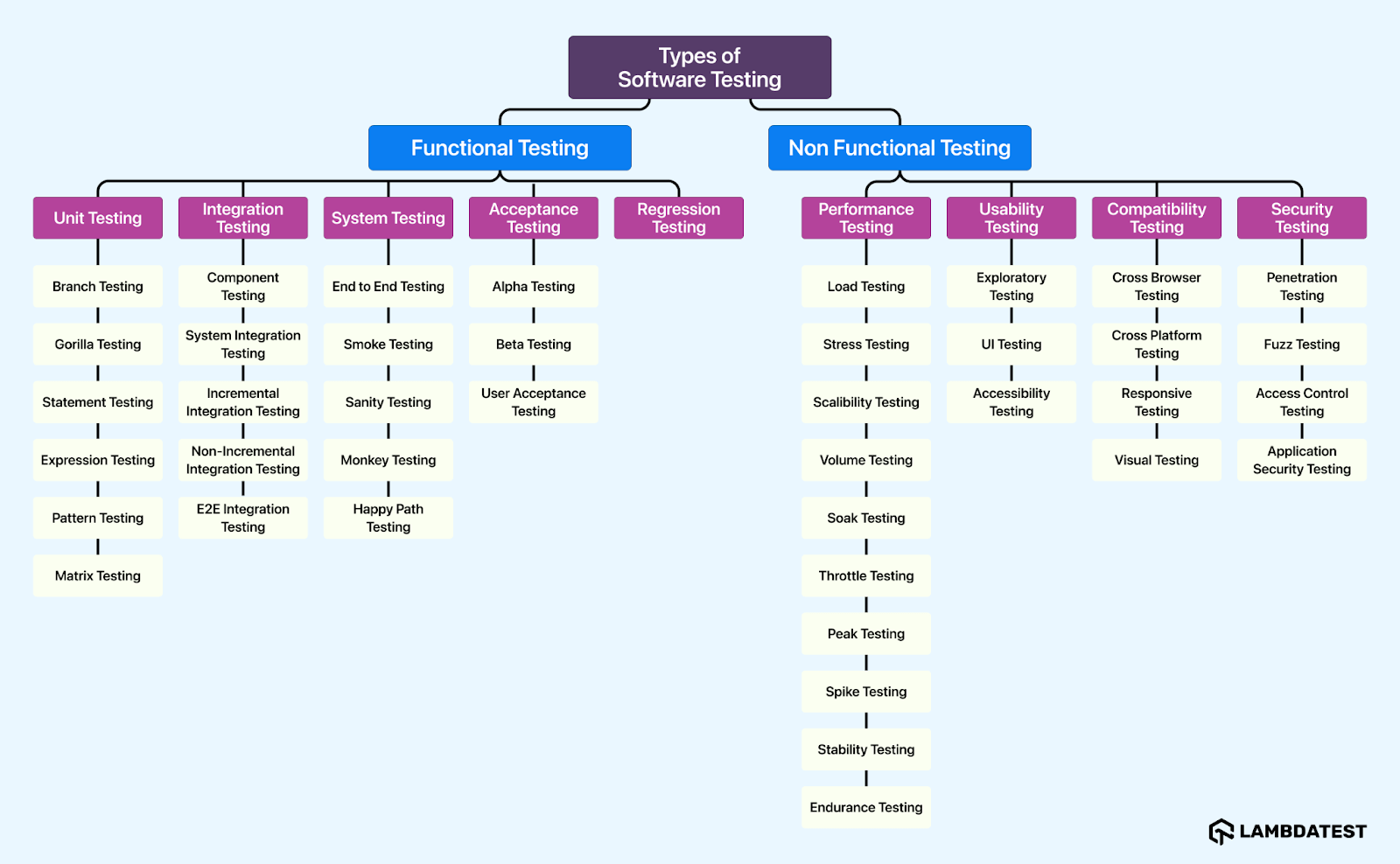
Types of Functional Testing
To simplify non-functional testing, it is divided into several types. Covering each can enhance the robustness of your application. Here are the most common types:
- Unit Testing: It involves testing the most minute units of the code to make sure each unit functions as expected.
- Integration Testing: It validates how two or more components of a system that have been unit-tested interact.
- System Testing: It validates an integrated system against different predefined requirements. Testers perform system testing in environments as close to real-life scenarios and in accordance with real-life usage as possible.
- Acceptance Testing: It focuses on verifying whether a system adheres to both user and business requirements before it’s released.
- Regression Testing: After developers are done fixing the code or making enhancements, running a regression test suite ensures that there hasn’t been an impact on existing functionalities due to changes. Testers also use regression testing to make sure that changes don’t introduce any new defects.

Note: Run automated functional tests across 3000+ real environments. Try TestMu AI Today!
What Is Non-Functional Testing?
Non-functional testing is a specific type of testing that evaluates the dependability, usability, performance, and some more non-functional characteristics of the software application. It intends to check how ready software is in accordance with a set of non-functional criteria.
Key aspects of non-functional testing include:
- Performance: Evaluates the speed, responsiveness, and stability of the system under different conditions.
- Load Handling: Assesses how well the system behaves under varying levels of workload (users, data processing).
- Scalability: Tests the system’s ability to scale up or down, depending on the growing demands.
- Usability: Focuses on how user-friendly the interface is, ensuring a smooth experience for end-users.
- Security: Ensures the system is secure from vulnerabilities like data breaches, unauthorized access, or other threats.
- Compatibility: Tests how the system interacts with different devices, browsers, and operating systems.
- Reliability: Verifies that the software performs consistently and stably over time.
Types of Non-Functional Testing
Non-functional testing involves attributes such as usability, scalability, reliability, and performance. Now, let’s move on to some common types of non-functional testing.
- Performance Testing: It evaluates how a web application behaves under various conditions, measuring its speed, responsiveness, and stability during normal and peak loads.
- Usability Testing: It assesses how user-friendly and intuitive a web application is by observing real users’ interactions to identify potential improvements in navigation and design.
- Compatibility Testing: It checks whether a web application functions correctly across different browsers, devices, operating systems, and network environments to ensure a seamless user experience.
- Security Testing: It uncovers a variety of vulnerabilities within the software application. Security testing identifies potential threats or risks that can ensure the robustness of a product against hacking vulnerabilities, breaches in data, or other similar security issues.
For more scalable functional and non-functional testing with real-time collaboration and broader device coverage, you can consider running both tests using cloud-based testing platforms.
AI-driven cloud testing platforms such as TestMu AI enable developers and testers to seamlessly perform both functional and non-functional testing on a remote test lab of 3000+ real browsers, devices, and operating systems. This ensures quality at every stage while reducing infrastructure costs and speeding up your release cycles.

Differences: Functional and Non-Functional Testing
Here are the core differences between functional and non-functional testing:
| Criteria | Functional Testing | Non-Functional Testing |
|---|---|---|
| Purpose | Tests software application functionality and makes sure that it adheres to specified requirements. | Checks non-functional software aspects like reliability, security, usability, and performance. |
| Testing Techniques | Includes black box testing, unit testing, white box testing, system testing, integration testing, and acceptance testing. | Includes load testing, usability testing, stress testing, and security testing. |
| Metrics | Covers metrics for the number of features tested and the rate for passed and failed. | Covers metrics for the success rate of a transaction, response time, and rate of resource utilization. |
| Execution | Occurs after software development when the software is completely ready to undergo testing. | Takes place throughout the entire SDLC, starting from as early as gathering requirements and spanning to the final deployment and testing stages. |
| Focus area | Focuses on the overall functionality of the software. In other words, emphasizes whether it meets set requirements. | Focuses on aspects that are strictly non-functional such as scalability, performance, security, usability, and reliability. |
| Requirement | Sets on the basis of what software should be doing, aka functional requirements. | Sets on the basis of non-functional requirements that cater to software performance. |
| Usage | Ensures that the software works as per expectation and adheres to functional requirements. | Ensures that the software works as expected in terms of non-functional requirements and meets scalability, performance, security, usability, and reliability standards. |
| Approach | Lets you execute functional tests manually. However, automation has become a lot more common as it saves time and resources. | Allows testers to use automation testing tools for certain types of testing, such as load and performance testing. |
| Example Test Case | Verifying that users can easily add new customers. | Verifying that the system won’t crash and will robustly handle hundreds of concurrent end users. |
Conclusion
When testing applications, there’s no one-size-fits-all approach. Prioritizing functional or non-functional testing exclusively isn’t ideal. Both functional and non-functional testing are equally important. However, many teams give non-functional testing less attention since its benefits seem less immediate. For example, users might tolerate slow performance but not broken functionality.
Because functional testing is faster and cheaper, it’s often the foundation of testing processes. Still, it’s unwise to downplay non-functional testing. Teams should include it, as it’s crucial for software’s overall quality—covering aspects like usability, performance, and more. A well-rounded test suite ensures both are validated effectively.


Frequently asked questions
Did you find this page helpful?
More Related Hubs
TestMu AI forEnterprise
Get access to solutions built on Enterprise
grade security, privacy, & compliance
- Advanced access controls
- Advanced data retention rules
- Advanced Local Testing
- Premium Support options
- Early access to beta features
- Private Slack Channel
- Unlimited Manual Accessibility DevTools Tests