

Next-Gen App & Browser Testing Cloud
Trusted by 2 Mn+ QAs & Devs to accelerate their release cycles


AI-Native Visual Regression Testing: Transforming Testing Practices
Discover how AI revolutionizes visual regression testing, enhancing accuracy, scalability, and efficiency in software testing.

Smeetha Thomas
December 19, 2025
With the integration of AI into software testing techniques, the visual regression testing approach has now been boosted with enhanced efficiency and accuracy. AI-powered testing frameworks leverage machine learning algorithms and computer vision techniques to quickly identify even the most subtle visual anomalies across multiple screen resolutions, devices, and browsers.
As per reports by EY, the potential of AI to redefine software testing is vast. AI’s role in software testing is expected to undergo a massive transformation, from that of an enabler to a critical component of delivery, in the next five years. The significance of validating software quality is growing, as even a tiny flaw in the UI can result in huge revenue losses. The user experience can severely impact brand perception and credibility. AI and computer vision, when applied to visual regression testing, help to identify errors or defects such as improper alignments, overlapping models, and missing or hidden elements.
Let’s take a closer look at the impact of AI on visual regression testing and how it can address visual defects, expand test coverage, improve team testing productivity, and deliver a faultless user experience across digital channels.

The Importance of Visual Regression Testing
With visual regression testing, you can avoid costly visual glitches from slipping through the production stage. Given how applications are evolving at a rapid pace, the need for comprehensive functional and visual testing becomes increasingly apparent.
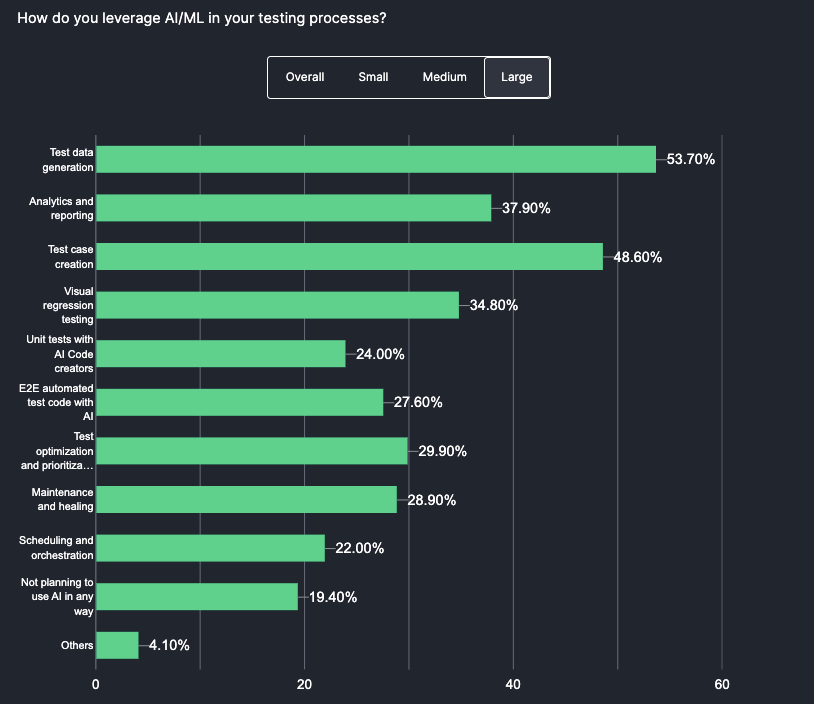
The good news is that, with the growing adoption of AI for visual regression testing, the recent Future of Quality Assurance Survey confirms that 34.8% of larger organizations are employing AI-driven solutions to address the escalating complexities of modern applications.
By capturing screenshots of the UI before a change is made and comparing them to a screenshot taken after, visual regression tests are designed to detect visual ‘bugs’. Visual regression serves as a robust safeguard, ensuring that any changes to the source code do not result in any issues or cause functionality regressions in the existing system.
This makes visual regression tests critical for eliminating disruptions to the user experience and upholding the reliability and stability of software applications.
With the rise of advanced Visual AI, teams can now detect even the slightest UI discrepancies that traditional testing methods often miss.
Traditional Visual Regression Testing Approaches and Limitations
Today’s websites are complex, with millions of elements. Conducting manual tests can introduce a series of challenges, apart from the costs and time involved. For instance, as different testers are involved, they may have varying results, causing inconsistencies in evaluation.
Take a look at the several challenges when visual regression tests are carried out manually:
- Delays to the release cycle: When you rerun multiple test cases after updates, it demands a considerable amount of time and effort from testing teams. This results in delays in the release cycle, impeding the pace of development.
- Optimization: Another challenge that manual visual regression tests present is the selection of relevant test cases for regression testing after code changes. This requires meticulous analysis. Any improper selection may result in inadequate test coverage, in turn prolonging testing cycles.
- Maintenance: Considering the pace at which software is released, consistent upkeep and maintenance of test suites are needed. Failure to regularly maintain test suites will lead to outdated tests and diminished effectiveness. Ensuring the continuous relevance of test suites calls for diligent efforts and resource allocation.
- Human fatigue: Manual regression testing is prone to human errors. When testing teams are running repetitive test cases over a long period of time—due to fatigue and lapses in attention, there could be an increasing likelihood of oversight and inaccuracies.
- Integration challenges: In the software development lifecycle, integrating visual regression testing into existing development pipelines causes technical and logistical challenges. It further requires careful adaptation of testing workflows. Furthermore, aligning visual regression testing with other methodologies poses additional complexities.
AI in Visual Regression Testing
AI has revolutionized the detection of visual discrepancies. By employing machine learning algorithms to analyze vast visual data faster and more accurately, testing teams are now uniquely positioned to enhance the value and handle the increasing levels of complexity of modern web applications effectively. Let’s see how:
- Adaptive Learning: AI is better at identifying and learning from visual changes, given how it works with large volumes of data across multiple instances. As a result, testing becomes more accurate with time.
- Enhanced Testing Efficiency: AI helps in delivering high-quality software products faster by speeding up the testing process and quickly identifying minor visual issues that humans are most likely to overlook.
- Focus on Higher-Value Tasks: With AI in charge of the repetitive parts of testing, human testers have more time in hand to look into important tasks like fine-tuning testing approaches and analyzing test results.
- Continuous Learning Process: AI also upgrades its testing capabilities constantly as it learns and improves from past tests.
Combining the skills of both AI and human testers makes the testing process more thorough and smoother.

Note: Deliver Seamless Digital Experience With AI-Native Visual Regression Testing. Sign up for free!
Benefits of AI-Native Visual Regression Testing
When software teams deploy AI augmentation into their continuous quality strategy, they can not only speed up the testing process but also benefit from multiple efficiency gains, as seen below.
- Automated detection and analysis: The AI-native visual regression cloud automates the identification of visual discrepancies, right from the point of studying color gradients and font sizes to layout changes.
- Scalability across devices: AI enables you to ensure consistent and seamless user experiences across various devices and resolutions.
- Contextual understanding: One of the major advantages of AI tools is that they understand the context of changes made. This helps in reducing false positives and enabling proactive issue resolution.
- Integration with development workflows: AI facilitates integration into CI/CD pipelines and provides immediate feedback, which helps streamline development processes.
As teams increasingly adopt AI-native platforms for testing, it becomes essential for QA professionals to validate their expertise. The KaneAI Certification equips testers with real-world skills in AI testing, helping them stay competitive in the evolving landscape of intelligent automation.
How is AI Transforming the Future of Visual Regression Testing?
Future advancements in AI tools and machine learning algorithms are expected to ensure greater precision in visual regression testing, ushering in next-level contextual understanding and adaptability in software testing.
A few of the key advancements that we can look forward to are:
- Smarter machine learning models: Backed by enhanced ML algorithms, AI will ensure more reliable and precise testing outcomes, significantly improving the quality of software applications.
- Autonomous testing: Improved AI-driven testing frameworks will become autonomous. This means—executing tests, analyzing results, and detecting issues without any human intervention. This level of autonomy in software testing will make way for faster feedback loops and agile development cycles.
- Personalized user experience testing: With AI, testers can simulate various user preferences and scenarios—allowing personalized user experience testing. Apart from identifying potential usability issues, this testing approach will optimize the user experience for different user segments and demographics.
- Greater integration with design tools: In time, we can expect AI to easily integrate with new-age design tools, enabling real-time feedback on design changes and their potential effect on visual regression testing. This integration will ensure greater collaboration between testers and designers—making sure that high levels of visual integrity are maintained throughout the development process.
Final Thoughts
In larger organizations, when it comes to cognitive AI-based use cases—the analysis of test logs and reporting is a common use case, constituting close to 37.90% of AI adoption. Following closely behind is the growing adoption of AI for visual regression testing. This signifies an increase in acceptance of AI’s effectiveness in software testing practices.
As a leading UI testing tool, TestMu AI provides a seamless digital experience through its AI-native visual regression testing capabilities.
This cutting-edge tool is enabling leading software players to achieve UI perfection. It automates the visual regression testing process across various websites, applications, browsers, and PDFs.
Additionally, TestMu AI allows teams to streamline their visual testing processes with a Software Development Kit (SDK) for multi-resolution and multi-browser tests. You can learn more about it, here.
Empower your teams to run AI-native visual regression tests with ease—book a demo with us today!


Did you find this page helpful?
More Related Hubs
TestMu AI forEnterprise
Get access to solutions built on Enterprise
grade security, privacy, & compliance
- Advanced access controls
- Advanced data retention rules
- Advanced Local Testing
- Premium Support options
- Early access to beta features
- Private Slack Channel
- Unlimited Manual Accessibility DevTools Tests