

Next-Gen App & Browser Testing Cloud
Trusted by 2 Mn+ QAs & Devs to accelerate their release cycles


Roles and Responsibilities of a Test Manager
Learn what a test manager does, their core responsibilities, key skills, and how they differ from a test lead, with a practical breakdown for QA teams.

Bhavya Hada
April 6, 2026
OVERVIEW
A test manager is the person accountable for the planning, coordination, and execution of all testing activities within a software project or organization. They own the test strategy, manage the QA team, track quality metrics, and make the release-readiness call.
The role sits at the intersection of technical depth and organizational leadership. A software test manager must understand how software breaks and how business decisions get made, then translate between both.
Overview
Who is a Test Manager?
A test manager is responsible for planning, coordinating, and overseeing all testing activities, ensuring quality goals are met and releases are ready for production.
What are the core responsibilities of a test manager?
- Test Strategy: Define scope, approach, environments, and release criteria
- Resource Management: Allocate testers, tools, and test environments
- Execution Oversight: Monitor progress and unblock testing issues
- Defect Management: Lead triage and track defect resolution
How do Test Manager, QA Lead, and Test Coordinator differ?
- Test Manager: Owns strategy, reporting, and multi-project quality
- QA Lead: Focuses on execution, mentoring, and team delivery
- Test Coordinator: Manages scheduling, environments, and logistics
What is the ISTQB Test Manager certification?
The ISTQB Advanced Level Test Manager certification is one of the most recognized credentials for QA leadership roles. It validates advanced knowledge in planning, risk-based testing, defect management, and process improvement.
How can TestMu AI support test managers?
Test managers spend significant time tracking execution status, compiling reports, and managing data across multiple tools. TestMu AI reduces this overhead by bringing planning, execution, defects, and reporting into a single platform.
- Unified visibility: Real-time dashboards show coverage, execution progress, and defect trends in one place
- AI-assisted testing: Automatically generate test cases from requirements to speed up planning and improve coverage
Who Is a Test Manager?
A test manager (also called a software test manageror QA manager) is the person accountable for the quality of software testing across a project or organization. They own the test strategy, allocate resources, oversee execution, manage defects, and translate test results into release decisions.
Unlike individual testers who execute test cases, the test manager operates at the strategy and coordination layer, ensuring the right tests happen at the right time, quality signals are credible, and stakeholders can make evidence-based release decisions.
In practice, the software test manager sits between engineering, product, and leadership, translating technical quality data into business risk language.
Key Roles and Responsibilities of a Test Manager
The test manager's responsibilities span the full testing lifecycle, from planning through retrospective.
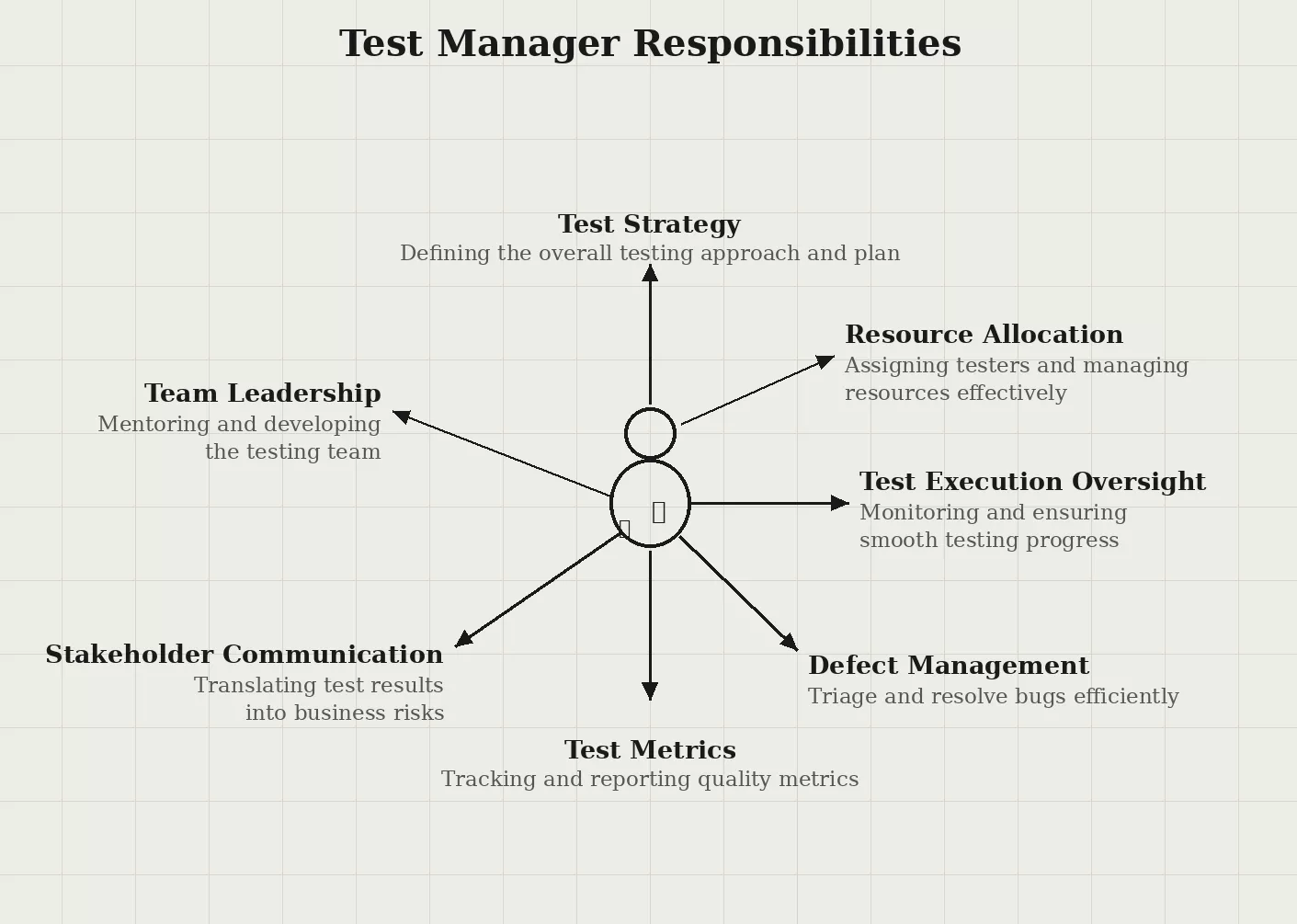
1. Test Strategy and Planning: Define the test approach for each release: scope, testing levels (unit, integration, system, UAT), automation strategy, environment requirements, entry and exit criteria, and schedule. The test plan is the governing document. The test manager owns it.
2. Resource Allocation: Assign testers to the right work. Balance manual and automated effort. Manage tool licenses, test environments, and test data infrastructure. In constrained teams, this means daily risk-based tradeoff decisions.
3. Test Execution Oversight: Monitor progress across manual, automated, and exploratory testing. Track planned vs. actual execution rates. Unblock stalled tests. The software test manager does not run every test. They make sure nothing falls through the cracks.
4. Defect Management: Own the defect triage process. Every bug gets logged with reproduction steps, severity, and priority. Drive triage meetings. Monitor defect aging to stop bugs from stalling in the backlog.
5. Test Metrics and Reporting: Track quality metrics that drive decisions: defect density, defect leakage rate, test coverage, pass/fail trends, automation coverage, and defect resolution time. Deliver weekly test status reports and release readiness assessments.
6. Stakeholder Communication: Translate test results into business risk language for product owners, engineering leads, and executives. Answer the question every stakeholder actually cares about: is this release safe to ship? Flag risks early. Manage expectations when quality gates are not met.
7. Team Leadership: Hire, mentor, and grow testers. Run retrospectives after each release. Resolve conflicts between development and testing. Invest in skill development across automation, performance testing, and security testing.
Test Manager vs QA Lead vs Test Coordinator
| Dimension | Test Manager | QA Lead | Test Coordinator |
|---|---|---|---|
| Scope | Multiple projects or org-wide | Single project or team | Single test phase or workstream |
| Focus | Strategy, budget, stakeholder reporting | Hands-on execution, mentoring | Day-to-day scheduling, environment setup |
| Hands-on testing | Rarely | Frequently | Occasionally |
| Reports to | Director of Engineering / VP | Test Manager or Engineering Manager | Test Manager or QA Lead |
| Key deliverable | Test strategy, release readiness report | Execution results, defect reports | Test schedules, environment readiness |
In smaller organizations, one person wears all three hats. In enterprise teams, these are distinct roles with separate career tracks.
Skills a Test Manager Needs
Core capabilities required to manage modern testing responsibilities:
- Technical knowledge: testing methodologies (functional, regression, performance, API, security), automation frameworks, CI/CD pipelines, defect tracking systems
- Test estimation: forecasting effort accurately using three-point estimation or Work Breakdown Structure techniques; poor estimation is the leading cause of compressed testing cycles
- Risk assessment: identifying which features carry the highest defect risk and allocating coverage accordingly
- Communication: presenting quality data to non-technical stakeholders in business risk terms, not test case counts
- Adaptability: absorbing mid-sprint requirement changes without losing critical coverage
- ISTQB certification: the ISTQB Advanced Level Test Manager (CTAL-TM) is the most recognized credential globally, covering test planning, risk-based testing, defect management, and test process improvement.
ISTQB Test Manager Certification
The ISTQB Certified Tester Advanced Level Test Management (CTAL-TM) is the most widely recognized credential for test managers globally. It validates advanced knowledge across test planning, risk-based testing, defect management, metrics, and test process improvement.
Prerequisites: ISTQB Foundation Level (CTFL) certification plus practical testing experience.
What it covers:
- Designing a test approach consistent with organizational strategy
- Risk identification and risk-based test prioritization
- Test monitoring and control across the SDLC
- Test team management and stakeholder communication
- Test process improvement methodologies
Career impact: CTAL-TM holders command higher salaries and are prioritized for QA leadership roles. The certification is recognized by employers across Europe, Asia, and North America. It also qualifies holders to pursue ISTQB Expert Level, the highest tier in the certification framework.
The certification validates structured knowledge. What it cannot validate is judgment, knowing when to override the plan, when to escalate, and when to accept residual risk. Both matter. Certification signals readiness; delivery proves capability.
Test Manager in Agile and DevOps
In waterfall, the test manager controls a defined testing phase. In agile and DevOps, the role changes shape:
- Quality coach: enabling teams to build quality in from the start, not gate it at the end
- Sprint-level test strategy: lightweight plans that adapt each iteration, not monolithic documents
- Shift-left ownership: testability reviewed during sprint planning, not after development closes
- CI/CD integration: automated regression, smoke, and integration tests run on every commit
- Metrics that matter: defect escape rate and cycle time, not test cases executed
coaching the team, and making quality visible through dashboards and real-time reporting.
How TestMu AI Test Management Helps Test Managers
Test managers lose the most time not to testing itself, but to the overhead around it: switching between tools, assembling status reports manually, and chasing execution data scattered across Jira, other test management tools and CI dashboards.
TestMu AI Test Management platform is built to eliminate that overhead. It brings test planning, test case management, execution tracking, defect integration, and release readiness reporting into a single platform.
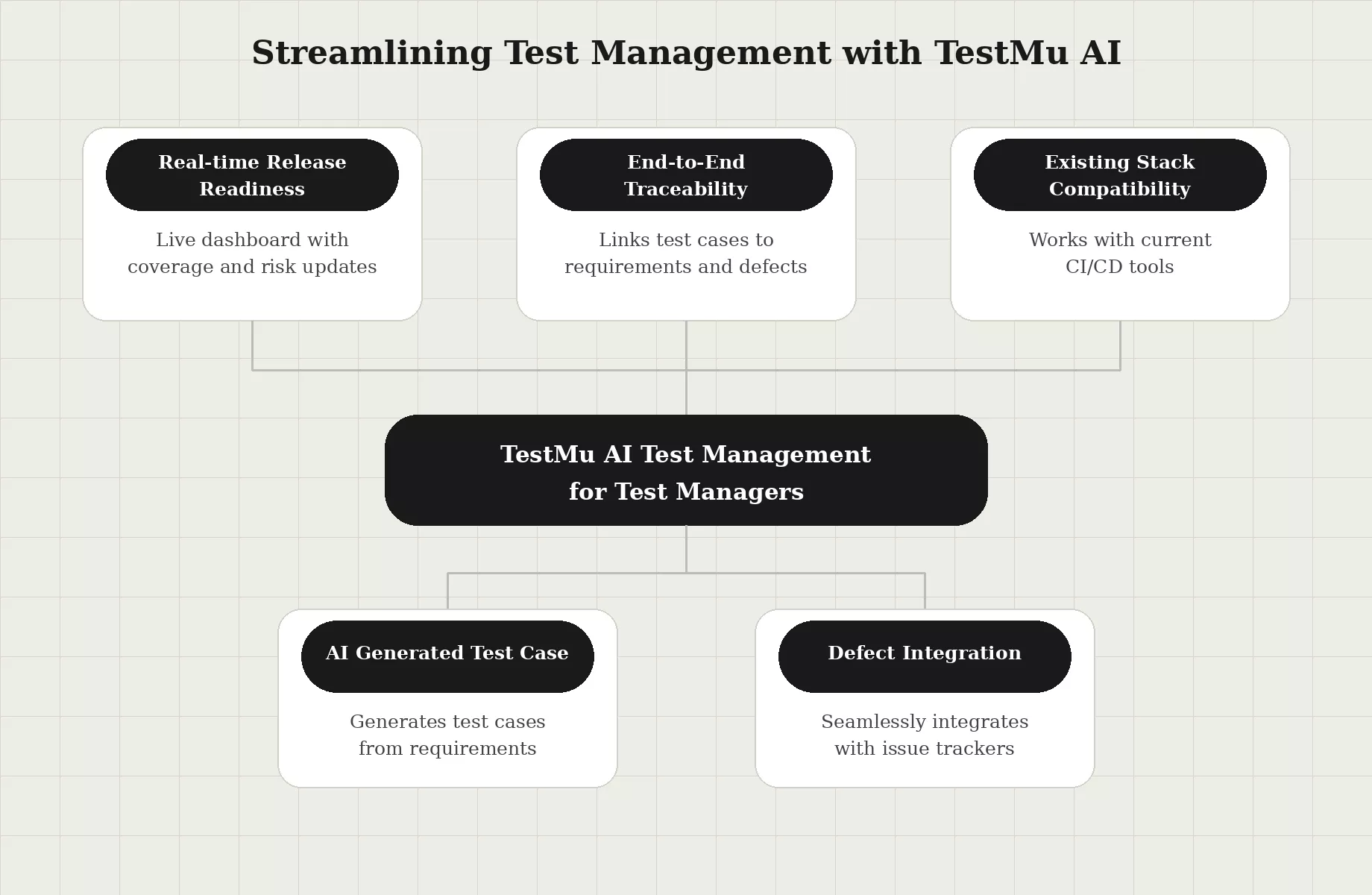
Here is what that looks like for a test manager in practice:
Real-time release readiness, not slide decks The TestMu AI Test Management dashboard gives you a live view of coverage, execution status, defect trends, and risk, updated as tests run. When engineering leadership asks if the release is safe to ship, the answer is already on screen. Not a report you spent two hours building.
AI-native test case creation, built into the platform TestMu AI's test management platform includes AI generated test cases. Write a requirement or a user story, and the platform generates structured, executable test cases from it. Test managers get broader coverage across more features without pulling senior testers away from exploratory work.
End-to-end traceability across the full cycle Every test case links to a requirement and forwards to any defect it surfaces. Test managers can answer "what is covered, what is not, and where did we find bugs" from a single view, not across three systems. Traceability stops being a manual documentation task and becomes an automatic output of how the platform works.
Defect integration without manual bridging Defects flow directly into Jira, GitHub Issues, and other trackers without copy-paste. Defect status, severity, and aging are visible inside the same platform where execution data lives. Triage meetings move faster because the data is already in one place.
Works with your existing stack TestMu AI Test Management integrates with Jenkins, GitHub Actions, GitLab CI, and Slack. It plugs into what your team already runs and adds the unified layer on top.
Test managers spend less time managing tools and more time managing quality. Explore the test manager documentation to set up your first test plan, coverage view, and release-readiness report.
Watch how a test manager sets up a complete test plan inside TestMu AI Test Management:
For more walkthroughs, tutorials, and testing best practices, subscribe to the TestMu AI YouTube channel.
Conclusion
The test manager role is where technical credibility meets organizational influence. Every release decision, what ships, what waits, what risk is acceptable, flows through the quality signal the software test manager builds and communicates.
The teams that consistently ship quality software are the ones with test management tool who treat process improvement as a discipline, not an afterthought. TestMu AI's Unified Test Management gives them the platform to do it at scale.


Summarize with AI


Frequently asked questions
Did you find this page helpful?
TestMu AI forEnterprise
Get access to solutions built on Enterprise
grade security, privacy, & compliance
- Advanced access controls
- Advanced data retention rules
- Advanced Local Testing
- Premium Support options
- Early access to beta features
- Private Slack Channel
- Unlimited Manual Accessibility DevTools Tests