

Next-Gen App & Browser Testing Cloud
Trusted by 2 Mn+ QAs & Devs to accelerate their release cycles


MLOps vs DevOps: Key Differences
Understand the difference between MLOps vs DevOps, their benefits, and how each streamlines workflows in software development and machine learning operations.

Chandrika Deb
April 1, 2026
Most engineering teams adopt DevOps successfully and then hit a wall when they try to bring machine learning into production. The CI/CD pipeline works, the containers spin up cleanly, and the model deploys without error. Weeks later, accuracy drops and nobody knows why. The tooling was built for software. The problem was a model. That distinction is what separates DevOps from MLOps.
Understanding the differences and similarities between MLOps vs DevOps is crucial for leveraging both methodologies effectively. While DevOps focuses on software development and delivery, MLOps addresses the unique challenges of machine learning workflows. Together, they complement each other as organizations can build reliable applications, streamline ML model deployment, and drive technological innovation across industries.
Overview
MLOps vs DevOps
- DevOps manages application code while MLOps manages code, data, and machine learning models together.
- The core reason MLOps exists is model drift. Deployed models degrade as real-world data shifts, a problem DevOps tooling was never built to detect or fix.
- MLOps extends DevOps, it does not replace it. Teams with strong DevOps foundations are better positioned to adopt MLOps.
- The MLOps pipeline adds stages, DevOps has no equivalent for: feature engineering, experiment tracking, model versioning, drift monitoring, and automated retraining.
- Most organizations building ML-powered products need both. DevOps handles the application layer while MLOps handles the model layer.
- Team roles differ significantly: MLOps requires data scientists and ML engineers alongside the DevOps and platform engineers already in place.
- Tooling overlaps at the infrastructure layer but diverges at the model layer, where MLOps-specific tooling takes over.
What is MLOps?
MLOps (Machine Learning Operations) applies DevOps practices to the ML lifecycle, focusing on automating and managing data collection, preparation (ETL), model training, validation, deployment, monitoring, and retraining.
Core components include:
- Data Management for collection, versioning, and preparation (ETL) of training datasets.
- Model Training and Experimentation for iterating on algorithms, hyperparameters, and feature sets.
- Model Registry for versioning, cataloging, and managing trained models across environments.
- Model Deployment for serving models in production via APIs, batch pipelines, or edge devices.
- Continuous Monitoring for tracking model drift, data quality, and prediction accuracy post-deployment.
- Automated Retraining Pipelines for triggering model updates when performance degrades or new data arrives.
Key benefits of MLOps:
- Automated pipelines for faster deployment.
- Reproducible workflows for consistency.
- Lifecycle management with tool integrations.
- Continuous monitoring to ensure model performance and scalability.
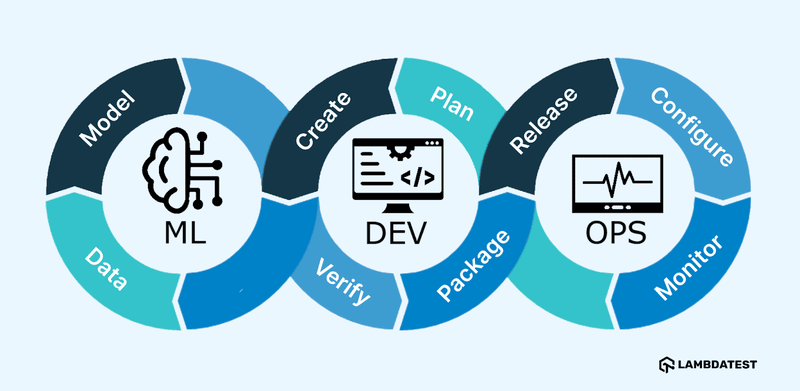
What is DevOps?
DevOps integrates software development (Dev) with IT operations (Ops) to enhance collaboration, agility, and automation.
Core components include:
- Source Code Management (SCM) for version control.
- Continuous Integration (CI) for automated code testing and integration.
- Continuous Delivery (CD) for frequent, reliable releases.
- Infrastructure as Code (IaC) for automated provisioning and configuration.
- Continuous Monitoring to ensure system reliability and optimize feedback loops for continuous improvement.
Key benefits of DevOps:
- Faster release cycles through automated CI/CD pipelines.
- Improved collaboration between development and operations teams.
- Higher deployment frequency with lower failure rates.
- Faster incident detection and recovery through continuous monitoring.
- Consistent, reproducible environments via Infrastructure as Code.

Note: Streamline model deployment, monitoring, and retraining by transitioning from DevOps to MLOps with ease. Try TestMu AI Today!
Key Differences Between MLOps vs DevOps
Think about how regular software behaves once deployed. A login function that works today will work the same way six months from now. A fraud detection model trained on 2024 payment patterns may start missing new fraud tactics by mid-2025, not because anyone changed the code, but because the world it was trained on has shifted. This is called model drift, and it is the core problem that makes MLOps necessary.
MLOps was built to manage models, which behave probabilistically and degrade over time. While DevOps manages code, where behavior is deterministic and monitoring means watching for crashes, latency spikes, and error rates.
Put simply: DevOps pipelines are code-driven, MLOps pipelines are data-driven. Everything else — the tooling differences, team structures, and pipeline stages — flows from that single distinction.
Let us take a detailed look at the main differences between the MLOps vs DevOps pipelines below:
| Aspect | MLOps | DevOps |
|---|---|---|
| Focus | Machine Learning (ML) operations and models | Software development and IT operations |
| Purpose | Streamline ML workflows, deployment, and operations | Optimize software development, deployment, and operations |
| Main Components | Data pipelines, Model registries, Monitoring | Code repositories, CI/CD pipelines, Infrastructure |
| Core Activities | Model training, Validation, Monitoring | Code integration, Testing, Deployment |
| Core Objective | Improve ML model deployment, retraining, and management | Accelerate software delivery and reliability |
| Key Challenge | Model drift, Data bias, Model explainability | Continuous integration, Infrastructure management |
| Collaboration | Involves data scientists, analysts, ML engineers, and IT Ops | Requires collaboration between development, testing, and IT Ops teams |
| Data Handling | Deals with ML-specific data, features, and models | Manages code and application-related data |
| Testing | Includes data validation, model quality validation, and model performance testing | Focuses on unit and integration tests |
| Deployment Workflow | Accounts for continuous training of models using new data, considering conditions like data drift | Starts with a build and then releases software to staged environments using CI/CD pipelines |
How To Choose Between MLOps and DevOps?
Choosing between MLOps and DevOps depends on your organization’s goals and technological focus. If your objective is to develop and deploy machine learning models, MLOps is the way to go. It specifically addresses challenges like data management, model versioning, and performance monitoring in production.
On the other hand, if your focus is on traditional software development and deployment, DevOps offers a comprehensive framework that emphasizes DevOps automation to improve collaboration, streamline workflows, and accelerate delivery. The DevOps lifecycle supports continuous integration, testing, and deployment, which can be crucial for optimizing software development processes.
The maturity level of your organization is also important. For those in the early stages of adopting machine learning, DevOps provides a solid foundation for unifying development and operations. This sets the stage for adopting MLOps in the future as the organization gains more experience with machine learning.
How do MLOps and DevOps Work Together?
MLOps does not replace DevOps. It extends it. Organizations with mature DevOps practices already have the CI/CD infrastructure, version control discipline, and automation culture that MLOps builds on. Where the two pipelines converge, particularly at deployment and test execution, speed becomes a bottleneck at scale.
HyperExecute addresses this directly by offering up to 70% faster test execution than traditional cloud grids through end-to-end test orchestration that fits into both pipeline types without additional configuration.

This capability optimizes both DevOps and MLOps workflows, ensuring faster and more efficient test and deployment cycles.
Here are a few ways to integrate MLOps and DevOps strategies:
- Unified Pipelines: MMerging CI/CD pipelines for software and ML model artifacts creates a unified standard for versioning, testing, and deployment systems, increasing the reliability and scalability of workflows across both DevOps and MLOps.
- Cross-Functional Teams: Data scientists, machine learning engineers, software developers, and operations personnel work within the same sprint cycles, improving communication, enhancing processes, and speeding up innovation.
- Adoption of MLOps Platforms: Integrating MLOps platforms with existing DevOps infrastructure standardizes workflows, enforces governance, and reduces operational complexity across both practices.
Future Trends in MLOps and DevOps
Both MLOps and DevOps are evolving rapidly as AI becomes central to software delivery. Key trends shaping both practices in 2026:
- GitOps: Infrastructure and model configurations managed entirely through Git, enabling automated, auditable deployments for both application and ML pipelines.
- AutoML: Automated model selection and tuning lowers the barrier for smaller teams to adopt MLOps without deep ML expertise.
- Federated Learning: Training models across distributed data sources without centralizing sensitive data, particularly relevant in healthcare and finance.
- Synthetic Data: AI-generated datasets enable model testing and validation without exposing real user data, helping teams meet privacy requirements.
- Continual Learning: Models that retrain automatically on new production data, reducing manual retraining cycles in fast-moving domains like finance and autonomous systems.
As AI becomes embedded in both DevOps and MLOps workflows, QA professionals who understand how to validate AI-driven pipelines will be increasingly valuable. The KaneAI Certification by TestMu AI validates practical AI testing skills built for this evolving landscape.
Conclusion
DevOps and MLOps are not competing approaches but complementary layers of the same engineering discipline. DevOps focuses on optimizing software code for integration into various processes, while extends that foundation to handle the unique demands of machine learning: data dependencies, model versioning, drift monitoring, and continuous retraining.
Organizations do not choose between the two. As ML becomes embedded in more products, teams that have invested in strong DevOps practices are better positioned to adopt MLOps. The difference is in what you are managing and how it can fail.
Citations
- Machine Learning Operations (MLOps): Overview, Definition, and Architecture: https://arxiv.org/pdf/2205.02302
- MLOps: Continuous delivery and automation pipelines in machine learning: https://cloud.google.com/architecture/mlops-continuous-delivery-and-automation-pipelines-in-machine-learning
- Quality issues in Machine Learning Software Systems. https://arxiv.org/abs/2208.08982


Frequently asked questions
Did you find this page helpful?
More Related Hubs
TestMu AI forEnterprise
Get access to solutions built on Enterprise
grade security, privacy, & compliance
- Advanced access controls
- Advanced data retention rules
- Advanced Local Testing
- Premium Support options
- Early access to beta features
- Private Slack Channel
- Unlimited Manual Accessibility DevTools Tests