

Next-Gen App & Browser Testing Cloud
Trusted by 2 Mn+ QAs & Devs to accelerate their release cycles


Accelerating Jenkins Pipeline Through Intelligent Test Orchestration
Optimize CI/CD with HyperExecute for faster tests, lower costs & simplified orchestration. Elevate efficiency in digital transformation.

Aman Chopra
December 29, 2025
In the ever-evolving landscape of software development, where innovation is constant, speed and efficiency are paramount, continuous integration and continuous delivery (CI/CD) pipelines cannot be overstated.
Jenkins, a tried-and-true companion for software development teams, has served as the bedrock for streamlining processes and ensuring the rapid delivery of software solutions. However, as enterprise teams grow, so do the complexities of their software and the test suites required to ensure quality. With this explosion of diverse functionalities, platforms, and devices, the challenge of maintaining efficiency and speed in test execution become more pronounced.
In this blog post, we’ll delve into the journey of transforming a Jenkins setup for a large enterprise team and the game-changing impact of HyperExecute. If you are preparing for an interview you can learn more through Jenkins Interview Questions.
Optimizing Efficiency: The Journey from Single-Node Jenkins to Intelligent Orchestration
Every journey has a starting point, and for many development teams, it begins with a single-node Jenkins setup. Initially efficient and effective, but as the team expands and the test suite grows, the performance bottleneck becomes evident.
For instance, consider a team working on a complex web application with a test suite of 100 tests. On a single-node Jenkins, these tests might take up to 8 hours to execute, with each test averaging 4 minutes. In a single-node setup, every stage of the CI/CD pipeline, from code checkout to test execution, runs sequentially on the same server. This means each test case must wait for the previous one to finish before it can begin.
Imagine a long assembly line where each test is a car. The line can only move as fast as the slowest car (test). Each test execution stretched for hours, draining a staggering 30% of the development time with a single-threaded execution. The need for change becomes inevitable.
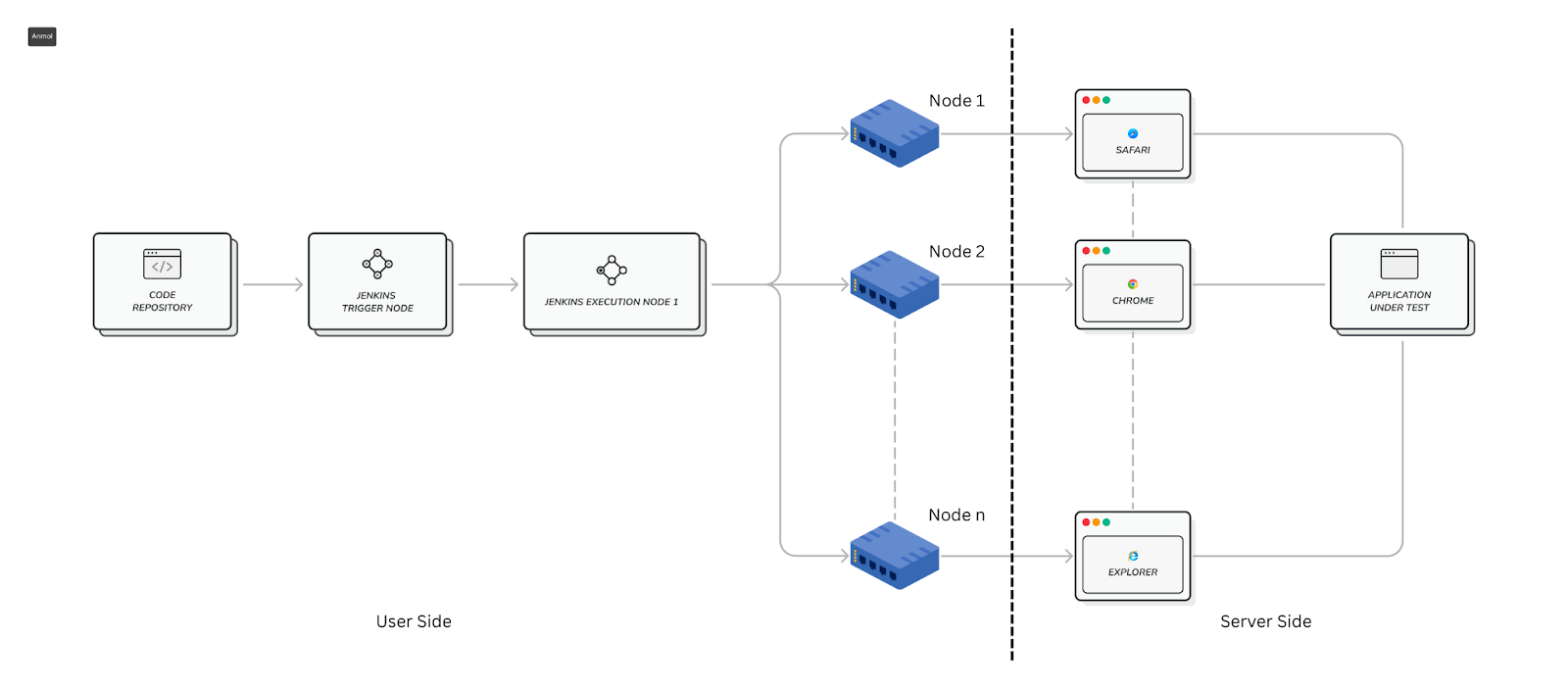
Since time efficiency is important, and therefore to tackle this challenge, teams usually come up with a solution that often involves scaling horizontally by introducing multiple Jenkins nodes and distributing tests across running tests over different browsers.
Now when the same test suite of 100 tests executed with 4 parallel nodes, took up to 2 hours duration with each test averaging 4 minutes. A multiple-node setup, also called master/slave architecture allows you to distribute the workload of executing Jenkins jobs across multiple nodes.
This means that the master node divides the workload, assigning subsets to different agent nodes for parallel execution. This parallelization accelerates the overall testing process, reducing the overall time from 8 hours to 2 hours with each agent node working independently and reporting results back to the master node.
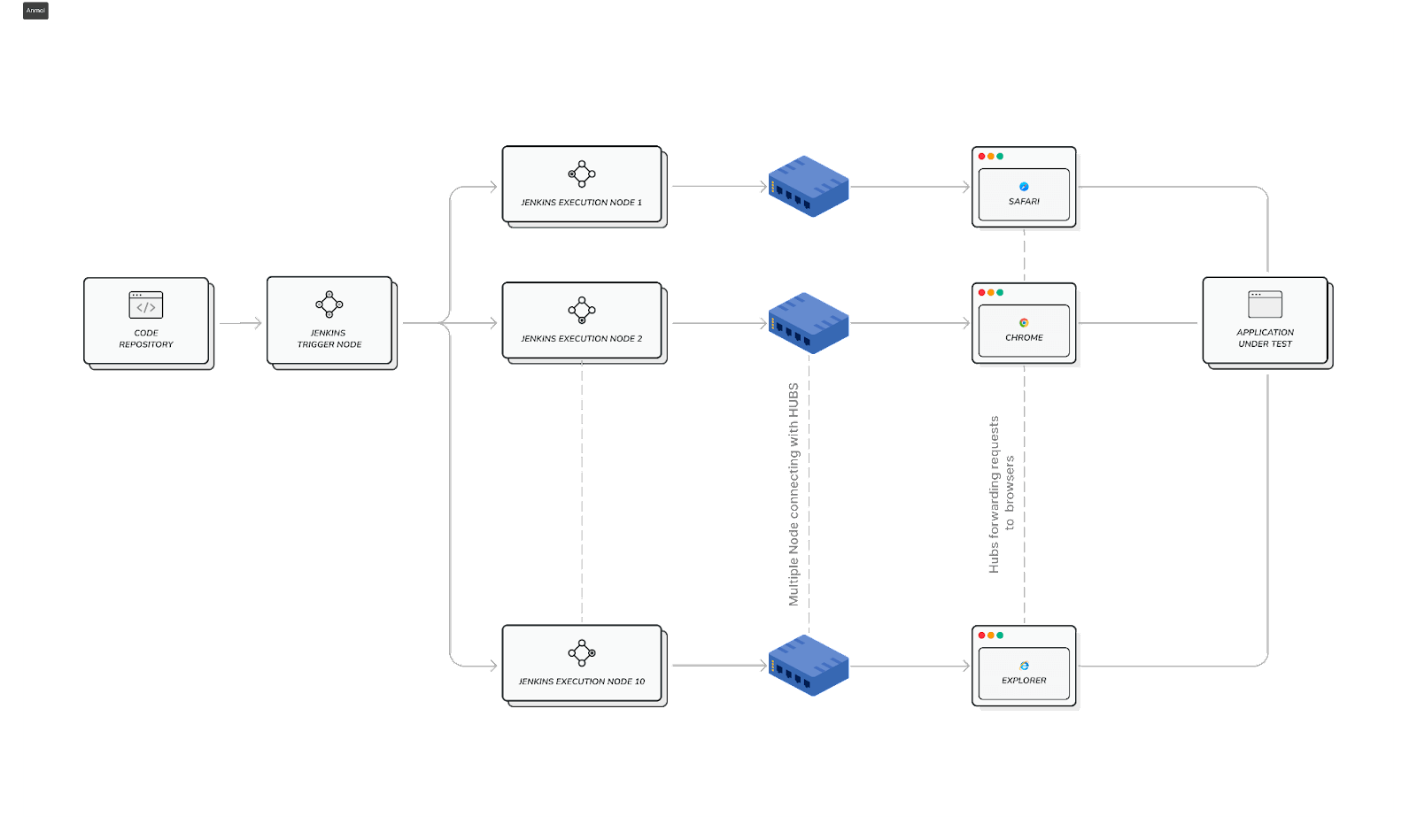
However, this leads to a new challenge — the imperative for intelligent test distribution to optimize execution across parallel nodes. The solution takes the form of multiple Jenkins nodes, accompanied by extra efforts on the development of a robust distribution logic as well as ensuring optimal resource utilization and minimizing test execution time.
While the shift to parallelization does tackle certain challenges, it introduces intricacies in overseeing the distribution of tests across nodes. This complexity has the potential to impede the process, causing slowdowns attributed to overhead, multiple network hops, and the unreliability of infrastructure. The necessity for a more seamless solution becomes evident in light of these considerations.
Optimizing Further With HyperExecute: Next-Gen Test Execution
TestMu AI’s HyperExecute is a true game-changer in the field of automation testing that promises to redefine the speed and efficiency of test execution for enterprises. HyperExecute doesn’t just address but elegantly conquers the limitations embedded in traditional CI/CD tools.
With its sophisticated distributed architecture and intelligent test orchestration processes, HyperExecute not only significantly trims down test execution times but also improves developer velocity by accelerating the feedback loop while seamlessly integrating into the existing CI/CD process.
HyperExecute’s well-crafted distributed architecture and intelligent test orchestration processes are engineered to not just cut down on test execution times but to enhance developer productivity. HyperExecute distributes the test cases based on test execution times and previous execution results, between the number of defined parallels for efficient and optimized test execution. If there are any dependent test cases, all those tests will be executed on the same node.
HyperExecute not only optimizes the test execution process but also provides comprehensive analytics on the results, empowering teams to make data-driven decisions and continuously improve their testing processes via:
- Detailed Test Reports and Artifacts: HyperExecute generates detailed reports for each test execution, including execution times, pass/fail status, screenshots, logs, and videos of test runs. This eliminates the need for additional investments in third-party analysis and reporting tools and associated configuration overhead. These reports provide granular visibility into test results, enabling rapid identification of failures and debugging.
- AI-Native RCA: The AI-native Root Cause Analysis (RCA) and Error Detection provides a thorough overview of the underlying causes of various error categories and aid in rapidly identifying these categories. This approach eradicates the reliance on multiple tools and manual investigations like log aggregation to determine the root cause of a test failure.
- Test History: HyperExecute provides a comparative analysis of test runs on a single click, allowing teams to compare current results with historical data. This eliminates the need to manually dig through disparate reports to analyze and compare the test results.

Let’s take the same scenario as before, a test suite of 100 test cases and see how HyperExecute execute tests efficiently
- Efficient Distribution: HyperExecute will efficiently distribute the test cases across multiple nodes without the overhead of spinning multiple Jenkins slave nodes.
- Optimized Test Execution: With the optimized Virtual Machines and adding the scripts, hub, and browser in one single Virtual Machine resulting in reduced network hops we make sure the tests are executed in the fastest way possible. As a result, test execution times are significantly reduced from 2 hours to nearly 1 hour in average scenarios.
- Seamless integration: The processing and distribution are taken care of by the HyperExecute which leads to a more streamlined and efficient CI/CD pipeline.
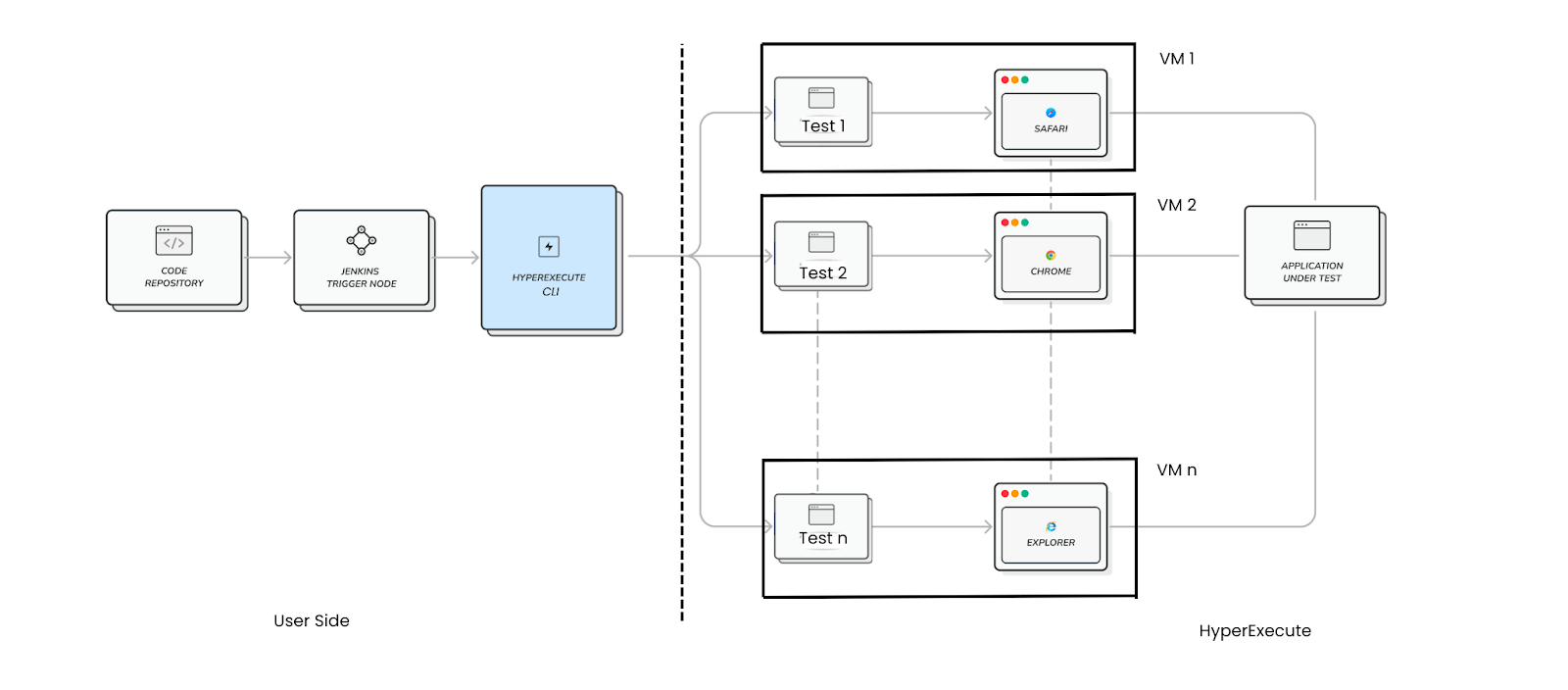
Benefits of using HyperExecute with CI/CD Tools
HyperExecute brings a multitude of benefits to enterprise CI/CD pipelines, including:
- Reduced Test Execution Times: HyperExecute’s distributed architecture and intelligent scheduling algorithms significantly reduce the need for multiple hops. This reduction in the multiple hops fastens the test execution times, enabling faster software delivery cycles.
- Cost Saving: HyperExecute’s streamlined architecture ensures that the nodes running your tests are equipped with both the hub and the browser. This eliminates the necessity for additional slave nodes, resulting in significant cost savings. The system efficiently manages test initiation, allowing for seamless triggering not only from a single node but also through CI/CD processes.
- Reduced Maintenance Overhead: HyperExecute efficiently maintains the pipeline environment and reduces the cost and resources of maintenance.
- Simplified Test Distribution: HyperExecute eliminates the complexities of manual test distribution, reducing overhead and streamlining the CI/CD process.
- Enhanced Scalability: HyperExecute’s distributed architecture seamlessly scales to meet the demands of growing test suites and large enterprise teams.
Conclusion
In conclusion, the experiment with HyperExecute showcased not just a reduction in test execution time but a paradigm shift in how we approach parallelization for large enterprise teams. The simplicity it brings to the table is a breath of fresh air, allowing teams to focus on innovation rather than getting bogged down by the intricacies of node management.
This exploration with HyperExecute is merely the tip of the iceberg. Our ongoing collaboration with multiple enterprise teams has led us to incorporate cutting-edge features, simplifying instructions that were once complicated with traditional setups. If you’re navigating the path of digital transformation, HyperExecute is your comprehensive solution.
Stay tuned for more exciting developments on this transformative journey!


Did you find this page helpful?
More Related Hubs
TestMu AI forEnterprise
Get access to solutions built on Enterprise
grade security, privacy, & compliance
- Advanced access controls
- Advanced data retention rules
- Advanced Local Testing
- Premium Support options
- Early access to beta features
- Private Slack Channel
- Unlimited Manual Accessibility DevTools Tests