

Next-Gen App & Browser Testing Cloud
Trusted by 2 Mn+ QAs & Devs to accelerate their release cycles


- Home
- /
- Learning Hub
- /
- Crowdsourced Testing
Crowdsourced Testing: What It Is, How It Works, and When to Use It (2026)
Crowdsourced testing distributes quality assurance across real users, real devices, and real network conditions worldwide. It extends your QA capacity without adding headcount.

Prince Dewani
March 23, 2026
Crowdsourced testing distributes quality assurance across real users, real devices, and real network conditions worldwide. It extends your QA capacity without adding headcount. This guide covers what crowdsourced testing is, how the process works, its types, top platforms, benefits, challenges, and how it fits into a modern quality engineering strategy.
Overview
Crowdsourced testing puts your software in front of real testers using their own devices, browsers, and networks across different locations.
What are the key aspects of crowdsourced testing?
- Real-World Testing: Testers work on their own devices and operating systems across varied locations, so bugs surface in conditions your lab setup would miss.
- Broader Coverage and Speed: A large, diverse tester pool runs exploratory and functional tests faster and wider than internal teams can manage alone.
- Cost-Effectiveness: You pay for the testing you need, when you need it, cutting overhead and infrastructure spend.
- Specialized Focus: Works especially well for mobile apps, websites, and IoT products where hardware, OS, and demographic variety matter.
- Platform Ecosystem: Tools like Applause, uTest, Testlio, and Digivante match companies with vetted testers and handle the logistics.
- Popular Testing Types: Most crowd testing engagements cover usability, functional, localization, and accessibility testing.
- Scalability on Demand: Scale testing up or down based on release cycles or sprint timelines without long-term hiring.
What Is Crowdsourced Testing?
Crowdsourced testing is a QA method that uses a distributed global network of testers to evaluate software under real-world conditions.
Crowdsourced testing (also called crowd testing or crowdtesting) relies on external testers who bring their own devices, operating systems, browsers, and network environments. A crowdsourced testing platform connects organizations with this distributed workforce, assigns test cycles, and consolidates results into actionable reports. Crowd Testing is a manual testing effort.
Testers are typically freelance QA professionals or domain-specific users recruited through a third-party vendor. They execute test scenarios that mirror actual end-user behavior across real-world conditions.
Companies like Microsoft, Airbnb, PayPal, and Netflix actively use crowdsourced testing to validate their products across global markets.
The global crowdsourced testing market reached $1.76 billion in 2025 and is projected to grow to $3.6 billion by 2032 at a CAGR of 10.8%, according to Fortune Business Insights.
How Does the Crowdsourced Testing Process Work?
The process follows five stages: scope definition, tester recruitment, test execution, bug reporting, and iterative analysis.
1. Define Testing Scope and Objectives
The process begins with clearly defined goals. Teams specify which features, platforms, device types, geographies, and testing types (functional, usability, localization) they need coverage for. Clear scope prevents unfocused testing and ensures the results are actionable.
2. Recruit and Match Testers
The platform selects testers from its global pool based on device ownership, geographic location, language fluency, domain expertise, and past performance ratings. Leading platforms vet testers through skills assessments and maintain quality scores to ensure consistency across test cycles.
3. Execute Test Cycles
Testers run predefined test scenarios and conduct exploratory testing on their personal devices. Because they operate from actual environments (home networks, carrier connections, real hardware), they encounter issues that controlled lab setups typically miss. Tests run across multiple time zones simultaneously, which compresses timelines significantly.
4. Report and Triage Bugs
Testers submit structured bug reports with reproduction steps, screenshots, screen recordings, device metadata, and severity classifications. Duplicate detection and triage happen at the platform level to reduce noise before results reach the development team.
5. Analyze, Fix, and Iterate
Development teams prioritize fixes based on severity and frequency. A regression testing cycle confirms that fixes resolve reported issues without introducing new defects. This loop repeats until the product meets release quality standards.
What Are the Different Types of Crowdsourced Testing?
Crowdsourced testing covers functional, usability, security, localization, compatibility, accessibility, and performance testing.
The type of crowd testing you need depends on your product stage, target audience, and release goals.
| Testing Type | What It Validates | When to Use It |
|---|---|---|
| Functional | Core features work as specified across environments | Pre-release validation of new features or updates |
| Usability | Navigation flows, UX clarity, and task completion rates | Before major redesigns or new user journeys |
| Compatibility | Consistent behavior across browsers, devices, and OS versions | Expanding to new platforms or device categories |
| Localization | Language accuracy, cultural relevance, regional formatting | International launches or multilingual rollouts |
| Security | Vulnerabilities, data exposure risks, access control flaws | Post-development audits or compliance checks |
| Accessibility | WCAG compliance, screen reader support, keyboard navigation | Before public launch or regulatory deadlines (EAA, ADA) |
| Performance | Load times, responsiveness, stability under varied conditions | Pre-launch stress testing or post-update validation |
| Exploratory | Unpredictable edge cases and undocumented behavior | Supplement scripted tests with unscripted real-world usage |
For teams that need browser-specific validation at scale, cross browser testing on a cloud platform like TestMu AI provides access to 3,000+ browser and OS combinations.
What Are the Benefits of Crowdsourced Testing?
Crowdsourced testing delivers real-world coverage, faster bug detection, cost efficiency, and scalable global test capacity.
1. Real-World Device and Environment Coverage
Crowd testers use their personal devices on their actual networks. This produces test coverage that mirrors production conditions.
But individual testers cannot cover every device and OS combination your users depend on. To increase device coverage without increasing cost, platforms like TestMu AI offers Real Device Cloud with access to 10,000+ real Android and iOS devices for both manual and automated testing.
It comes with the following Capabilities:
- Network Condition Testing: Simulate 2G/3G/4G/5G, offline mode, and custom bandwidth configurations to validate app behavior under real network constraints.
- Geolocation Testing: Test from 170+ countries with IP-based geolocation and GPS coordinate injection to validate language, currency, and region-specific content.
- Device Security: SOC 2 Type II certified with fully isolated sessions, automatic device wipe between tests, and TLS 1.3 encryption in transit.

2. Faster Parallel Execution
Hundreds of testers working simultaneously across time zones compress test cycles from weeks to hours. A feature that would take a 5-person in-house team two weeks to validate across 50 device configurations can be covered by 100 crowd testers in a single day.
3. Cost Efficiency at Scale
Organizations pay for testing output (bugs found, test cycles completed) rather than maintaining headcount. This eliminates recruitment, training, device procurement, and infrastructure costs. Crowd testing scales up for major releases and scales down during quieter phases.
4. Unbiased User Perspective
External testers have no internal assumptions or familiarity bias. They navigate the product as first-time users, which surfaces usability issues, confusing workflows, and broken edge cases that in-house teams consistently overlook.
5. Global Localization Validation
Testers in specific regions validate that language, currency, date formats, and cultural elements render correctly in their local context. This is significantly more reliable than centralized localization QA performed by a single team from one geography.
What Are the Challenges of Crowdsourced Testing?
Key challenges include tester quality variance, IP security risks, communication overhead, and inconsistent bug reports.
1. Tester Quality Variance
Not all testers deliver the same quality. Platforms that rely on unvetted, open-access crowds risk low-value reports. Choose a vendor with rigorous vetting, skill assessments, and ongoing performance ratings to mitigate this.
2. Intellectual Property and Data Security
Sharing pre-release software with external testers introduces IP exposure risk. Leading platforms address this through NDA enforcement, device-level security controls, watermarked builds, and restricted distribution channels. Evaluate the vendor's security posture before onboarding.
3. Communication and Coordination Overhead
Managing distributed testers across time zones requires clear documentation, structured test plans, and responsive project management. Without well-defined scope and acceptance criteria, teams receive unfocused results that consume more time to triage than they save.
4. Duplicate and Low-Signal Bug Reports
Large tester pools can generate duplicate submissions and reports that lack reproduction detail. Effective platforms implement deduplication logic, mandatory structured fields (steps to reproduce, expected vs actual behavior, device info), and tester ranking systems to filter noise.
How Does Crowdsourced Testing Compare to In-House and Outsourced Testing?
Crowdsourced, in-house, and outsourced testing differ in scale, cost, control, and real-world coverage.
| Factor | In-House Testing | Outsourced Testing | Crowdsourced Testing |
|---|---|---|---|
| Team | Internal FTEs with deep product knowledge | Dedicated external teams under contract | Distributed global freelancers on-demand |
| Scalability | Limited by headcount and budget | Scales with contract scope | Highly elastic, instant scale up/down |
| Device Coverage | Restricted to device lab inventory | Dependent on vendor's lab | Thousands of real personal devices |
| Cost Model | Fixed (salaries, infrastructure) | Contract-based (T&M or fixed bid) | Pay-per-use (bugs, cycles, hours) |
| Speed | Sequential, limited parallelism | Moderate, depends on team size | High parallelism across time zones |
| Control | Full direct control | SLA-governed, moderate | Platform-mediated, less direct |
| Real-World Accuracy | Low (lab conditions) | Low to moderate | High (real users, real environments) |
| Best For | Core product logic, security-sensitive | Specialized testing, compliance audits | Device coverage, localization, UX |
The most effective QA organizations combine all three: in-house depth for business-critical logic, outsourced specialists for compliance, and crowdsourced testing for breadth, speed, and real-world coverage.
Which Are the Top Crowdsourced Testing Platforms?
Leading crowd testing platforms include Applause, test IO, Testbirds, Global App Testing, and BugFinders.
The crowdsourced testing market includes both fully managed platforms and self-service models. Each platform differs in tester pool size, vetting rigor, supported testing types, and pricing. Here are five established platforms actively used by enterprises.
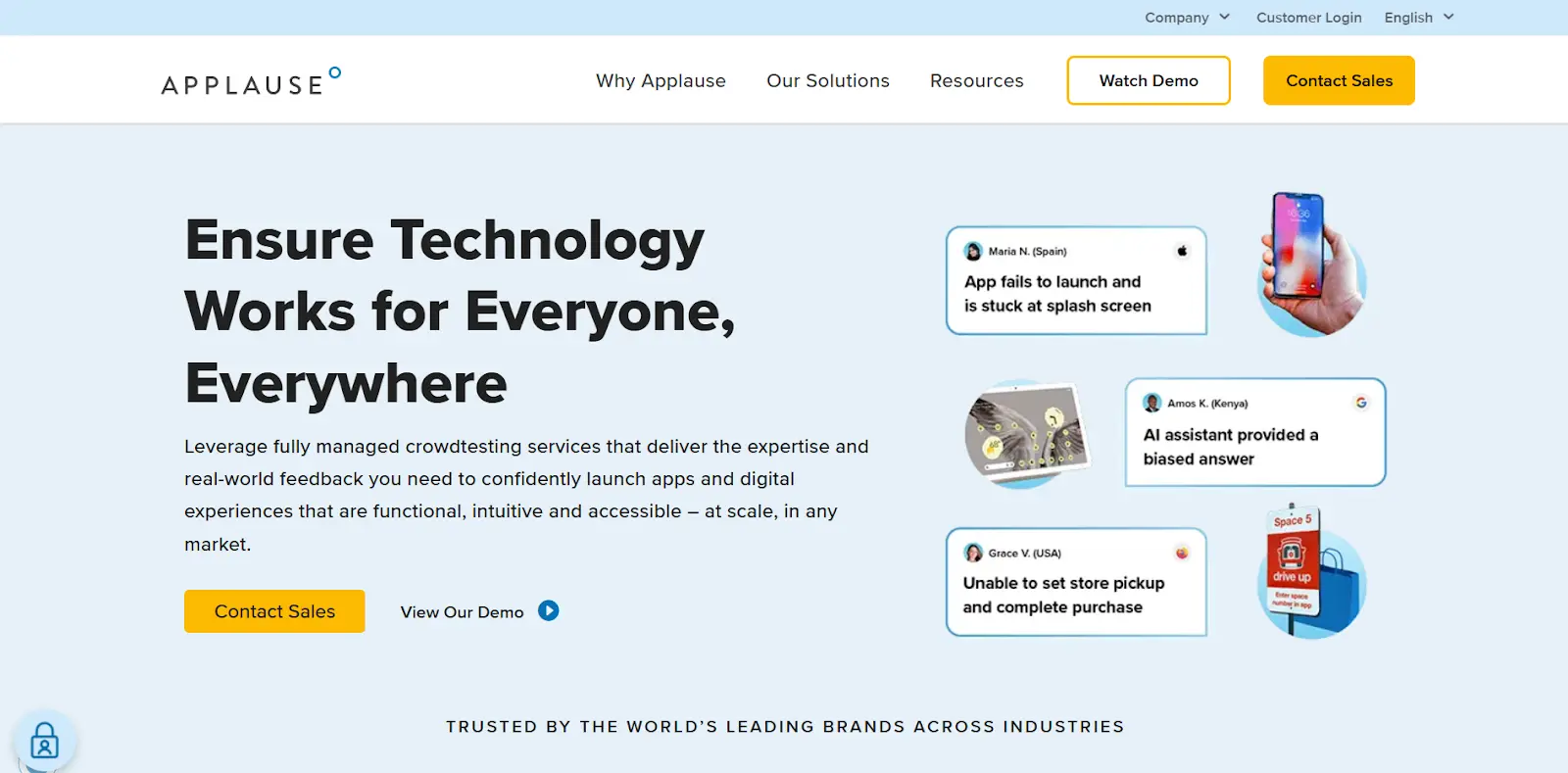
1. Applause (formerly uTest)
Applause is the largest crowd testing platform with over one million testers across 200+ countries. Fully managed model with dedicated project managers.
- Testing Coverage: Functional, payment, accessibility, localization, and IoT testing across web and mobile.
- Security Controls: Enterprise-grade NDA enforcement, SOC 2 compliance, restricted build distribution.
- Integrations: Jira, Slack, and CI/CD pipelines.
- Clients: Google, Ford, Fox, Dow Jones.
2. test IO (by EPAM)
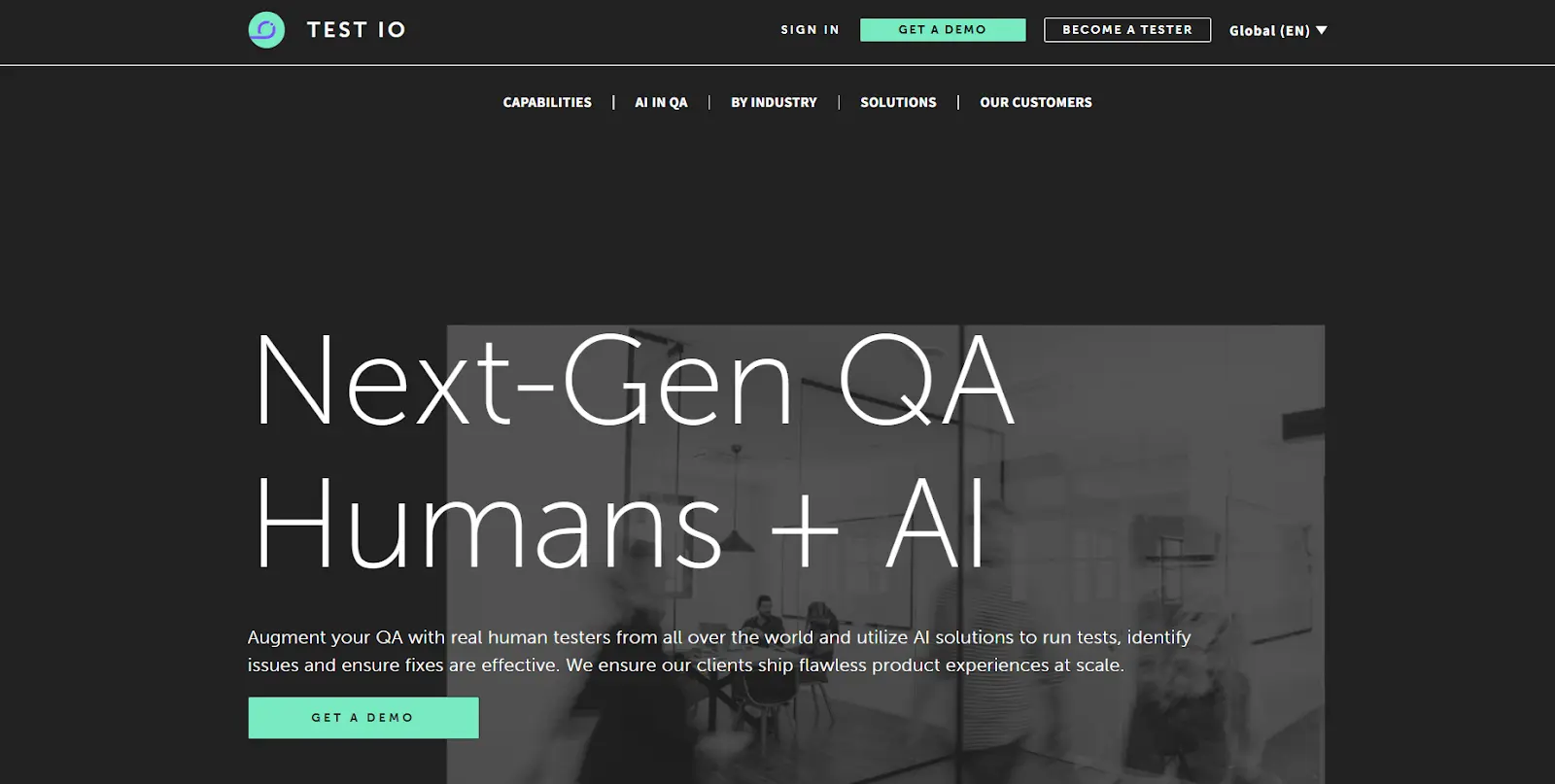
test IO focuses on rapid, on-demand bug detection with fast turnaround. Built for Agile and DevOps teams that need crowd testing inside sprint workflows.
- Tester Quality: Performance-rated testers auto-assigned to each engagement based on quality scores.
- Integrations: Native Jira, GitHub, and CI/CD integration for direct bug-to-backlog workflows.
- Bug Reporting: Structured exploratory testing with dev-ready bug reports, screenshots, and device metadata.
3. Testbirds
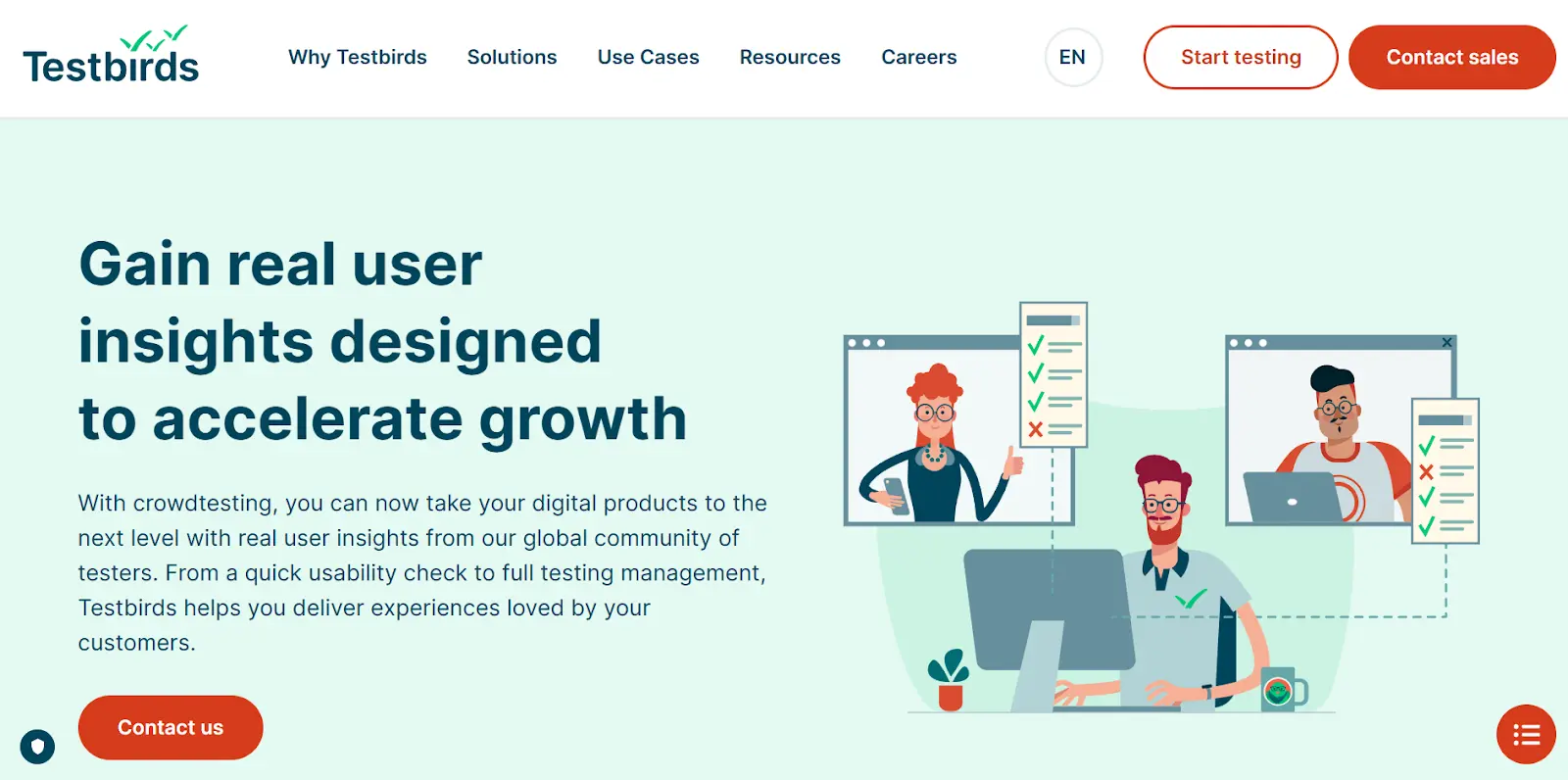
- Journey Testing: Customer Journey Testing across online and offline touchpoints.
- Accessibility: European Accessibility Act (EAA) compliance testing.
- Language Testing: Chatbots, voice assistants, and conversational AI.
- Clients: BMW, Audi, Deutsche Telekom, Allianz.
4. Global App Testing
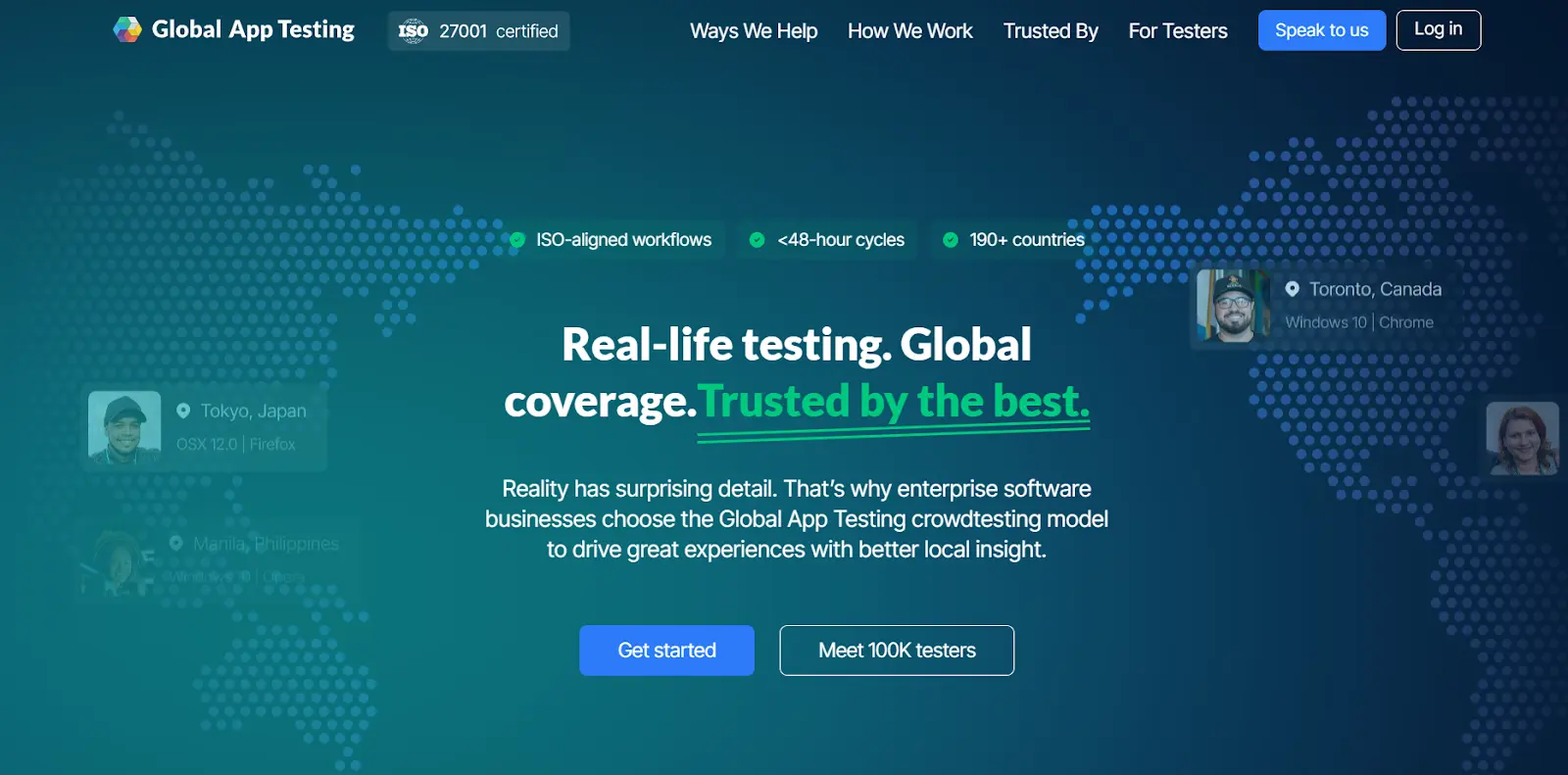
Global App Testing operates in 190 countries, blending autonomous technology with human testers. Built for speed with direct CI/CD integration.
- Delivery Models: Fully managed and co-managed models for flexible oversight.
- Autonomous Layer: Autonomous testing augments human testers for faster issue detection.
- Focus: Real-world mobile and web application testing.
- Clients: Microsoft, Meta, Google, Canva.
The right platform depends on your team size, release cadence, and how much vendor management you need.
How Does Crowdsourced Testing Fit into a Modern QA Strategy?
Crowdsourced testing is the real-world validation layer between automated regression and production release. It does not replace automation or in-house QA. Each layer covers a different failure type.
What Does Each Testing Layer Own?
A modern QA strategy operates across three layers: in-house QA for product logic, automated regression for build stability, and crowd testing for real-world validation.
- In-House QA: It owns test strategy, product logic, security-sensitive flows, and the automation suite. This team defines release criteria, writes regression scripts, and makes the final call on whether a build ships.
- Automated Regression: It owns speed and consistency. It runs thousands of test cases across browser and OS combinations on every build and returns a pass/fail signal within the CI/CD pipeline. It only validates what it has been scripted to check.
- Crowd Testing: It owns real-world unpredictability. Real testers on real devices catch what scripted tests cannot, such as gestures that fail on specific screen sizes, payment flows that break in specific regions, and localization errors only a native speaker would catch.
Where Does Crowd Testing Sit in the Pipeline?
Crowd testing starts after automated regression confirms build stability and runs as the last validation step before the release decision.
- Unit and Integration Tests: These run on every commit. They validate individual components and module interactions at the code level.
- Automated Regression: It runs after unit and integration tests pass. It confirms existing features work across supported browsers, OS versions, and device configurations.
- Crowd Testing: It runs after regression tests passes. It distributes the build to real testers across geographies, devices, and network conditions to surface issues that lab environments miss.
- Release Decision: It is the final gate. If crowd testing surfaces critical defects, the cycle loops back to fix, regress, and re-validate.
How Does Regression Validation Work After Crowd Testing?
After a crowd testing cycle, the development team receives a high volume of bug reports that need triage, prioritization, and fixes. Each fix then requires regression tests to confirm it resolves the reported issue without breaking existing functionality. The speed of this regression loop determines whether the next release ships on schedule.
- Sequential Execution on Traditional Grids: It runs regression tests one after another across shared grid infrastructure. Network latency, queue wait times, and resource contention add days to the post-fix validation loop.
- Parallel Test Orchestration: It distributes regression tests across isolated environments simultaneously. Results return in hours instead of days.
Running regression tests sequentially on traditional grids after a crowd testing cycle is the most common bottleneck in pre-release QA workflows.
This delays fix validation, pushes release timelines, and reduces the overall ROI of crowd testing. To solve this, TestMu AI offers HyperExecute, an AI-native test orchestration platform that accelerates test execution by up to 70% faster than traditional testing grids.
It runs tests in isolated, unified environments that place test scripts and all components together, eliminating network latency and matching local execution speeds. Key capabilities include:
- Smart Test Distribution: Matrix and Auto-Split strategies intelligently distribute tests across available resources, maximizing parallel execution and minimizing idle time.
- Flaky Test Detection: It identifies flaky tests with failure frequency analysis and retries failed tests automatically with configurable retry logic, so teams debug actual bugs instead of infrastructure noise.
- CI/CD Integration: Native integration with Jenkins, GitHub Actions, GitLab CI, Azure DevOps, CircleCI, and 14+ tools with real-time status updates to dashboards and pull requests.
To better understand how to set parallel regressions for your pipeline, you can explore our documentation guide on getting started with HyperExecute.

What Should You Look for When Choosing a Crowd Testing Vendor?
Evaluate vendors on tester vetting, device reach, security controls, report quality, and tool integration.
The difference between a high-signal testing partner and a noisy, unmanaged crowd comes down to how the platform recruits, manages, and maintains its tester community.
1. Tester Vetting and Quality Control
Look for platforms that screen testers through technical assessments, maintain ongoing quality scores, and have low acceptance rates. Under 10% acceptance is a strong indicator. Vetted communities produce significantly higher signal-to-noise ratios than open-access crowds.
2. Device and Geographic Reach
Confirm the platform can match your target audience in device types, OS versions, and geographic regions. If your users are primarily in Southeast Asia on mid-range Android devices, a platform skewed toward North American iOS testers will not serve your needs.
3. Security and Compliance
Evaluate NDA enforcement, data handling practices, build distribution controls, and certifications (ISO 27001 is a strong baseline). For regulated industries like finance or healthcare, verify the platform supports your specific compliance requirements.
4. Reporting and Integration
Bug reports should include structured fields: steps to reproduce, expected vs actual behavior, device metadata, screenshots, and video. The platform should integrate with your existing tools (Jira, Slack, CI/CD).
5. Managed vs Self-Service Models
Some platforms offer fully managed services with dedicated project managers handling tester coordination, scope refinement, and result curation. Others provide self-service crowd access. If your QA team is small, a managed model reduces operational burden significantly.
Conclusion
Crowdsourced testing extends your QA reach across real devices, real networks, and real users without scaling your team. It works best when paired with a defined scope, a vetted platform, and a structured bug review process. Use it to close the coverage gaps your in-house team cannot reach alone.


Frequently asked questions
Did you find this page helpful?
More Related Hubs
TestMu AI forEnterprise
Get access to solutions built on Enterprise
grade security, privacy, & compliance
- Advanced access controls
- Advanced data retention rules
- Advanced Local Testing
- Premium Support options
- Early access to beta features
- Private Slack Channel
- Unlimited Manual Accessibility DevTools Tests