

Next-Gen App & Browser Testing Cloud
Trusted by 2 Mn+ QAs & Devs to accelerate their release cycles


Smoke Testing vs Sanity Testing: A Comparison
Confused between smoke testing vs sanity testing? This blog dives into the differences & helps you choose the right testing approach.

Nazneen Ahmad
December 24, 2025
Sanity test and smoke test are the terms that are used interchangeably, but they hold significant differences. Smoke testing is generally the first level of testing performed after a new build is available.
If the smoke tests pass, indicating a baseline level of stability, then sanity testing can be conducted to delve deeper into specific changes. It is crucial that you understand the key difference between smoke testing vs sanity testing so that the right test strategy can be applied while performing software testing.
What Is Smoke Testing?
Smoke testing, also known as Build Verification Testing (BVT), is an initial testing stage that validates the proper functionality of crucial features within a software application. It is executed when a significant modification in the code, like introducing a new feature, ensures the application’s core workflows function correctly. In simple terms, we ensure that the critical features of software applications are functional and that there are no significant issues in the code under test.
The main goal is to check if the essential parts of the software work. It helps teams avoid spending time on broken builds. If basic functions fail, deeper testing is not needed. This saves time and effort, making sure only stable versions go for further testing.
Example of Smoke Testing
Let’s take an example of developing an eCommerce website and how smoke testing is implemented.
- Scenario: Building a new eCommerce site.
- Smoke Test: User registration, login, product browsing, and shopping cart functionality.
- Execution: Navigate the homepage, register, login, browse categories, add items to the cart, and initiate checkout.
- Outcome: Identify critical issues early (crashes, non-functionality), stop testing if major problems exist, and inform developers of quick fixes.
- Benefit: Simple test ensures basic stability.
What Is Sanity Testing?
Sanity testing checks if small code changes work without causing new issues. It helps confirm that bug fixes or new features are stable. This test focuses only on specific functions, not the whole application. It is usually done before a quick release, like a critical bug fix.
The goal is to see if key features still work after changes. It helps find defects fast and decides if more testing is needed. If the test fails, the build goes back for fixes, saving time and effort.

Example of Sanity Testing
Imagine you’re working on a CRM system’s initial build. Core functionalities like email integration and task tracking are implemented. After development, testers perform sanity tests. These tests focus on verifying the most critical functions, such as:
- Customer information management: Can you seamlessly create, edit, and view client information?
- Task tracking: Can you effectively assign tasks, set deadlines, and track progress?
If these initial sanity tests pass, the team moves to the next development stage.
- New feature and regression prevention: Let’s say a calendar synchronization feature is added in the next build. It’s crucial to ensure this new feature doesn’t disrupt existing functionality. Here’s where sanity testing helps:
- Testers re-run sanity tests specifically on customer information management and task tracking.
- This targeted approach helps confirm the new calendar synchronization feature hasn’t negatively impacted the CRM’s core functionalities.
- Bug fix validation: Sanity testing isn’t just for new features. Suppose a bug is identified later, like an issue with assigning tasks. After the development team fixes the bug, sanity testing becomes vital again:
- Testers run sanity tests on task assignments to validate the fix.
- This ensures the bug is resolved without introducing new complications.
Smoke Testing vs Sanity Testing: Key Differences
Smoke testing and sanity testing are required to test the core functionality of the software applications and to determine when the build is suitable for further testing. However, they are not the same.
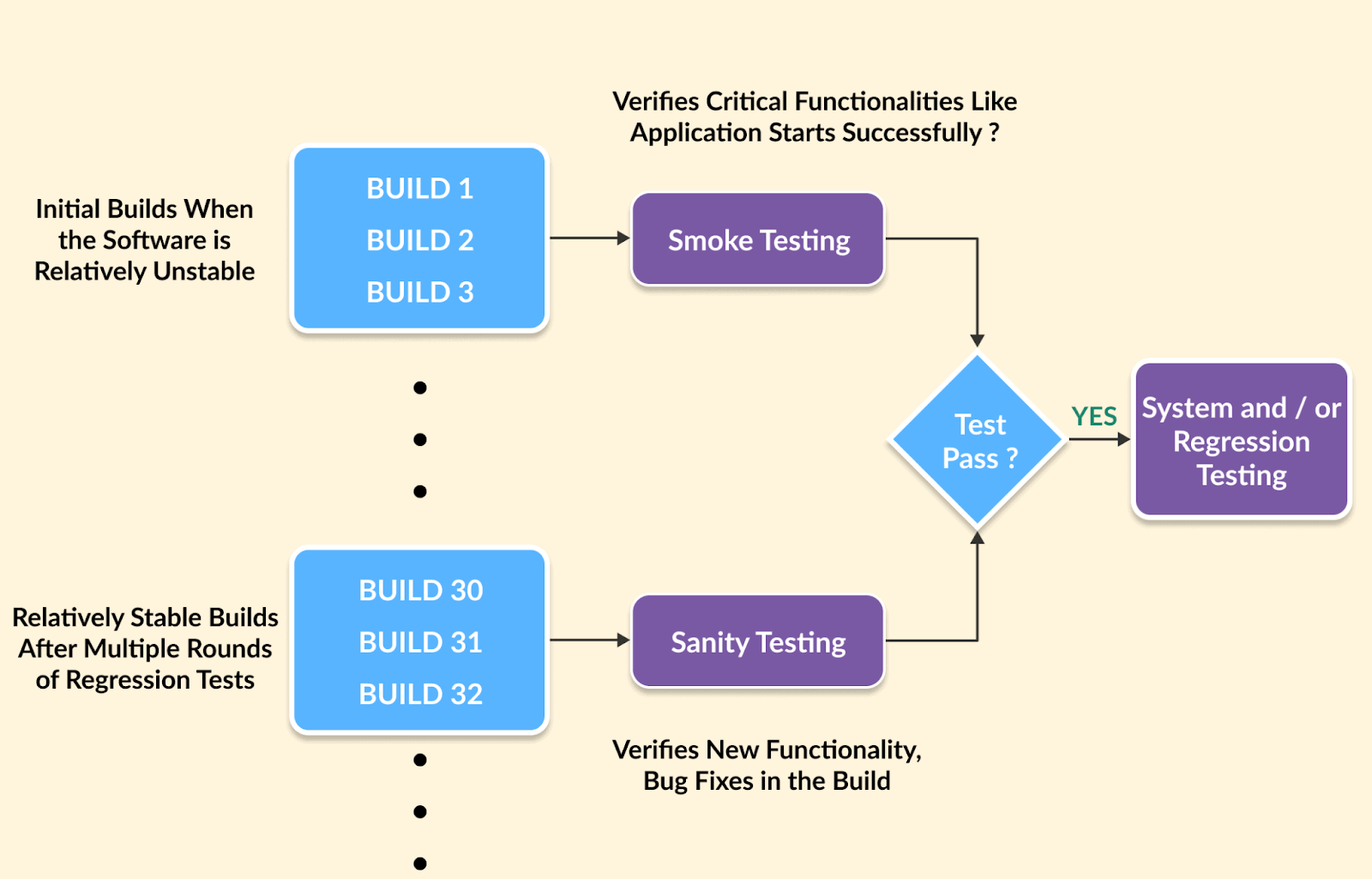
Want to understand the difference between smoke testing vs sanity testing? Here are the key distinctions between them:
| Parameters | Smoke Testing | Sanity Testing |
|---|---|---|
| Goal | The primary objective of smoke testing is to confirm the overall stability of the software. | Sanity testing focuses on ensuring the correctness of specific functionalities in the software. |
| Performed By | Smoke testing is conducted by both software developers and testers. | Sanity testing is exclusively performed by testers. |
| Purpose | Smoke testing aims to verify the critical functionalities of a system to ensure it is ready for more in-depth testing. | Sanity testing aims to confirm the functionality of specific new features, such as bug fixes. |
| Subset Relationship | Smoke testing is a subset of acceptance testing. | Sanity testing is a subset of regression testing. |
| Documentation | Smoke testing involves documented or scripted test cases. | In contrast, sanity testing is not documented. |
| Verification Scope | In smoke testing, the entire system is verified from end to end. | Sanity testing focuses on verifying only a particular component of the system. |
| Focus | The main focus of smoke testing is on critical functionalities that should work flawlessly. | Sanity testing zeroes in on newly added functionalities and resolves specific issues. |
| Build Stability | Smoke testing may be conducted on both stable and unstable builds. | Sanity testing is typically performed on relatively stable builds. |
| Build Stage | Smoke testing is usually carried out on initial builds. | Sanity testing is conducted on relatively stable builds. |
| Testing Type | Smoke testing is a part of basic testing. | Sanity testing is considered a component of regression testing. |
| Frequency | Smoke testing is generally performed with every new build release. | Sanity testing is strategically planned when there is insufficient time for in-depth testing. |
| Functionalities Coverage | Smoke testing covers the basic end-to-end functionalities of the entire system. | Sanity testing focuses on specific modules where code changes have been made. |
Furthermore, you can leverage the potential of smoke and sanity testing with AI-native cloud testing platforms like TestMu AI. With access to a remote test lab with 5000+ devices and browser versions, it supports seamless test execution using various test automation frameworks, such as Selenium, Playwright, Cypress, Appium, and more.
In a cloud-based environment, sanity and smoke tests offer benefits such as reducing infrastructure costs, providing scalability for automated tests, fostering team collaboration, and allowing flexibility in the test environment.
Understanding Smoke Testing
Here is a brief overview of advantages of smoke testing, when you should perform it, how it works, challenges along with best practices.
Advantages of Smoke Testing
Some of the advantages of smoke testing are as follows:
- Smoke testing verifies build stability for further testing.
- Early bug detection saves time when fixing critical issues.
- Improved software quality by weeding out major issues early.
- Reduced risk of failures later in development.
- Faster time to market by catching bugs early.
- Smoke tests can be conducted frequently due to minimal resource requirements and simple processes.
- Offers flexibility with manual, automated, and hybrid approaches.
When Should You Perform Smoke Testing?
Smoke testing is performed when new software features are built and integrated with the existing ones to ensure seamless functionality of software applications. It happens when developers deliver a fresh build to the QA teams.
However, smoke testing is not restricted to the initial stages of a new project; even when adding new modules to existing functionality, smoke testing must be executed. Thus, you should run a smoke test when the new build is deployed and if any changes are made during the software development process. This allows us to check whether all critical functionalities of the software are working and stable simultaneously.
The next section of this blog on smoke testing vs sanity testing will look at how smoke testing works.
How Does Smoke Testing Work?
Smoke testing is performed by QA testers when the software developers give them a new build after following a code review. It is mainly done through manual or automation approaches through pre-existing test scripts.
Upon successfully completing the smoke test, the software is integrated into an existing build within the QA and staging environment. Subsequently, the software build advances to more rigorous tests, including unit and integration tests. Failed smoke tests signal critical issues that require developer attention before further investment in testing.
A general procedure for conducting a smoke test can be outlined as follows:
- Decide on the testing approach: Choose between manual, automated, or a hybrid testing method. Typically, manual testing is the initial preference, and automated tests are introduced as more elements are incorporated into the smoke test.
- Prepare for the tests: Define the scope and objectives, select high-priority test cases, and ensure the testing environment is appropriately configured.
- Develop testing scenarios: QA testers must determine the number of test cases required for each core software feature. Establish pass or fail metrics based on software and organizational requirements and standards.
- Write the smoke tests: Utilize manual or automated processes to write and create the test suites. Develop concise and targeted test cases, prioritize them based on criticality, and document the necessary test data for execution. Given the focus on core features in smoke testing, ensure the creation of tests essential for verifying these features.
- Execute and document tests: Run the smoke tests and establish a systematic process for recording the results of each test. This documentation can be performed manually or automated.
- Analyze smoke test results: If the software fails the smoke test, return it to the development team for further testing. If it passes the smoke test, it is deemed ready for more extensive functional testing.
Challenges of Smoke Testing
Although smoke testing is important part of the Software Testing Life Cycle (STLC), it has certain drawbacks:
- Focuses only on specific core functionalities and does not cover all aspects of software.
- Some bugs or issues may not be detected through smoke tests, with potential discoveries later in the development process.
- Manual smoke testing takes a longer time to complete, especially in larger software projects.
The next section of this blog on smoke testing vs sanity testing will have some best practices for running smoke tests.
Best Practices of Smoke Testing
Even if you carefully follow the correct procedures for running smoke tests, it’s possible that you will encounter issues. The following best practices can help you save time and effort in such situations:
- Set up the smoke test suite on Continuous Integration (CI) pipelines to automatically execute when a new build is introduced.
- Perform testing early and consistently to ensure the stability of the code build in every sprint.
- Choose the most suitable testing method based on your project’s requirements and available resources. If you have a limited budget, opting for a hybrid or automated approach may be more efficient than conducting the tests manually.
- Develop uncomplicated and direct test cases that specifically focus on the core functionalities.
- Regularly review the smoke test suite to verify its alignment with the current software requirements.
- Give significant importance to collaboration between QA teams and developers to facilitate the effective execution of smoke tests.
Understanding Sanity Testing
Here is a brief overview of advantages of sanity testing, when you should perform it, how it works, challenges along with best practices.
Advantages of Sanity Testing
Some advantages of sanity testing include:
- Validate core functions after new features, ensuring stability.
- Catch critical issues early, preventing wasted regression testing efforts.
- Fast and focused, sanity tests save development time by pinpointing issues quickly.
- Identify regressions early and keep the development process smooth.
- Act as safety checks, giving developers confidence before further investment.
- Help ensure a high-quality product by focusing regression testing on new areas.
When Should You Perform Sanity Testing?
If compared with the smoke test, the sanity test is executed after its successful completion and approval of the smoke test by the testing team. This is because it mainly targets one or more critical functions within the tested software applications. Therefore, there are other situations as well under which the sanity test should be executed:
- When there are minor modifications in the application’s code.
- Upon adding new features that need to be integrated into the software application.
- After completing a series of regression tests and generating a new build.
- After bug fixes to ensure the software application performs as expected.
- Before the production deployment.
Determining the frequency of sanity testing in a Software Development Life Cycle depends on specific requirements and the complexity of the software application.
In the next section of this blog on smoke testing vs sanity testing, we will understand how sanity testing works.
How Does Sanity Testing Work?
Unlike other testing methods, sanity testing is more flexible. It doesn’t rely on rigid scripts or detailed test plans. Instead, testers use their knowledge and experience to quickly check core functionalities and critical features after a code change. They rely on user requirements and specifications as a guide, ensuring the software behaves as expected in these key areas.
When a developer makes a modification, the tester steps in. They act like a typical user, playing around with the software to see if anything seems off. Did the change break something important? Are there any unexpected bugs or errors? Testers keep their eyes on to check for anything unusual and document it. This feedback is then sent to the developers for fixes. This approach is particularly useful for catching major issues early on before they turn into major issues later. It’s a great way to ensure the software application stays on track after making changes.
Sanity testing, as mentioned before, is known for its adaptability. Unlike scripted tests, it doesn’t require a rigid, pre-defined plan. Testers leverage their expertise to identify potential issues in critical functionalities. They use user requirements and specifications as a guide to evaluating the core features of the application.
Following are the steps that you can follow to perform a sanity test:
- Identify changes: The first step is understanding what has changed in the new build. This could include new features, bug fixes, or software modifications. You can get this information from developers’ notes, code commits, or release documentation.
- Define scope: Based on the identified changes, determine what functionalities need to be sanity tested. Focus on critical areas and core functionalities of the software.
- Create test cases (optional): Sanity testing is often exploratory, and detailed test cases might not be necessary. However, you can create simple test cases for complex changes or critical functionalities to guide your testing process.
- Setup the test environment: Ensure you have a clean testing environment configured with the new build. This environment should mirror the production setup as closely as possible.
- Execute tests: Run your manual tests or leverage automation tools to verify the core functionalities identified in Step 2. Focus on checking whether the new features work as expected and whether the changes have not broken existing functionalities.
- Evaluate results: Analyze the test results. If critical functionalities fail or major bugs are found, the build might be unstable and require further development attention before proceeding with formal testing.

Note: Automate your sanity testing across 5000+ real environments. Try TestMu AI Today!
Challenges of Sanity Testing
Like other types of software testing, sanity testing also has certain disadvantages:
- Cover critical functionalities and missing potential issues in untested areas.
- Lack of documented tests makes it difficult to reproduce issues and track progress.
- Focus on core functions might miss regressions in rarely used features.
- Effectiveness relies on testers’ understanding of critical functionalities.
- Unscripted tests make it challenging to reuse them for future builds.
- Though faster than regression testing, sanity testing can still be time-consuming.
Best Practices of Sanity Testing
To address the disadvantages of sanity testing, you can follow below mentioned best practices of sanity testing:
- Perform sanity testing whenever there is a modification or addition to a component or when a bug is fixed.
- Focus on the essential functionalities crucial to the working of your software build.
- If you have the necessary resources, tools, and technical expertise, automating sanity tests can expedite the testing process and standardized testing methodologies.
- Always establish a test plan and review the Software Requirement Specification (SRS) of applications before undertaking sanity testing.
- Ensure that the sanity test is conducted within the framework of a test strategy. The approach is easy, allowing for the integration of thorough testing with the sanity test or regression testing to ensure the proper functioning of the software application.
Conclusion
In this blog on smoke testing vs sanity testing, we’ve explored the key differences between sanity testing vs smoke testing. Let’s summarize the key learnings. Smoke and sanity testing play crucial roles in a robust software quality assurance process, providing checks to ensure that software builds meet essential criteria for stability and correctness. They help the QA team save time by quickly assessing if an application functions correctly and determining its eligibility for further testing.
Citations
Software Testing: Smoke and Sanity: https://www.ijert.org/software-testing-smoke-and-sanity


Frequently asked questions
Did you find this page helpful?
More Related Hubs
TestMu AI forEnterprise
Get access to solutions built on Enterprise
grade security, privacy, & compliance
- Advanced access controls
- Advanced data retention rules
- Advanced Local Testing
- Premium Support options
- Early access to beta features
- Private Slack Channel
- Unlimited Manual Accessibility DevTools Tests