

Next-Gen App & Browser Testing Cloud
Trusted by 2 Mn+ QAs & Devs to accelerate their release cycles


39 Top Python Frameworks To Look For In 2026
Check out the top Python frameworks that developers and QAs can use for web development and software testing.

Nazneen Ahmad
February 8, 2026
Among various programming languages, Python is becoming the popular programming language in web development and testing due to its versatility, simplicity, and readability.
When we think of Python frameworks, many names come to our minds. This often confuses us regarding which is most appropriate for software projects. However, if we look ahead to the future, what will the popular Python frameworks be in 2025?
To clear this up, I have curated a detailed list of the most popular Python frameworks for software development and testing. You will get information on the features and benefits of these frameworks, which you should keep in mind when looking for Python frameworks.
What are Python Frameworks?
In Python, the framework is a collection of pre-written codes that gives developers a set of tools and structures to build applications efficiently. In other words, you can understand this as a collection of modules or packages that help developers build web applications. Mainly, the Python framework is a set of tools that lay the foundations for building applications, so you don’t have to start from scratch every time.
Python framework can help developers by providing the following aspects:
- Standardized structure for an application that allows easy development and maintenance.
- Pre-built libraries and tools help simplify common tasks like database management, form validation, and user authentication.
- Security and performance, as many frameworks are designed with security and scalability in mind.
A Python framework can be either full stack, asynchronous or micro. However, before digging into the Python framework in detail, I will briefly introduce them in the below section.
Type of Python Frameworks
Python frameworks are divided into three main categories that define its specification. Here are those three Python frameworks explained.
Full Stack Framework
It comprises all web development requirements and offers all-in-one solutions. This indicates that a full-stack framework provides all features and tools needed to build web applications from start to finish. For example, it includes form generators, form validation, template layouts, and many more. Basically, this provides everything required to develop a web application, like a template engine, ORM, and admin interface.
Some popular Full-Stack Python frameworks include Django, Web2py, CubicWeb, Giotto, FastAPI, Pylons framework, TurboGears, BlueBream, and Websauna.
Micro Framework
It is a lightweight framework used for minimalistic web application development because it provides only the bare essentials needed to build them. For example, routing, request and response handling, and HTTP protocol support. Hence, this provides developers with only a minimum set of functionalities, allowing them to build lightweight and fast web applications.
Unlike a Full-Stack framework, it does not provide additional features like database abstraction, form validation, etc. However, it requires more manual work from developers. This includes manually adding other code and requirements or using third-party libraries and tools to implement the desired functionality. If you take this in a different sense, using microframework, you get more flexibility and customization options because of more control over their code.
Some popular Micro Python frameworks include Flask, Dash, Falcon, MorePath, Pycnic, and Hug.
Asynchronous Framework
Asynchronous Python frameworks allow developers to write asynchronous code, meaning the code can execute multiple tasks simultaneously without blocking other tasks. It is designed to handle a large set of concurrent connections and processes, which means managing multiple requests simultaneously without blocking the program’s execution. Using this framework, developers write codes that can be run concurrently, enabling faster and more efficient data processing.
It utilizes the asyncio library in Python, which provides a way to write asynchronous code using coroutines and event loops. Some popular Asynchronous Python frameworks include Sanic, AIOHTTP, Growler, and Tornado.
Why use Python Frameworks?
When you develop web applications or mobile apps, there are the majority of redundant operations like handling HTTP requests and responses, routing, database interactions, user authentication and authorization, input validation, and others. You always want a framework that can save time and effort in software application development. This is possible by leveraging pre-built tools and components of Python frameworks.
Python frameworks allow developers to reuse code for different tasks like HTTP operations, etc. Hence, you don’t have to re-write the code from scratch, making the development process quick and efficient.
It is easy to use Python frameworks to build and maintain software applications because it is structured in a way that allows modularity and code organization. Some standard structure features include MVC architecture, middleware, and configuration. This makes it easier for developers to understand and maintain the codebase, even as the application scales.
Below, I have curated an exhaustive list of the best Python frameworks for web development and automation testing so that you get all information in one place.
Python Frameworks for Automation Testing
Python testing frameworks are a crucial part of the web application development process that helps in testing your code to ensure it gives correct functionality.
When it comes to choosing Python frameworks for testing, you have to consider the key information that defines its specificity. For example, you should look for its ability, script quality, simplicity of test cases, and other factors.
Robot
Robot Framework is an open-source test automation framework that simplifies writing test cases and makes them more readable and clear based on the keyword-driven approach. The thing that makes it one of the most popular Python frameworks is its specificity for acceptance testing, acceptance test-driven development, behavior-driven development, and robotic process automation.
Further, the use of tabular syntax to write test cases and a large ecosystem of libraries and tools also make it a popular choice for test automation. When you use the Robot Framework, you should also know that although it is based on Python, it works seamlessly with Jython and IronPython (.net based).
This diversifies its ability to test your code. All you need is to install Python version 2.7.14 or higher, install the Python package manager (pip), and download development frameworks like PyCharm Community Edition.
GitHub: 10.3k Star and 2.4k Fork as of March 2025.
Key features of Robot Framework
- It is built on a keyword driven testing approach, which helps the tester to write test cases utilizing understandable keywords. You don’t need to have any coding experience to get started with Robot Framework.
- Provides simple, understandable syntax which is easy to use for test data. This allows testers to create and maintain test cases. It is possible to write test data in plain text, CSV, and HTML.
- Supports testing of all types of applications, including desktop applications, mobile applications, and web applications across all crucial platforms and OS like Linux, Windows, and macOS. This shows its cross-platform feature that makes it highly versatile.
- Provide very easy-to-read and understandable test reports that help identify issues or errors and get them to troubleshoot. Generally, XML and HTML formats are used for generating test reports which can also be customized.
- It is highly extensible and allows testers to create custom keywords and libraries that can be shared across multiple web development projects. Its extensibility is also witnessed by the availability of numerous APIs that help extend its functionality to meet the specific needs of the projects.
- It supports various built-in test libraries and tools that help in web testing, database testing, and API testing. Some examples of supported libraries are SeleniumLibrary, AppiumLibrary, and DatabaseLibrary. Some supported tools are Robot IDE, RIDE, Test Data Editor, etc.
- It has strong and active community support of developers and users. This ensures that Robot Framework is evolving and improving daily with changes in software technologies to meet the users’ needs.
pytest
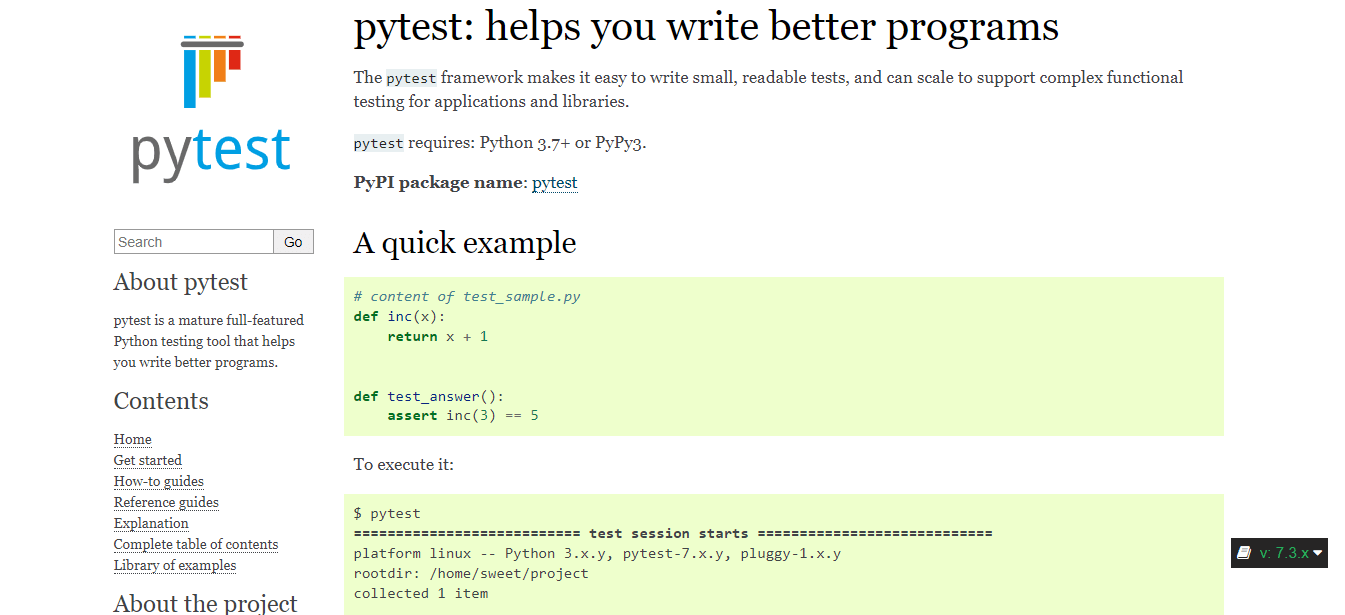
pytest is one of the most widely used Python frameworks, which is open source and supports unit testing, functional testing, and API testing. It is easy to use and learn, which also extends to be utilized for individual practice groups and open-source projects. This is possible by its simple and intuitive syntax that allows easy writing and running of automation tests.
All you need is to install Python version 3.5 and above.
GitHub: 12.5k Star and 2.8k Fork as of March 2025.
Key features of pytest:
- Supports plugins like pytester to help you write tests for plugin code. Pytest HTML plugin is the most used one to generate HTML reports for test results.
- Provides built-in assertions method that allows writing clear test assertions.
- Supports parameterization in pytest, which means running the same test with different sets of parameters is possible.
- It has simple and intuitive syntax for writing tests where plain assert statements are used rather than complex assertion methods. This makes test code easy to read.
- Fixtures are functions that can be called before each test to provide setup data and after each test to clean up resources. pytest has a fixture mechanism allowing the management of test data and resources.
- It has a large community of developers and users that supports and contributes to the framework in terms of adding new features and bug fixes.

Behave
Behave is considered one of the best Python frameworks for testing, which is particularly useful when it comes to Behavior-Driven Development (BDD). It is an Agile development method that helps developers, stakeholders, and quality analysts work together. When you use Behave, it is easy to execute BDD without any hurdles. It is very much similar to Cucumber.
When using Behave, all test scripts are created in simple language and then added to the running code. It enables the reuse of previously defined steps in other use-case scenarios. To start with the Behave framework, you need to install Python 2.7.14, pip and set up PyCharm.
On a side note, you can automate your Selenium BDD test suites on a scalable TestMu AI cloud grid with Behave framework.
GitHub: 3.3k Star and 650 Fork as of March 2025.
Key features of Behave:
- It uses a domain vocabulary for defining system behavior and semi-formal language. This ensures that everyone on the team uses consistent terminology to explain the system’s behavior.
- It uses semi-formal language to describe system behavior. With this feature, you can communicate with each other and the manager to better understand what is being developed.
- Provide a set of building blocks that can be used to execute different ranges of test cases. With this, you can work on multiple modules and coordinate team efforts effectively.
- All the test specifications (or specs) are written utilizing a similar format. No matter who is writing the specifications or which modules are being tested, the specs will have consistent structure and format to have better clarity on the output of developers and QAs.
Lettuce
Lettuce is another one of the popular Python frameworks for BDD, based on Cucumber. The primary intention of Lettuce is to focus on tasks of Behavior-Driven Development. This makes the process of defining scenarios, automating the test execution, and generating reports on the results simple and easy.
GitHub: 1.3k Star and 322 Fork as of March 2025.
To get started with Lettuce, you need to set up Python 2.7.14 and above, install PyCharm or a similar IDE, and use the package manager for Python.
Key features of Lettuce:
- Developers using Lettuce can program in multiple scenarios (different inputs and expected outputs for different scenarios) and define its features in a simple language.
- It enables coordination between team members involved in developing software applications, which is very similar to the Behave Framework.
- It uses Gherkin language for defining scenarios that create a shared understanding of the behavior of their application with other stakeholders.
- It is a useful framework specifically for black box testing that enables testing without any knowledge or idea of its internal working. Lettuce uses natural language to define scenarios that help testers create tests and verify the behavior of the software application from the end-users’ perspective.
Doctest
Doctest is a built-in module in the Python programming language’s standard library. Using doctest allows the developers and testers to create tests based on the output of the Python interpreter shell. This indicates that developers can write test cases by giving input values and then enable a robust comparison of actual output with the expected output.
While testing, developers need to cut and paste the test cases in the docstrings of Python code. The doctest module will then automatically extract the test cases and allow its run to verify the output matches the expected result.
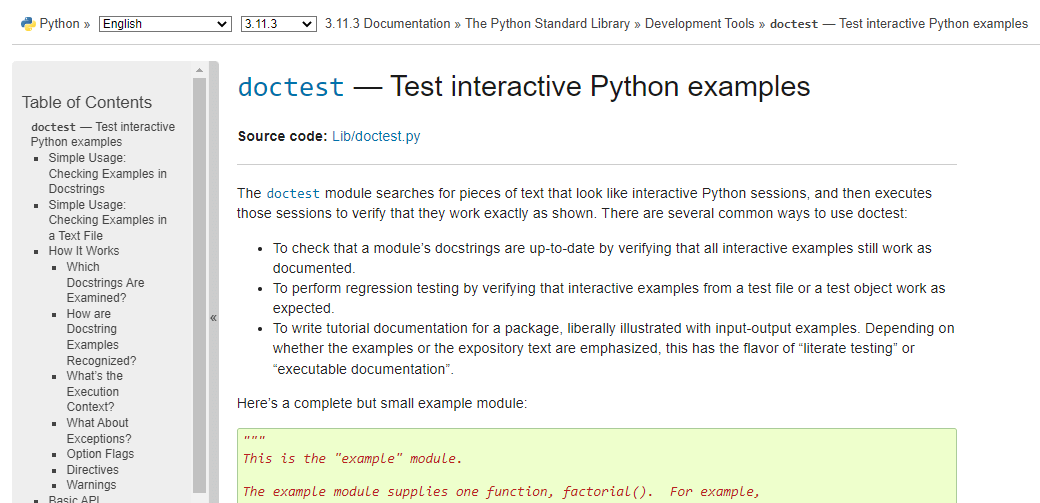
GitHub: 6.1k Star and 653 Fork as of March 2025.
Key features of doctest:
- The use of doctest for testing web applications is very easy because it is part of the Python standard library, and there is no need to install any additional packages.
- It allows developers to have detailed documentation of their code, which comprises examples of how to use the code.
- The documentation is written in the form of docstrings positioned in the initials of the Python function or module.
- Tests are written in the docstring of the code, which allows frequent code change over time.
- It can be integrated with test runners, including pytest and unittest.
- It is not possible to parameterize as it is static.
Nose2
Nose2 is the replacement for the nose framework. It extends PyUnit beyond its functionality with its added plugins, which support test execution, test discovery, fixtures, decorators, and parameterization.
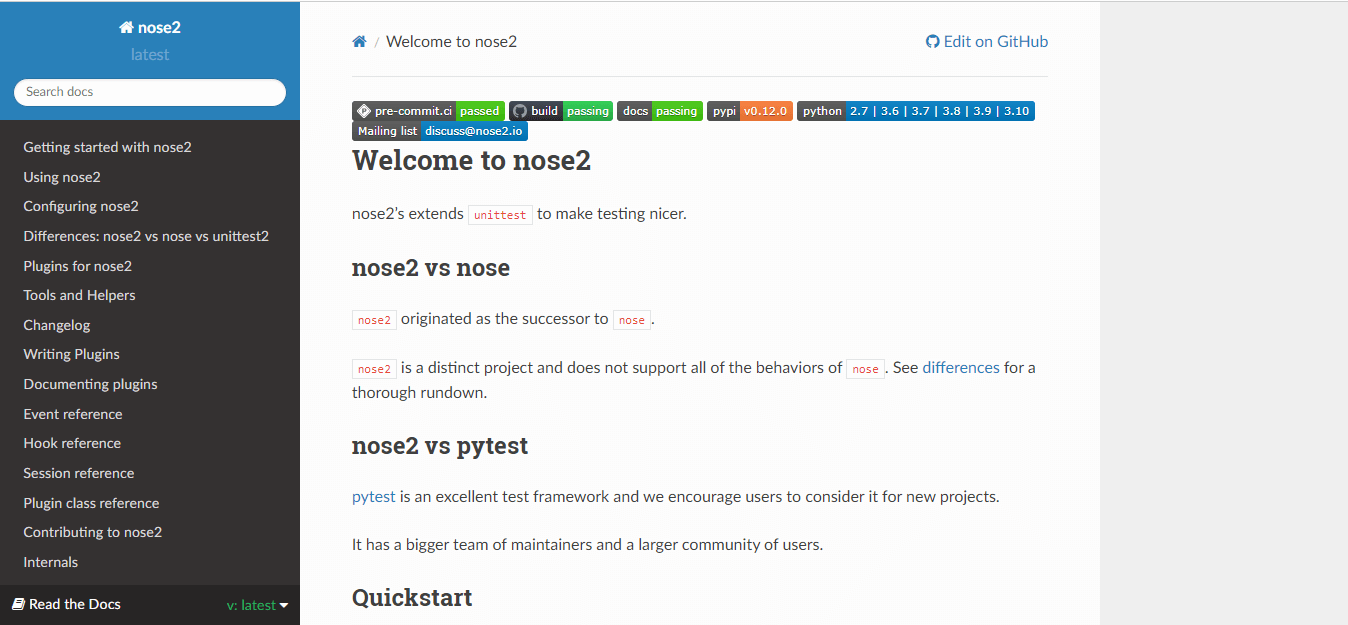
GitHub: 800 Star and 131 Fork as of March 2025.
Key features of nose2:
- It is easy to use as it is built on the PyUnit framework, which stands out of the box with the Python library.
- It gives many built-in plugins, including coverage plugins, logging plugins, parametrize plugins, skip plugins, xUnit plugins, and profiling plugins.
- The plugin features of nose2 add aspects of coverage reporting, test discovery, and others.
- It enables parallel testing with the use of a multiprocessing plugin.
- It can automatically discover and run all tests related to software applications without manually specifying each test.
Testify
Testify is a Python-based framework mainly used for integration and system testing. It intends to replace the unittest and nose framework and add some advanced features to it. Some of those include better support for mocking, parallel test execution, and more detailed reporting of test results.
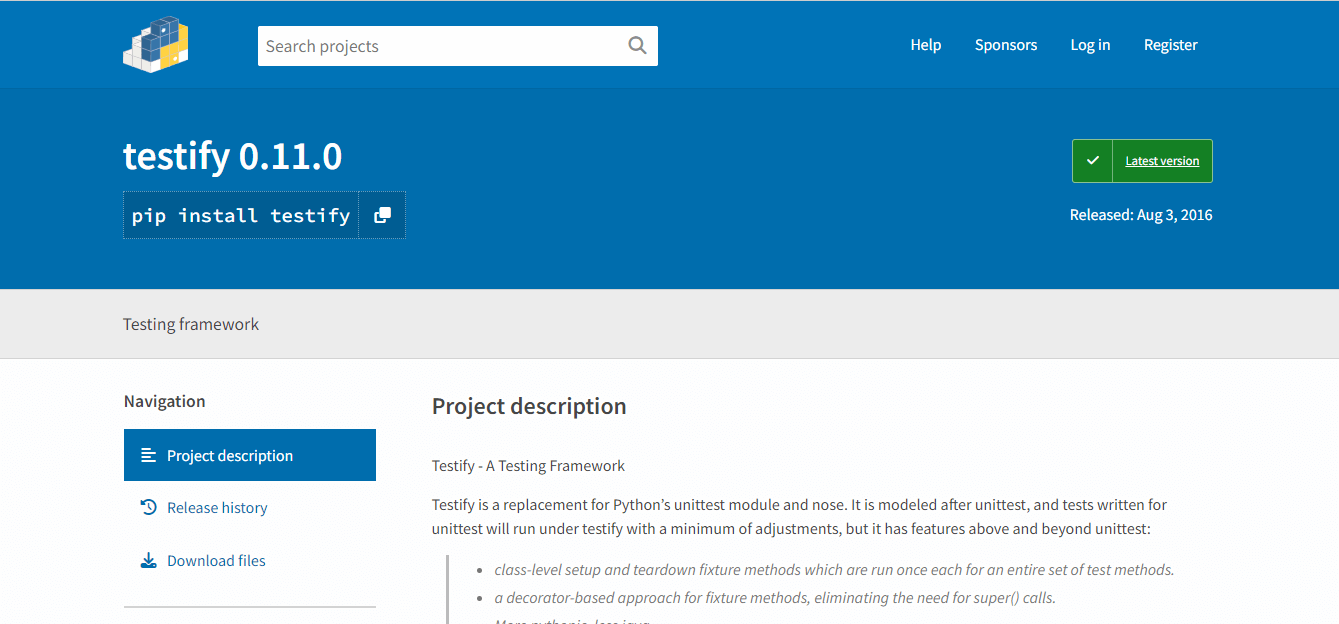
GitHub: 306 Star and 66 Fork as of March 2025.
Key features of Testify:
- It has a simple interface that eases writing and running tests.
- Provide a plugin system that allows developers to extend its functionality beyond the existing one.
- Provide built-in support for finding tests in a codebase, indicating that developers are not required to discover tests to run manually.
- Testify utilizes a simple and intuitive syntax for defining tests, thus allowing developers to write and understand test cases.
unittest
unittest is a Python-based framework modeled after JUnit. This framework is standardized and included by default with the Python package. It allows automated testing that helps you share code for setting up and closing out tests, organizes your tests into groups, and ensures your tests are separate from any reporting system you use. unittest is also known as PyUnit.
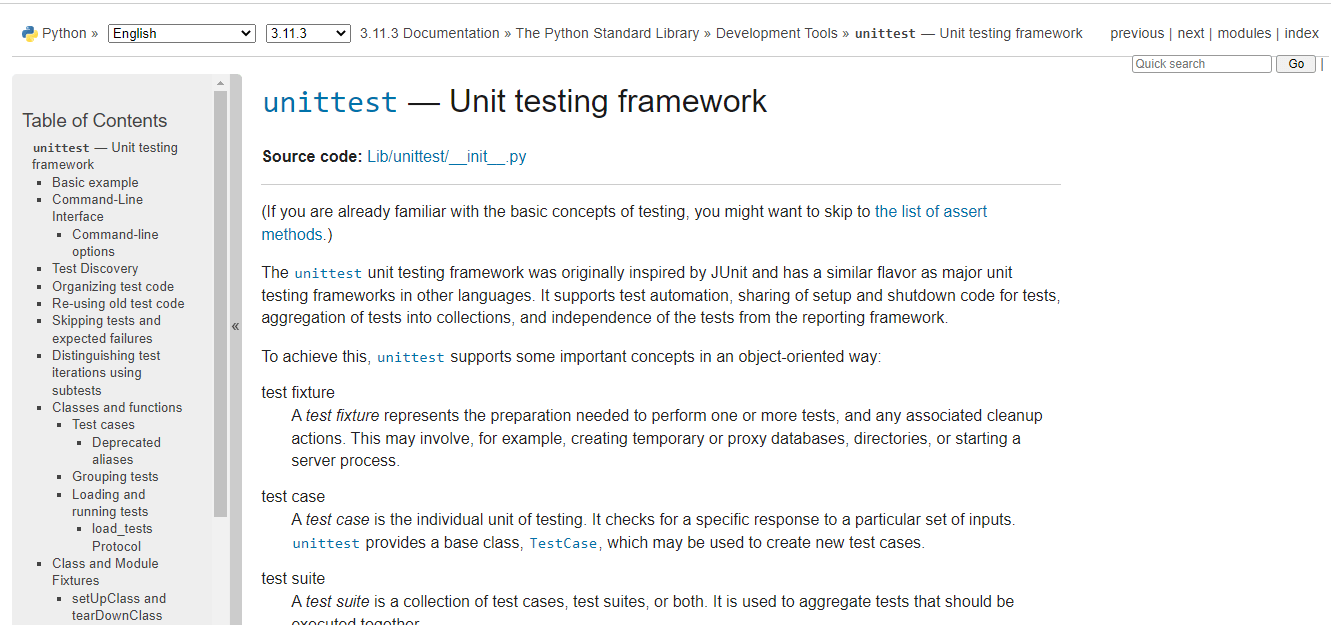
GitHub: 2 Star and 1 Fork as of March 2025.
Key features of unittest:
- Provide an easy-to-use interface to write and execute test cases and allows developers to create tests for their code.
- It is possible to run individual test cases simply, and there is only a need to specify names on the terminals.
- It is based on the xUnit framework, which is part of the unit testing framework inspired by JUnit. This provides easy writing and executing unit testing.
- There is no requirement to install any additional modules or packages.
- Allows generating test reports in multiple formats, including SMLUnit and XML reports.
The true capability of using the Python framework can be leveraged by testing your web application on the cloud. It provides on-demand resources that can scale up or down depending on your requirements.
AI-native test execution platforms like TestMu AI lets you perform Python automation testing on an online browser farm of real browsers, devices, and OS. It supports various Python frameworks for Selenium Python testing like pytest, Behave, Robot, unittest, Lettuce, etc., allowing you to perform tests with your preferred Python testing framework.
Visit our documentation to get started with automation testing using Python.

Note: Automate website testing using Python across 5000+ environments. Try TestMu AI Now!
Python Frameworks for Web Development
Python is a popular programming language, in addition to testing, it is also widely used for web development. What makes it the ideal choice? It is the simplicity and flexibility of the Python-based framework. There are several Python frameworks available for web development.
Here is a list of several Python frameworks for web development that will work well for you in 2025.
Django
Django is one of the most popular Python frameworks that is an open-source and high-level full-stack framework. It comprises all the required Python features and components that a developer would need to develop a web application, like database connectivity and user authentication.
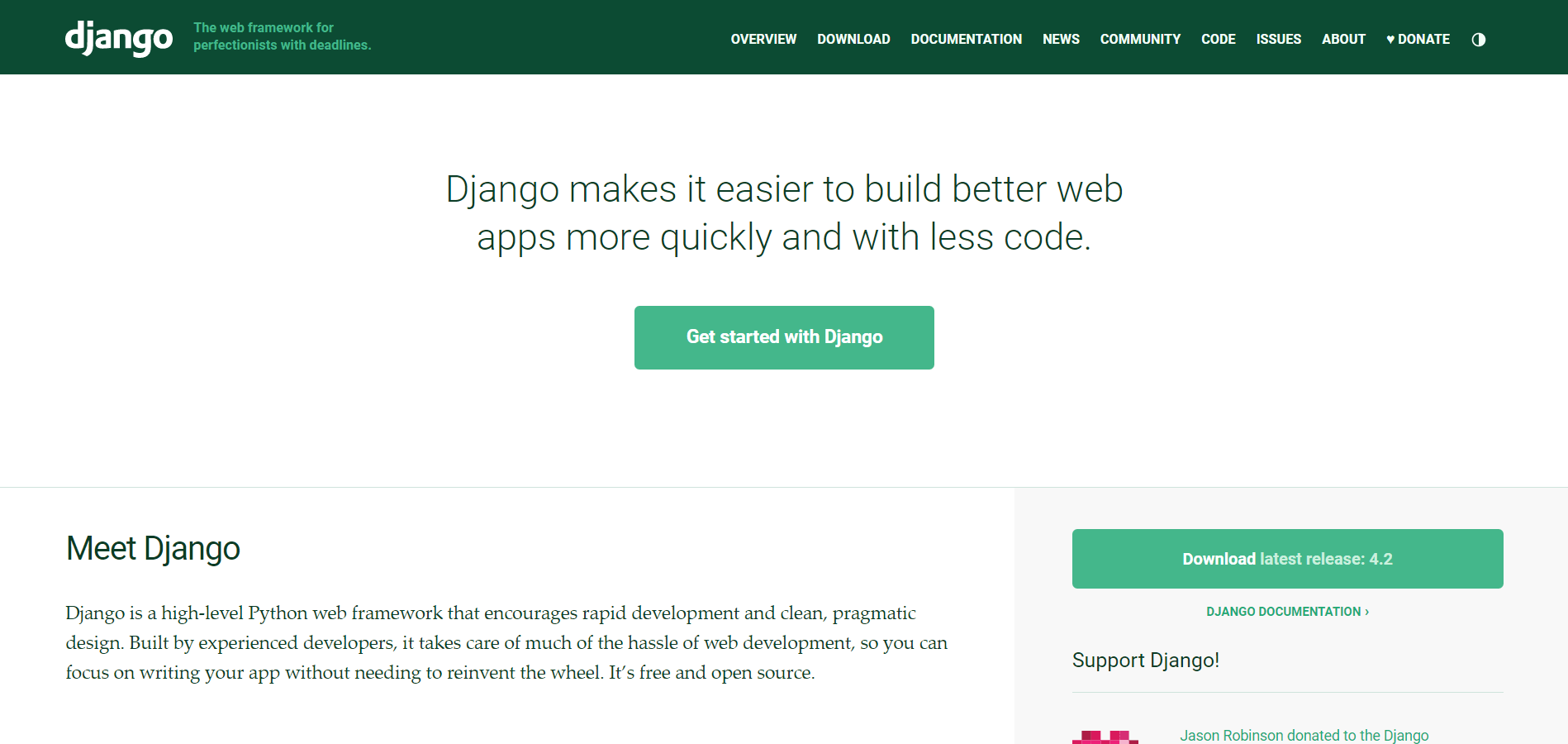
What makes Django unique and specific from other frameworks? It is the principle of DRY (Don’t Repeat Yourself) that is followed. It emphasizes the significance of reducing the duplication of codes. This helps in improving maintainability, reducing bugs, and increasing productivity.
GitHub: 82.5k Star, 32.3k Fork as of March 2025.
Key Features of Django:
- It supports rapid development and clean, programmatic design.
- Experienced developers build it and handle much of the web development complications.
- Django allows you to define URLs for your web applications and map them to the appropriate view functions and classes.
- It comes with a template engine, which allows the creation of dynamic HTML pages using a template.
- Django has a large ecosystem of third-party libraries that can be seamlessly integrated into your web applications. Using this, you can add features like user authentication and file uploads to your web applications.
- It focuses on security and has built-in protections against the common risks of web applications like SQL injection and cross-site scripting.
Web2py
Web2py is an open-source Python framework that can be run on all popular operating systems. It has a web-based IDE, including a code editor, debugger, and one-click deployment. This makes it an independent framework where development, database administration, testing, debugging, deployment, and maintenance of applications, can all be executed through the web interface.
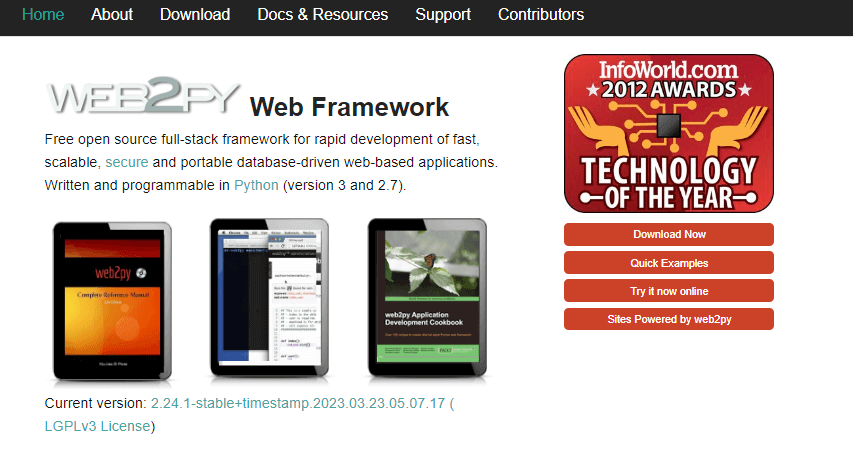
Web2py follows MVT architecture patterns that allow developers to manage their code and separate the distinct aspects of a web application into diverse layers. This helps to maintain and extend the application over time.
GitHub: 2.1k Star and 906 Fork as of March 2025.
Key features:
- It supports settlement over configuration that helps facilitate rapid web development.
- It has no configuration files and does not require any installation. Hence, it can run off a USB drive.
- Supports all major OS like Windows, Unix/Linux, Amazon EC2, Mac, and Google App Engine.
- Supports all web hosting platforms through Python 2.7/3.5/3.6/ version.
- It provides support to MVT architecture that simplifies web development.
- You can work with relational and NoSQL databases.
- It quickly communicates with SQLite, PostgreSQL, Sybase, Oracle Google App Engine, MSSQL, IBM DB2, Informix, Ingres, and MongoDB.
- Uses batteries to build various web apps without utilizing external tools and services.
- Backward compatibility in Web2py ensures that applications built with older versions of the framework can still run on newer versions without any significant issues, allowing developers to maintain and scale their applications over time without having to rewrite their entire codebase.
- It keeps web applications more secure by addressing vulnerability and security issues like Cross Site Scripting, Injection Flaws, and Malicious File Execution.
Flask
Flask is licensed under Berkeley Software Distribution (BSD), which indicates that it is free and open source. It is one of the most popular Python web frameworks classified as a micro-framework that is easy to use and lightweight. The main reason for the above is that it does not have particular libraries and tools for web application development.
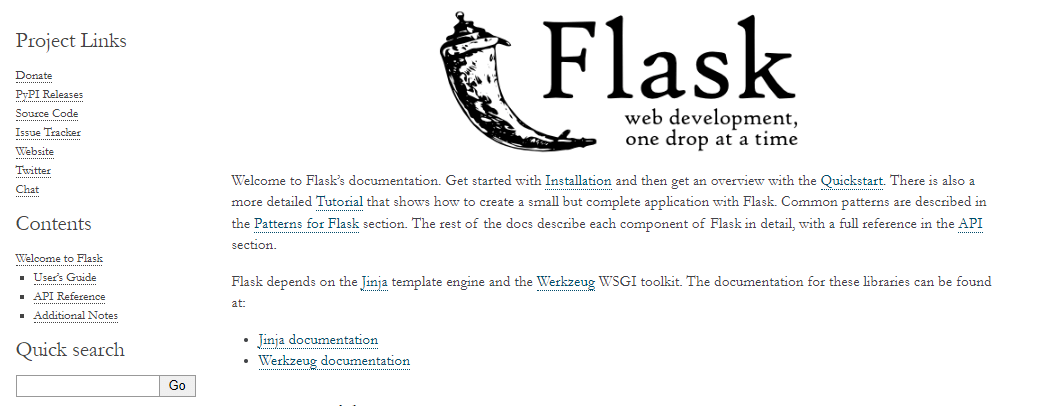
Flask has no form validation or database abstraction layers, mainly in large web frameworks. However, the common functions are provided by third-party extensions, which enable adding features to the application.
GitHub: 68.9k Star and 16.3 Fork as of March 2025.
Key features of Flask:
- It comes with a built-in debugger that helps developers to identify and fix errors in their code during the development of web applications.
- It makes use of the Jinja2 template engine. You can easily create dynamic HTML pages that involve variables, loops, conditionals, and others.
- The Unicode-based feature of Flask highlights its compatibility with it. You can handle international characters and languages without facing any issues.
- Includes built-in development servers that allow easy web application testing during its development phase.
- Provides simple API for handling HTTP requests that help to build web applications in less time with the ability to respond to user input.
- It complies with Web Server Gateway Interface (WSGI), an interface between web servers and Python web applications.
- Provides support for RESTful request dispatching and ease of creating web services and APIs.
- It is flexible and used with different Object-Relational Mapping libraries. Hence, it helps developers choose the ORM that addresses their web application project’s needs.
Bottle
Bottle is a lightweight and simple WSGI micro web framework for prototyping and building simple personal applications. It is distributed as a single file module and creates a single source file for different applications developed using the Bottle framework. There are no dependencies for developing web applications other than Python’s standard library.
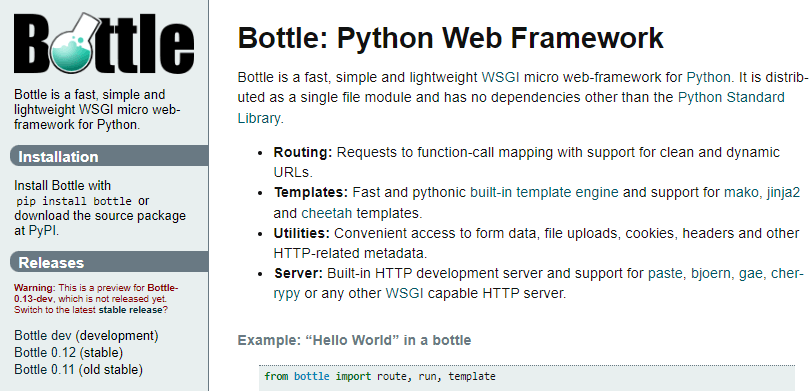
The amazing functionality of Bottle includes utilities directing, templating and fundamental abstraction. This enables developers to work closely with hardware to build personalized use apps.
GitHub: 8.5k Star and 1.5k Fork as of March 2025.
Key features of Bottle:
- Provides easy-to-use syntax for defining URL routes. This makes it simple to map incoming requests to the appropriate handler functions.
- It has a fast and Pythonic built-in template engine and supports Mako, jinja2, and Cheetah templates.
- It supports databases like MySQL, SQLite, PostgreSQL, and MongoDB through plugins. With this, you can process user input and make changes in the server response based on user input.
- Gives easy access to HTTP-related metadata like headers, cookies, and file uploads. Hence, you can quickly work with HTTP protocol and build robust web applications.
- Using routing in Bottle, it is easy to map the requested URL to a specific function and handler.
- Bottle framework provides an abstraction layer over WSGI, a low-level interface between web servers and applications.
CherryPy
CherryPy is a Pythonic and object-oriented framework that helps developers build web applications similar to other object-oriented Python programs. This allows smaller source code to be developed in less time. It was released in 2002 and marked to be one of the oldest Python frameworks to be used widely by developers.
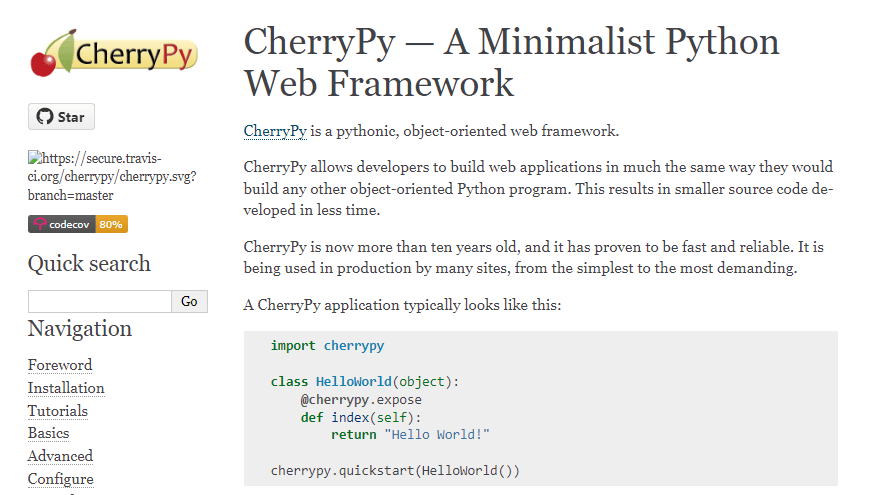
You do not need to install Apache to run CherryPy. The application developed using CherryPy is embedded with its multi-threaded web servers and executed on any OS. Further, the best part of CherryPy is that you can use any type of technology for developing templates and data access.
GitHub: 1.9k Star and 368 Fork as of March 2025.
Key features of CherryPy:
- It has a flexible plugin system, which means that developers can extend the framework’s functionality seamlessly. It is added to CherryPy and adds extra features and functionality which are not available by default.
- CherryPy has built-in support for testing, coverage, and profiling. It is one of the crucial features as it allows developers to debug and optimize their codes.
- Identifying the part of the code responsible for slowing down the applications is also possible. Also, with coverage testing, the developers can easily ensure that all parts of the code are run during the test. With testing ability, developers can ensure the working of specific components of code work of web applications.
- The feature that makes CherryPy highly popular is the ability to run on various OS like macOS, Linux, etc. Developers can deploy their web applications across multiple platforms, showing compatibility.
- It streamlines the running of multiple HTTP servers at once. This is possible by an interface that manages multiple servers. Developers can use this interface to start, stop, and restart multiple servers within the application.
- CherryPy automatically ensures that data is encoded and decoded correctly across multiple browsers and servers.
- Provided built-in authentication system. This feature helps the developers to add secure login and authentication functionality to their applications easily. Some examples of authentication methods are HTTP basic authentication, cookie-based authentication, and custom authentication mechanisms.
Pyramid
Pyramid framework is an open-source and small Python web framework developed as part of the Pylons projects. It is licensed under a BSD-like license, which indicates that it can be used in proprietary and open-source projects.
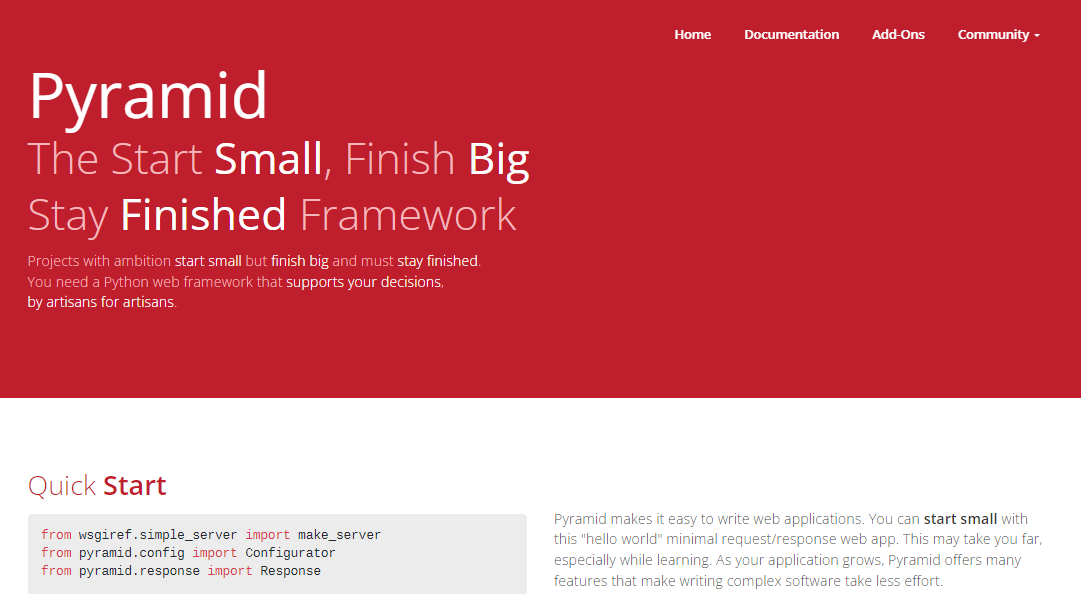
It allows Python developers to create web applications easily with minimalistic complexity. It is structured to build real-world web applications with quick deployment. Further, the most preferred aspect of Pyramid is its ability to work equally with small and full-scale applications.
GitHub: 4k Star and 887 Fork as of March 2025.
Key features of Pyramid:
- Offers a flexible authentication and authorization system, making it unique. This includes built-in support for different authentication and authorization schemes like Digest authentication and HTTP basic.
- It has function decorators used to define views, event subscribers, and other components of applications. Here, the decorator takes another function as input and gives a modified function as input.
- It has a predicates system that allows developers to define the rules that control which views (or pages) are called or displayed for a given request. With this, you can easily have diverse functionality of your web applications on the grounds of requests like user agents, HTTP requests, or custom request headers.
- It has a flexible renderer system that helps developers render diverse output types like HTML, JSON, or XML. This all can be done using different templating engines.
- It is one of the ideal choices for writing prototypes and small tools. This is possible because Pyramid offers a single file application, making it easy to write small web applications.
- Supports many templating engines like Jinga2, Mako, and Chameleon. You can also specify assets using Pyramid, like CSS and JavaScript files, which are important for your application.
- Provide a robust URL generation system that helps developers generate URLs easily for different components of the web applications. This also simplifies your code and makes it maintainable.
- Prominent website Built with Pyramid: Mozilla, Yelp, Dropbox, and SurveyMonkey.
Dash
Dash is an open-source Python framework designed mainly to build visual data interfaces. It was launched in 2017 as a Python library and later developed and grown to have R, Julia, and F#. With its ability to abstract complexities of web development, like working with multiple programming languages (CSS, JavaScript), it has simplified the process of building web applications.
Now, it has become one of the favorite frameworks of data scientists, as they can build analytical web applications without requiring any advanced web development knowledge like JavaScript. They can develop their web application entirely on Python by just using simple syntax to define its layouts and behavior.
The core of Dash constitutes three major technologies:
- Flask: It gives web server functionality.
- React.js: Renders the user interface of the web page.
- Plotly.js: Creates interactive charts and graphs used in web applications.
GitHub: 22k Star and 2.1k Fork as of March 2025.
Key features of Dash:
- Dash eliminates the need to rely on multiple programming languages and streamlines the development process for users. You focus on a single programing language, no matter if it is Python, R, Julia, or F#, as Dash, with its pre-built components and tools, allows you to create high-quality web applications quickly.
- It has Dash Deployment Servers that help developers to deploy and manage web applications. It offers features like error handling, which can easily identify and resolve errors in the web application.
- Dash apps are customizable, which indicates that developers can easily change the look and feel of the applications, add features, and modify existing ones.
- It has LDAP integration that allows developers to utilize the organization’s LDAP server for effective management of user authentication and access control for web applications.
- Dash provides support to plugins that allow developers to extend the functionality of the web applications. This is possible as you can add new plugins that give new features and tools.
- Dash provides a simple interface where developers can use different UI controls like drop downs, graphs, and sliders.
- It provides URL routing that allows developers to define custom URLs. This helps developers to access specific pages and features within your web applications.
Note: Test your Dash websites on a real device cloud. Try TestMu AI Now!
AIOHTTP
AIOHTTP is a Python framework built on top of Python’s asyncio library, which allows asynchronous programming in Python. For example, it allows the use of async/await syntax and handles multiple requests simultaneously by not blocking the execution of the program. AIOHTTP can be used to create web applications and APIs for clients and servers.
It is a server web framework and is also used as a client framework to handle HTTP requests to other servers. Further, it also provides a simple API to make HTTP requests to other servers.
GitHub: 15.5k Star and 2.1k Fork as of March 2025.
Key features of AIOHTTP:
- It has request objects and routers, which help to direct the requests from the client to the handler functions. It allows developers to define different routes for diverse URLs and methods like POST. You can also map each route to a particular function that handles the request.
- Creation of a view of the web application is simplified by using the AIOHTTP framework. It also allows you to define the view function that manages incoming requests, processes, and return responses. With this, it is much easier to create web applications.
- Supports middlewares which indicates that developers can use them to add headers, change request/outgoing responses, and authenticate users.
- Supports signals which can be utilized to add functionality like logging and error handling to the web application.
CubicWeb
CubicWeb framework was developed by Logilab. It is a freely available, semantic, and Python-based framework based on data models. When we compare this other Python framework that uses separate views and models, CubicWeb is quite different as it uses cubes which are independent components.
These are reusable modules with a specific set of functionality where each cube comprises the data model, views, controller, and others that determine the application’s functionality.
Here, the cubes are integrated to develop web applications based on CubicWeb, which can also be connected to a database, web servers, and others. Such cubes can also be shared, extended, and modified, thus allowing easy-to-reuse code, creating the flexible architecture of web applications, and lowering their development time.
GitHub: 1 Star and 2 Fork as of March 2025.
Key features of CubicWeb:
- It supports OWL(Web Ontology Language) and RDF (Resource Description Framework), which helps web applications to be more interoperable and readable.
- It is easy to build web applications using CubicWeb because it allows developers to reuse the components of web applications.
- It comprises built-in security workflows like authentication and authorization.
- It supports RQL, a query language that helps in recovering and manipulating data from the database of applications. Such RQL queries can be embedded in your code.
- It shows compatibility with database backends like PostgreSQL, MySQL, and Oracle, among others.
Falcon
Falcon is a minimalistic ASGI (Asynchronous Server Gateway Interface)/WSGI (Web Server Gateway Interface) framework for Python focused on building REST APIs and microservices. It emphasizes the reliability, performance, and correctness of the Falcon web application developed.
Thus, if you want to develop critical applications that require a high level of functionality and quality, Falcon can be a good choice. Popular applications like LinkedIn, OpenStack, and RackSpace use Falcon.
GitHub: 9.6k Star and 953 Fork as of March 2025.
Key features of Falcon:
- It supports WebSocket protocols, WSGI and ASGI. This gives wide options to the developer for their particular use cases.
- Supports native asyncio, which is a Python library for asynchronous programming. Using these features, developers can write high-performance concurrent code which manages multiple requests.
- It does not depend on global variables for state management and routing because it makes code difficult to maintain and debugs. Instead, it uses the RESTful routing approach, which offers an organized and modular way of defining routes and provides response objects and responses that encapsulate state information. Thus making it easy to manage application functions.
- The codebase of Falcon is highly optimized and extensible, which allows developers to add or modify features and build fast and scalable applications.
- Supports middleware components and hooks, and developers can use this to process requests and responses in a DRY manner. It can also lower code duplications and allows easy management of application logic.
- Aligns to the Request for Comments standard, which ensures reliability and interoperability of implementation of web protocols.
- It gives idiomatic HTTP error responses, and with this, developers can write code that is easy to read.
- Supports both CPython 3.5+ and PyPy 3.5+ and extends its accessibility to developers using diverse Python implementations.
Giotto
Giotto is a Python web framework that supports functional styles where the decoupling of model, view, and controller code is done. This shows that web designers, developers, and system administrators can work independently. Here, the model layer manages data and business logic. The view layer presents data to a user in a visually appealing way. The controller layer is an intermediary layer between the model and the view layer, which handles user input.
It also has controller modules that help users to create web applications on different platforms like the web, IRC, and command line.
GitHub: 60 Star and 10 Fork as of March 2025.
Key features of Giotto:
- It has extremely terse code, which means that using Giotto, you can write clean and minimalist code. Using this, developers can create full-featured applications under 300 lines of code which is considerably less compared to other web frameworks.
- It has a pre-built, generic view and models which are effectively used to develop web applications. It also allows developers to create their controllers, which makes the framework customizable.
- Supports RESTful interface, which allows developers to create APIs and communicate with other web services using standard HTTP methods like GET, POST, PUT, and DELETE.
- It has a functional CRUD (Create, Read, Update, and Delete) pattern mainly used for implementing HTML forms. However, it does not require Django-style form objects to create and validate HTML forms.
- It can automatically route URLs to the correct controller, which eases the management and organization of codes.
- Provides built-in cache, which supports Redis and Memcache that are designed to be fast and efficient. The developers using Giotto do not require to write additional code to implement caching in their web application.
- Uses SQLAlchemy as its Object Relational Mapper, which provides high-level API for working with databases.
- Giotto uses Jinja2 as its default template engine, allowing developers to create easy-to-read and maintain HTML templates.
Growler
Growler is a Python framework based, built on top of asyncio, an asynchronous library as marked in PEP 3156. It is added to the standard library in Python 3.4. It is inspired by Node.js and Express/Connect, popular frameworks in the JavaScript programming language.
GitHub: 686 Star and 29 Fork as of March 2025.
Key features of Growler:
- It is well known for its ability to implement complex web applications. This makes it the most popular choice among web application developers.
- Use middleware technology to manage requests, which means it is not handled within the framework. Instead, a request has to pass through middleware for processing.
- Supports multiple open-source packages and uses function decorators to write clear and reusable code.
- Consist of clear program flow as it eliminates the need for callbacks and proper try-and-try blocks to handle the request.
- It has a Ziapp module, which allows zipping web applications into a single executable file.
Hug
Hug is a Python framework that intends to develop a simple Python-driven API. It is one of the most preferred choices of developers to create RESTful API quickly with less boilerplate code. The main reason is its simplicity and ease of use. It has clean and simple syntax for defining API endpoints, which allows for building application logic.
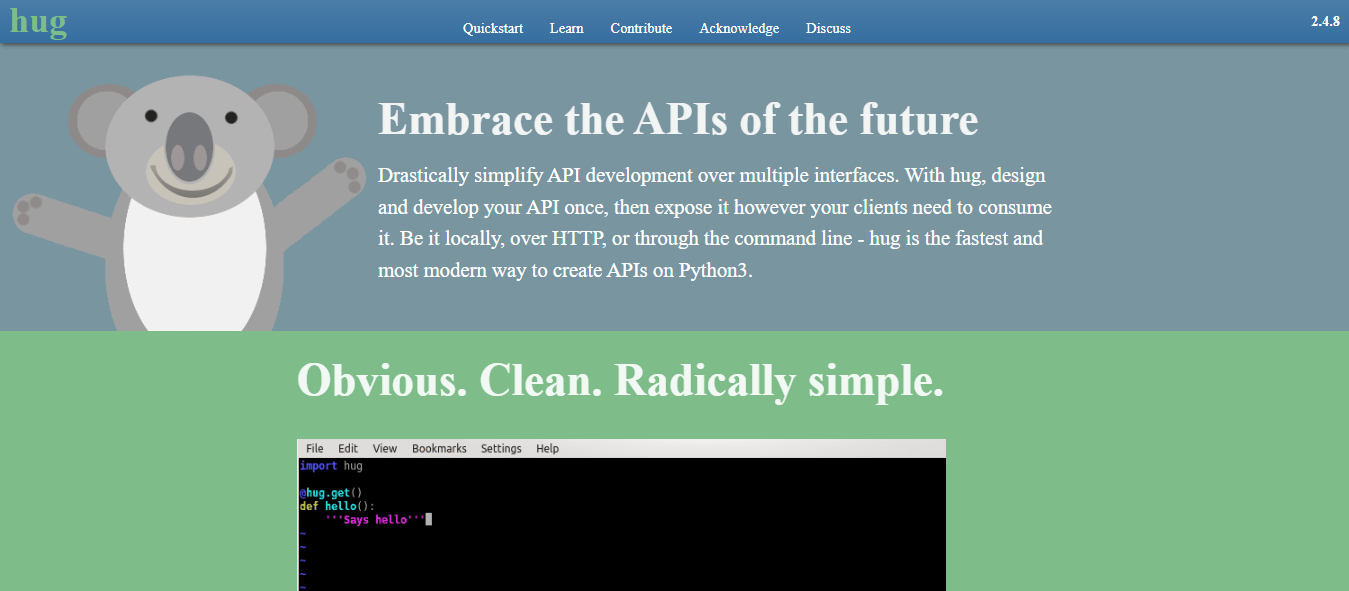
Further, Hug is well known for its performance and claims to be the fastest web framework for Python 3. This is because Hug only uses system resources like CPU and memory usage when required. It uses Cython to compile Python code into C code and then into machine code which is executed faster than Python code.
GitHub: 6.9k Star and 387 Fork as of March 2025.
Key features of Hug:
- Supports multiple interfaces that help developers create API once and later can be used in different contexts, whether through HTTP or command line interface (CLI).
- It has a unique aspect of annotation-powered validation that simplifies input validation. This is possible by allowing developers to annotate function arguments with validation rules. For example, a developer might annotate a function argument with a rule specifying a string’s minimum and maximum length or the range of valid values for numeric input.
- Provides inbuilt version management and management of different API versions within the same codebase is possible with the use of different routes or URL prefixes for each version. For example, developers can use /api/v1″ for version 1 of their API and “/api/v2” for version 2.
- Supports automatic documentation and generation of API documents based on code is easy. This saves developers time and effort in documenting APIs with information like API routes, expected input and output formats, and others.
FastAPI
FastAPI is a high-performing web framework for building APIs using Python 3.7 or higher. FastAPI is based on standard Python-type hints, which can be understood as annotations that help developers specify the type of function argument and return values. This makes writing and maintaining code very easy because you can use type hints to detect the error at the earliest. This often leads to improving code readability and documentation.
GitHub: 81.5k Star and 7k Fork as of March 2025.
Key features of FastAPI:
- It is one of the fastest Python frameworks available, on par with Node.js and Go. This shows that it can handle high levels of traffic and data-intensive applications effortlessly.
- Offer various built-in features that help lower the amount of code required to be written by developers. Some of those features are the automatic generation of OpenAPI documentation, type checking and validation, dependency injection, and WebSocket support.
- Helps to lower the number of human-induced errors by 40%. This is because of features like type checking and validation that allows fast detection of bugs.
- It has great editor support that helps in easy integration with code editors like Visual Studio Code, PyCharm, and others.
- The assortment of a simple and clean API and built-in features designed to lower the amount of code and potential errors make FastAPI an easy-to-use and efficient framework for building APIs with Python.
- Minimized code duplications and allowed the reuse of code. It offers the ability to declare multiple features from each parameter declaration. Say, for example, you can define different parameters, their default value, and validation rules in a single line of code.
- It is compatible with open standards for APIs like OpenAPI and JSON Schema. This allows easy integration with third-party tools and services that support these standards, like API testing tools and client libraries.
Morepath
Morepath is a microframework designed to create web applications with fewer setup requirements. Morepath is based on Web Server Gateway Interface (WSGI), a standard Python interface for interaction between web servers and web applications. It is mainly designed to get typical use cases for fast execution in developing web applications and the creation of RESTful Web Services with the use of Python data structure.
GitHub: 393 Star and 34 Fork as of March 2025.
Key features of Morepath:
- Morepath is a model-driven, powerful, and flexible web framework that offers a straightforward approach to developing web applications using Python.
- Routing in Morepath maps the incoming request to Python models, which shows entities like resources, views, and other aspects of web applications.
- Utilizes a model-driven approach to define views (Python function or class that takes a web request as its input and gives HTTP response as output) that make it generic.
- Generic views offered by Morepath can be reused in other views without needing to write them again. For example, developers can define a view that manages requests, like displaying a list of items, and reuse that view in other parts of the application.
- Provides all important tools to create RESTful web services like Routing system, Model-driven approach, HTTP method support, serialization and deserialization, authentication, and authorization.
- Allows developers to create a generic user interface with the approach of subclassing existing views. This lowers the need for custom code and gives an effective user experience across the application. Overall, the development process of web applications using MorePath is simplified.
Pycnic
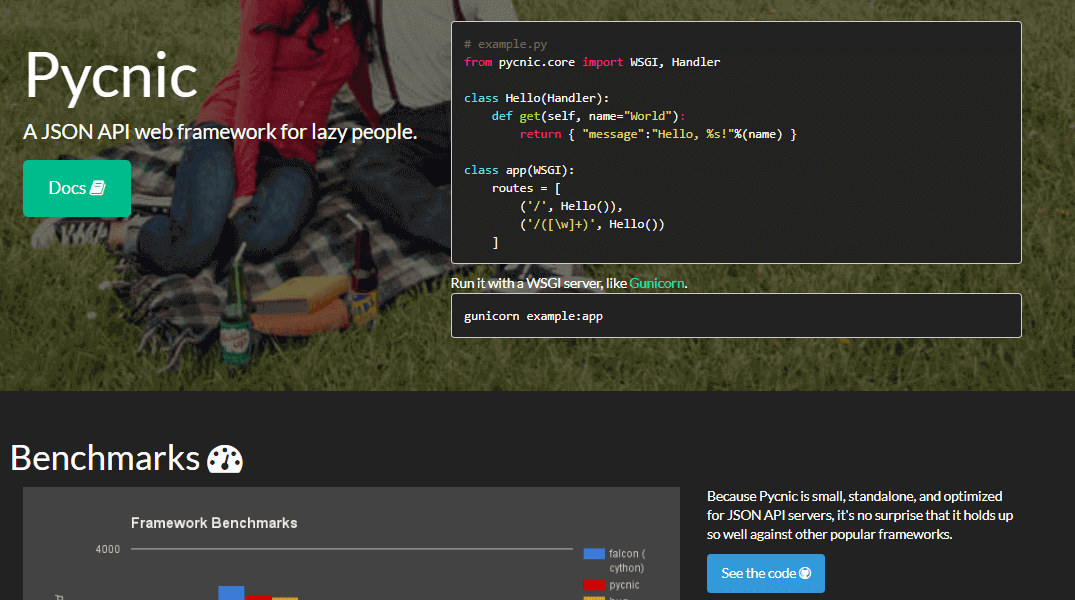
Pycnic is a Python-based microframework designed to build fast and efficient JSON-based APIs. Pycnic works according to the principle of object-oriented programming and is optimized to handle JSON data. It is a small and standalone framework with less footprint, making it fast and efficient. If you’re interested in diving deeper into object-oriented programming concepts, exploring oops interview questions interview questions can be an excellent way to solidify your understanding and prepare for technical interviews.
GitHub: 158 Star and 26 Fork as of March 2025.
Key feature of Pycnic:
- Well-known feature that makes Pycnic most preferable because of its simplicity. It has a clean and easy-to-use API that allows developers to build APIs easily and quickly.
- Pycnic has several built-in tools and libraries to handle common tasks like response generation, error handling, and request handling.
- It is highly extensible and customizable, which helps developers easily add new features and modify existing code.
- It has a built-in error-handling ability; with this, developers can easily handle and respond to errors that may be reported during API processing. Developers can quickly provide API error messages to users, which eases its fixation.
- Provides routing capabilities that allow developers to define an approach used to access various API endpoints. With this, you can ensure that requests are directed to the correct end-points and get timely responses.
- Provides support for handling cookies which are small data stored on the user’s device and utilized to store user preference and session data. Thus, this allows developers to write and read cookies as per need.
Pylons
Pylons is an open-source Python-based full-stack framework intended to develop web applications quickly. It provides developers with a complete set of tools and features needed to develop frontend and backend components of web applications. It also incorporates properties of languages like Perl, Ruby, and Python, making it a powerful tool for developers.
Pylons framework allows web application development concisely, ranging from as small as single Python modules to large-scale projects with complex directory structures. It has project templates using which developers can boot-strap the new application projects. It even gives the option to start from scratch in developing web applications that include the basic directory structure and files needed to get started with the project.
GitHub: 233 Star and 76 Fork as of March 2025.
Key features of Pylons:
- Has built-in support for validating HTML forms and generating HTML forms using Python code.
- It allows URL routing to map URLs to particular functions or controllers within web applications.
- It provides a text-based templating engine called Mako. Using this, developers can create dynamic HTML pages according to their requirements with simple Python codes.
- Utilizes a URL dispatch system that helps developers to map URLs to specific actions while developing web applications. Thus, developers can create readable URLs with this feature and organize the code structure of applications.
- Provides Web Server Gateway Interface (WSGI) that helps developers create reusable components for other web applications.
- Pylons also has a WebHelpers library with several utility functions for working with URLs, like a function for creating URLs based on the Route configuration of the application.
Sanic
Sanic is an open-source Python framework built on top of Python’s uvloop library, allowing it to handle high levels of concurrency with minimal overhead. It is specifically designed to provide HTTP response by asynchronous request handling. This makes it compatible with Python 3.5’s async/await functions, enhances speed, and improves the non-blocking ability of the framework.
It is proven to perform well even under heavy loads. In the benchmark test, Sanic was able to handle 33,000+ requests in a second. Such speed makes it the most appropriate choice for applications that require high-performance web servers like real-time data processing, high-traffic web applications, and streaming.
GitHub: 18.3k Star and 1.6 Fork as of March 2025.
Key features of Sanic:
- It has built-in functionality to handle HTTP cookies.
- Sanic allows different types of logging, like access logs and error logs. These logs can record detail regarding each request and errors during processing, respectively.
- It is a simple and lightweight framework that eases the development of web applications.
- Sanic has a simple and intuitive API with a smart defaulter, which indicates that developers can build a web application without spending much time on configuration.
- It is opinionated, which signifies that it does not impose any particular way of building web applications.
- Can handle large volumes of traffic like user traffic and scale to meet any specific requirements of web applications.
- Provide plugin support, adding extra functionality to web applications like easy integration with other services or databases.
- Provide support for blueprints for sub-routing within the web applications.
Tornado
Tornado is one of the popular Python frameworks designed to handle and manage high levels of traffic and able to maintain long-lived connections to users. In other words, it is an excellent choice for a web application with real-time updates and a long polling connection.
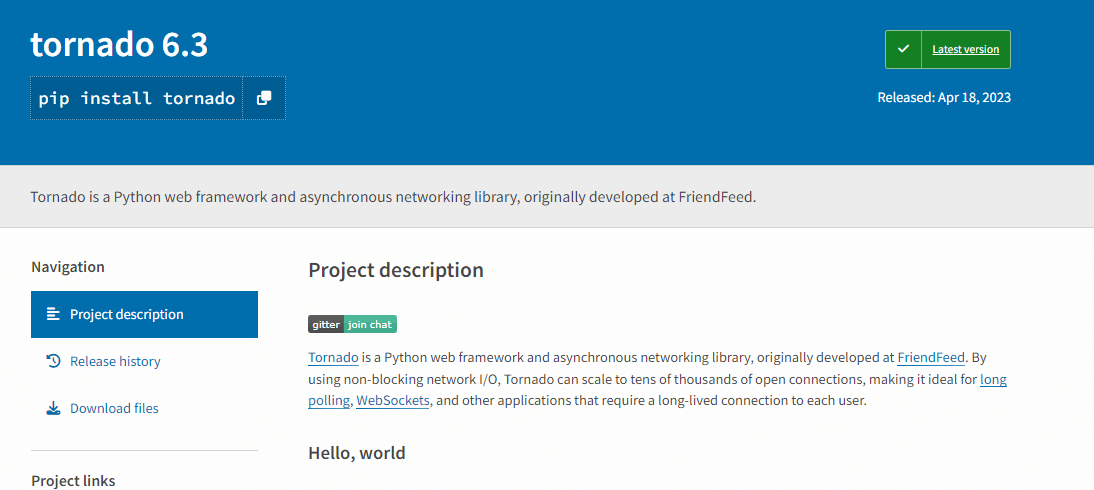
Tornado is an asynchronous networking library with tools and abstractions allowing developers to build scalable, high-performance networked applications. For example, these tools include support for non-blocking I/O, network sockets, and other low-level networking operations.
GitHub: 21.9k Star and 5.5k Fork as of March 2025.
Key features of Tornado:
- One of the most significant features of Tornado is that it supports non-blocking network I/O. This allows the Tornado developers to handle many open connections without using excessive system resources or slowing down.
- The use cases of Tornado have long polling applications. This allows the server to wait for new data before giving it to the clients.
- It supports WebSockets, a protocol establishing two-way communication between clients and servers in real-time.
- Developers can integrate Tornado with third-party authentication and authorization schemes like JWT and OAuth.
- Supports translation and localization that allows easy development of multilingual applications.
- It has built-in support for user authentication. This helps the developers to add user authentication to your web application where there is no need to write custom code.
- Provides a web templating engine that helps to develop dynamic HTML pages.
TurboGears
TurboGears is a full-stack web application framework that allows the easing of the development of data-driven web applications. It provides all the required components for the development of web applications like database connectivity, front-end technologies like React, Vue.js, and Angular, back-end development tools, and templating.
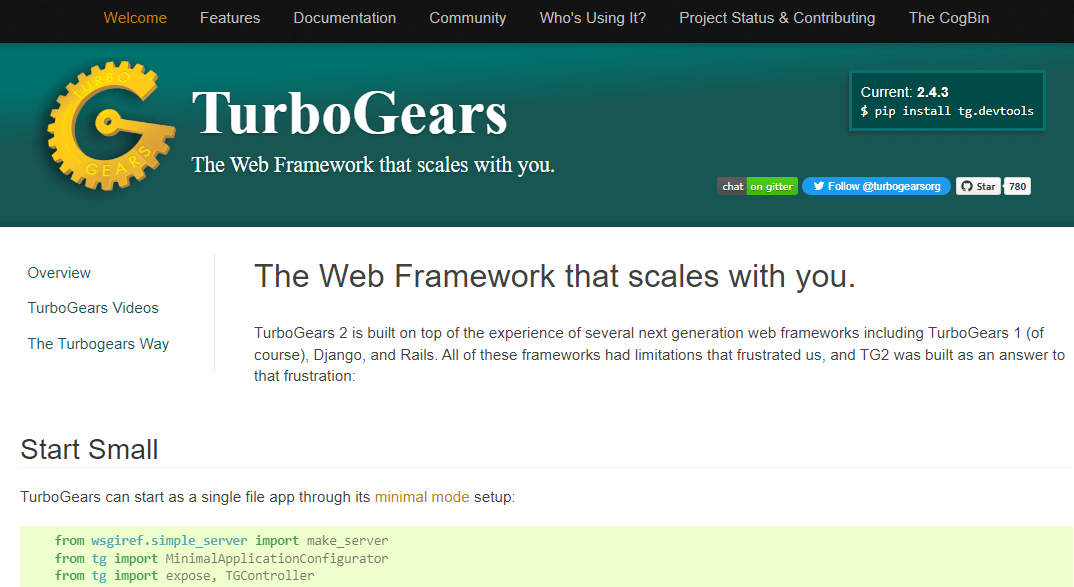
TurboGears helps web developers to integrate JavaScripts development tools with their Python-based web applications. This enables the developers to use such tools to build single-page and traditional multi-page applications.
GitHub: 810 Star and 80 Fork as of March 2025.
Key features of TurboGears:
- Supports Object-Relational Mapping (ORM), and mapping the database table to a Python object and vice versa is possible.
- It has a templating system, which indicates that developers can use it to create dynamic content on web pages quickly.
- The components like Genshi, Repoze, SQLAlchemy, and WebO are used by TurboGears, offering a flexible framework for developing web applications.
- It has built-in support for AJAX, where developers can update data without reloading the entire page.
- Its working begins as microframeworks suitable for building simple and lightweight applications. However, it is possible to scale up to a full-stack solution, and developers can also create complex applications.
- Supports Horizontal data partitioning, also known as sharding, that distributes data across multiple data servers and improves scalability and performance.
Grok
Grok is an open-source web development framework that gives agile development experience to all developers using Python by leveraging Zope Toolkit (ZTK) technology. It focuses on two general principles, which include DRY (Don’t Repeat Yourself) and convention over configuration.
Here, the principle of convention over configuration indicates that Grok has default conventions and assumptions regarding the structuring and configuration of web applications. Such approaches help developers to write code quickly for any specific application logic. Further, based on the DRY principle, Grok enables developers to remove any redundancy by not duplicating the code and configurations.
GitHub: 28 Star and 15 Fork as of March 2025.
Key features of Grok:
- Provides a stable foundation for developing robust and extensible web applications.
- It allows web developers to utilize the power of Zope 3, a library collection for developing web applications.
- Offer integrated data security while developing web applications with Grok framework.
- Grok’s component architecture helps developers lower the unpredictability of development and form modular and reusable code.
- It provides essential building blocks and assets to form custom web applications that meet business needs, for example, authorization and authentication systems, form handling, and templating engine.
BlueBream
BlueBream is an open-source Python framework designed to build online complex and large-size web applications. It is a server and library too. Earlier, it was called Zope 3 and developed by the Zope team.
The framework was built on top of the Web Server Gateway Interface specification, through which it is easy to interact with Python web applications and web servers. With this, BlueBream can be deployed on a wide range of web servers and platforms.
Key features of BlueBream:
- It has a component architecture that allows developers to develop pluggable and reusable components. This can be easily integrated into large web applications. Such a modular approach makes the code easy to maintain and allows adding new features to web applications.
- It has a Zope Object Database (ZODB), a transactional object database that enables data integrity and effectively stores application data.
- Comes with built-in support for both functional and unit testing that allows the testing of code perfectly, which helps to know its expected working.
- Utilizes Zope Page Template (ZPT) languages. It is understood as the XHTML-compliant language for creating new templates. This approach lets you make dynamic web pages that can be easily maintained and updated.
- It has form-generation tools. With this, developers can easily create web forms with fewer requirements for coding.
- It has Zope Component Architecture (ZCA), a robust framework for developing reusable components. With this, developers can create modular and extensible applications which can be easily maintained and updated.
Quixote
Quixote is the Python framework for developing web applications to improve performance and offer flexibility. Quixote uses traditional technologies, including server-side programming language, rather than new technologies like Single Page Applications (SPAs).
With Python classes and functions, the logic for formatting web pages is easily defined. It does not cause any enforcement to separate the presentation of logic and back-end logic. Instead, it uses traditional techniques for the structuring of code. One approach could be to segregate presentation logic into its individual sub-packages. This allows cleaner and maintainable code.
GitHub: 88 Star and 13 Fork as of March 2025.
Key features of Quixote:
- It has a simple and flexible design with session management API that helps developers to manage user sessions in their applications.
- It shows HTML form support, and with the library of functions, it is easy to analyze HTML forms for web applications.
- Utilizes Python-like syntax for its HTML templates. Such templates can be imported like other Python code, thus making the reuse of code easy across the applications.
- It can work with any web server that supports CGI and Fast CGI protocols like Apache. Apache’s mod_python is also supported for improving performance and SCGI protocol for scalability.
Weppy
Weppy is the lightweight and high-performance WSGI web framework used for developing high-quality web applications.
GitHub: 1 Star and 0 Fork as of March 2025.
Key features of Weppy:
- It has a URL routing system to map URLs.
- Provides built-in tools to update and validate data models.
- Provide secure authentication and authorization mechanisms.
- It is easy to cache content with dependencies.
- Supports middleware functions to modify requests and responses.
Masonite
Masonite is a Python web framework that follows Model-View-Controller (MVC) architectural pattern. This gives developers easy-to-use syntax to develop web applications.
GitHub: 2.2k Star and 127 Fork as of March 2025.
Key features of Masonite:
- It has a built-in authentication and authorization system.
- Provide URL routing and middleware system.
- It also has a templating engine.
- Provide built-in support for WebSockets.
Jam.py
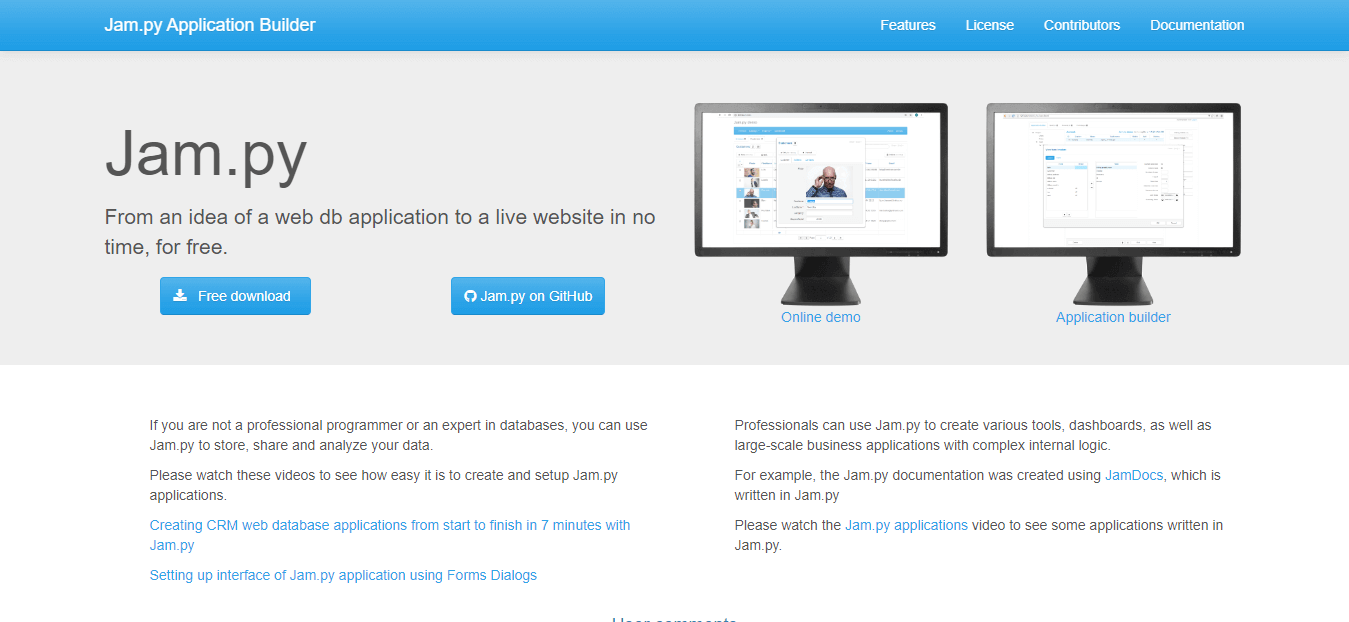
Jam.py is a Python web framework that helps developers to create web applications using the DRY principle. It focuses on CRUD (Create, Read, Update, and Delete) operations.
GitHub: 455 Star and 88 Fork as of March 2025.
Key features of Jam.py:
- Provide a set of tools for developing models, views, and controllers.
- It has built-in support for databases like PostgreSQL, MySQL, SQLite, and Oracle.
- It also provides support web servers that allow easy testing and developing of the web application locally.
- The incredible thing is that it can generate code automatically using the application models.
- Provide flexible and extensible architecture.
Reahl
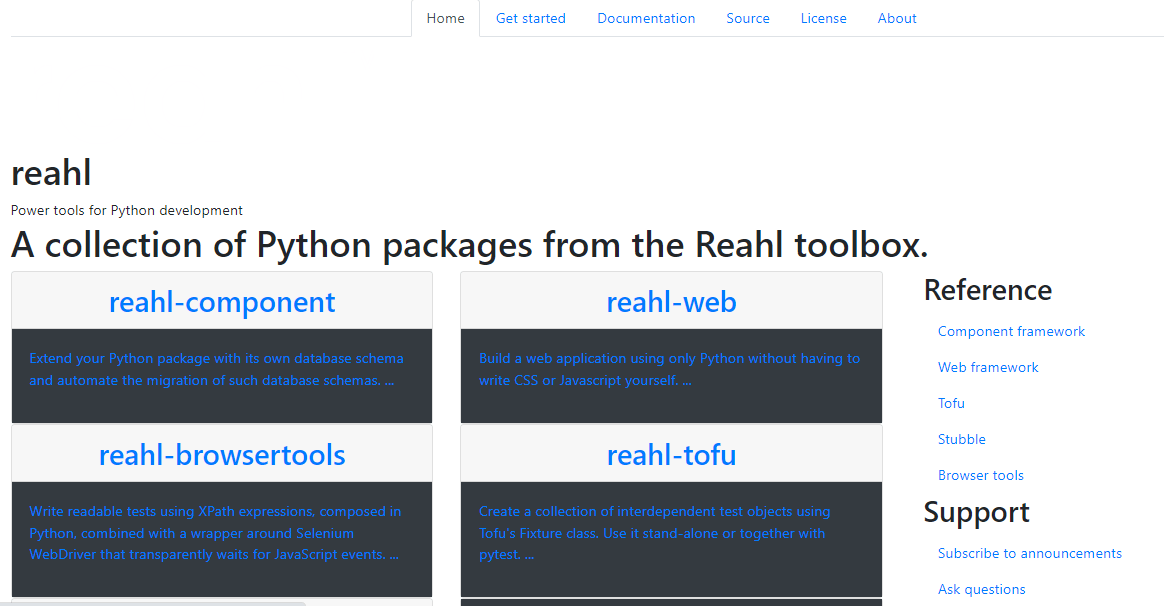
Reahl is a web framework that helps developers build web applications using Python. It can also be used to customize and compose widgets in usual Python code.
GitHub: 130 Star and 7 Fork as of March 2025.
Key feature of Reahl:
- Developers can build web applications based on Python and do not require HTML, CSS, or JavaScript knowledge.
- Offer responsive design, and the user interface can automatically fit different screen sizes and resolutions.
- It has built-in security features like secure cookies, HTTPS, and cross-site request forgery.
- Provide built-in support for data integration using Python code.
Websauna
Websauna is the Python framework for developing websites and backends for customers and businesses. Websauna was created with modern Python 3 features, SQLAlchemy, and Pyramid web routing framework.
GitHub: 262 Star and 55 Fork as of March 2025.
Key features of Websauna:
- It has a default admin interface and user sign-up.
- It provides a Jinja template and Bootstrap theming.
- Comes with integrated IPython Notebook support.
- Strongly focuses on security due to its feature of optimistic concurrency control and ACID principle.
Wheezy.web
Wheezy.web is a lightweight and high-performance WSGI web framework in Python. It gives simple and useful tools for developing web applications.
GitHub: 26 Star and 0 fork as of March 2025.
Key features of wheezy.web:
- Provides routing, templates, and middleware.
- Needs Python 3.6+.
- It is based on MVC architecture patterns.
- It offers functionality like model update/validation, authentication/authorization, and content caching.
Zope
Zope is a web application server and framework based on Python. Zope was released in 1998 and progressed into many different applications, frameworks, tools, and libraries.
GitHub: 361 Star and 101 Fork as of March 2025.
Key features of Zope:
- Provide a set of tools and libraries for developing web applications. Some are object databases, object-oriented page templating language, and component architecture.
- It provides support for content management, collaboration tools, and web publishing.
Quart
Quart is a lightweight and async Python web microframework. Quart is designed to be compatible with the Flask web framework that uses the asyncio library to give an asynchronous programming model.
GitHub: 3.2k Star and 170 Fork as of March 2025.
Key features of Quart:
- It gives HTTP/2 support.
- Provides WebSocket support.
- Provides built-in support for testing and debugging.
- It is easy to stream request and response data.
- It can write (Restful) JSON APIs.
Once you have developed web or mobile applications using your preferred Python framework, you can test them on a digital experience testing cloud like TestMu AI to ensure your Python website or mobile app gives a uniform experience across all browsers, devices, and operating systems combinations.
Note: Perform cross browser compatibility testing of Python websites. Try TestMu AI Now!
Choosing the Right Python Framework
Development of web applications based on Python gives you various options in terms of the frameworks using which you can structure high-quality applications. However, deciding the right framework that aligns with the web project’s needs may be challenging. This is because of the availability of several Python frameworks for web development and testing with similar features.
Choosing the right Python framework requires considering factors that help you make better decisions. First, you need to be familiar with the requirements of web development projects. For example, you may ask
- Are you building a small web application or a complex system that requires a lot of scalability and performance?
- Do you need a highly secure framework or one that is easy to use?
If you understand the right requirement, it is easy to narrow down the list of possible Python frameworks, and among those, you can select the most appropriate one.
Another factor you should consider is around community and support offered by the Python framework. For example, is the framework widely used and well-established? Is there an active community of developers contributing to the framework and providing support? Answering such questions will give you an idea of a well-supported framework that ensures you access resources while developing and testing web applications.
You should address the Python framework’s learning curve and ease of use. Always be inclined to select a Python framework that is easy to learn and helps you get started with the testing and development process.
However, no single factor should be considered when choosing the right Python framework. Therefore, the appropriate framework will entirely depend on associated factors and the specific needs and requirements of your web development and testing projects.
Conclusion
Python will progress to remain popular among developers and testers for the release of quality web applications in 2025. The demand for web and mobile applications increases with new software technologies and methodologies. Therefore, the requirement for an efficient Python framework will increase more than ever in the coming year.
In this blog, I have discussed 39 Python frameworks likely to dominate the software development and testing landscape in 2025. Their required and unique features and capabilities allow easy testing of software applications, ensuring reliability and scalability.
I hope this blog will help to get good information on different Python frameworks for your software project needs.


Frequently asked questions
Did you find this page helpful?
More Related Hubs
TestMu AI forEnterprise
Get access to solutions built on Enterprise
grade security, privacy, & compliance
- Advanced access controls
- Advanced data retention rules
- Advanced Local Testing
- Premium Support options
- Early access to beta features
- Private Slack Channel
- Unlimited Manual Accessibility DevTools Tests