

Next-Gen App & Browser Testing Cloud
Trusted by 2 Mn+ QAs & Devs to accelerate their release cycles


Pytest vs Unittest: Which Testing Framework Should You Choose?
Compare pytest vs unittest in Python. Learn their key differences, strengths, and best use cases to choose the right testing framework for your project.

Saniya Gazala
December 24, 2025
When it comes to Python testing, two frameworks often dominate the conversation: pytest and unittest. Both are widely used, but they serve different needs and project scales.
The pytest vs unittest comparison highlights how pytest stands out for its simplicity, flexibility, and powerful plugin ecosystem, while unittest remains Python’s built-in framework, offering a structured, class-based approach that ensures reliability without additional dependencies.
Understanding the strengths, limitations, and best-fit scenarios for each framework will help you choose the right tool for your testing strategy.
Overview
Deciding between pytest vs unittest depends on your project’s testing needs, each offering unique strengths for writing, organizing, and maintaining automated tests.
Comparison: pytest vs unittest
- Learning Curve: pytest allows quick onboarding with simple function-based tests, while unittest benefits developers familiar with class-based xUnit frameworks.
- Test Structure: pytest emphasizes lightweight, modular tests; unittest enforces a formal class-based organization.
- Flexibility: pytest offers dynamic fixtures and extensive plugins; unittest relies on built-in setup/teardown methods with limited extensions.
- Test Execution: pytest automatically discovers tests with minimal configuration; unittest requires explicit entry points or discovery setup.
- Error Reporting: pytest provides detailed, readable failure messages; unittest outputs are more traditional and may need extra debugging effort.
- Best Fit: pytest suits modern, collaborative projects needing speed and scalability; unittest works well for smaller or legacy projects prioritizing stability and built-in reliability.
What Is pytest?
pytest is an open-source testing framework for Python that makes it easy to write and organize tests. It supports unit, integration, and functional testing while offering features like fixtures for test setup, parameterization for running tests with multiple inputs, and a rich plugin system to extend functionality.
It automatically discovers tests, integrates with CI/CD pipelines, and works well with tools for API, UI, and database testing, making it suitable for projects of any size. For a deeper dive on pytest, check out the complete pytest tutorial.
What Is unittest?
unittest is Python’s standard testing framework that follows the xUnit architecture used in many programming languages. It organizes tests into classes, where each method represents an individual test scenario.
The framework provides setup and teardown methods to prepare and clean up test environments, supports grouping related tests into suites, and includes built-in test discovery to automatically locate test files.
Since it is part of Python’s standard library, no external installation is required, making it a reliable choice for writing and running automated tests across modules, functions, and classes.

Note: Run your pytest and unittest at scale simultaneously across 3000+ real browsers and OS combinations. Try TestMu AI Now!
Difference Between pytest vs unittest
The pytest vs unittest debate often comes down to scalability and ecosystem. pytest is designed with modern flexibility in mind, while unittest leans on traditional stability. Your decision depends on what you value more: speed and advanced tooling with pytest, or built-in reliability with unittest.
| Aspect | pytest | unittest |
|---|---|---|
| Ease of Writing Tests | Allows writing tests as simple functions without mandatory classes, reducing boilerplate and making test design faster. | Requires tests to be written inside classes, which can feel verbose, but enforces structured design. |
| Assertion Style | Uses Python’s natural assert keyword with powerful introspection for better error messages. | Relies on specific assertion methods like assertEqual, assertTrue, etc., which can be less intuitive. |
| Parameterization | Built-in support for parameterized tests (@pytest.mark.parametrize), making it easy to test multiple data sets with minimal code. | No native support; parameterization requires manual loops or external libraries. |
| Plugins & Extensions | Rich ecosystem with plugins for coverage, parallelization, flaky test retries, and reporting, helping scale tests in real projects. | Very limited extension ecosystem since it’s tied closely to the Python standard library. |
| Execution & Discovery | Automatically discovers tests based on file naming conventions, no need for boilerplate main() functions. | Needs explicit test discovery or unittest.main() entry point, adding extra steps. |
| Reporting & Debugging | Generates highly readable reports, highlights failing cases with detailed introspection, and integrates easily with CI tools. | Standard error outputs are less descriptive; debugging failures often requires stepping through manually. |
| Learning Curve | Quick to pick up for beginners due to simplicity and fewer rules around structure. | Easier for those with backgrounds in Java’s JUnit or similar xUnit frameworks because of the familiar class-based style. |
| Best Fit | Ideal for modern, large-scale projects that require speed, advanced tooling, and collaboration across teams. | Best suited for smaller projects or when you want reliability without installing additional packages. |
Understanding pytest
pytest is a Python framework that helps you structure, run, and extend automated tests with minimal setup. It adapts to small scripts or large projects, offering flexibility through fixtures, parameterization, and plugins.
Advantages of Using pytest
pytest provides several benefits that make it a better testing framework compared to unittest. In fact, when looking at pytest vs unittest in real-world projects, developers often find pytest faster, more readable, and easier to scale.
Below are some of the advantages of using pytest:
- Easy test discovery: You don’t have to configure or name every test manually; pytest automatically finds your test files and functions.
- Readable test cases: Tests look like simple Python code, making them easier to write, review, and maintain.
- Reusable fixtures: You can avoid repeating setup logic by defining fixtures once and reusing them across multiple tests.
- Parameterization support: Run the same test with different sets of data without writing duplicate test functions.
- Extensible plugins: Choose from a wide plugin ecosystem to integrate with tools like Selenium, Django, or Flask, saving time on setup.
- Rich reporting: When a test fails, pytest gives detailed tracebacks and context, helping you debug faster.
- Parallel execution: Speed up your test runs by executing tests in parallel, which reduces waiting time in CI pipelines.
Limitations of Using pytest
While pytest is highly flexible, it’s not without drawbacks. In the pytest vs unittest comparison, one limitation is that pytest may feel less familiar to teams used to the class-based structure of unittest. Additionally, some advanced pytest features can have a steeper learning curve for beginners.
Below are some of the limitations of using pytest:
- Learning curve for advanced features: While writing simple tests is easy, mastering fixtures, plugins, or parameterization can take extra effort.
- Not always beginner-friendly: Developers coming from unittest may initially find pytest’s function-based style and advanced features unfamiliar.
- Dependency on plugins: For certain integrations (like coverage, parallelization, or specific frameworks), you may need external plugins instead of built-in support.
- Verbose failure output in large suites: Although reporting is detailed, it can become overwhelming in very large projects without proper filtering.
- Limited built-in mocking tools: Unlike unittest, pytest doesn’t provide its own mocking library; you typically rely on external modules like unittest.mock.
When to Use pytest?
Choosing between pytest vs unittest often depends on your project’s needs. pytest is ideal when you want quick test development, parameterization, and plugin support, while unittest may be more suitable for projects requiring strict adherence to Python’s built-in standards.
- For quick test writing: If you want to get started fast without boilerplate code or rigid class structures.
- For data-driven testing: When you need to run the same test with multiple sets of inputs using parameterization.
- For reusable setups: If your project requires shared resources or repeated setup/teardown logic across tests.
- For scaling test suites: When your codebase grows and you need plugins, fixtures, and parallel execution to manage large test suites effectively.
- For modern workflows: If your team uses CI/CD pipelines and wants better integration with reporting, coverage tools, and external frameworks like Selenium or Django.
- For collaboration: When you want clean, readable tests that both developers and testers can easily review and maintain.
Understanding unittest
Unittest is Python’s built-in framework that brings structure and consistency to automated testing. It follows a class-based approach, letting you organize test cases, manage setup and cleanup routines, and combine tests into suites for systematic execution.
Advantages of Using unittest
Below are some of the advantages of using unittest:
- Part of the Python standard library: No extra installation required, making it available out of the box.
- Structured test organization: Class-based style helps you group related tests together in a consistent format.
- Built-in fixtures: Provides setUp() and tearDown() methods to prepare and clean up test environments.
- Test suites support: Easily combine multiple test cases into suites for batch execution.
- Integration with tools: Works smoothly with coverage, CI/CD, and reporting utilities without additional setup.
- Familiar for xUnit users: If you’ve used JUnit, NUnit, or other xUnit frameworks, unittest feels familiar.
Limitations of Using unittest
Despite its reliability, unittest does come with a few limitations. When comparing pytest vs unittest, developers often point out unittest’s verbosity and limited flexibility as drawbacks for modern, large-scale projects.
- More verbose syntax: Requires class definitions and method naming, which can slow down test writing.
- Less flexible fixtures: Setup and teardown are tied to classes, making them harder to reuse across different test modules.
- Weaker parameterization support: Running the same test with multiple inputs requires workarounds or additional libraries.
- Steeper overhead for small tests: Writing a simple test feels heavier compared to frameworks like pytest.
- Fewer extensions: Lacks the plugin ecosystem that pytest offers, limiting customization.
When to Use unittest?
The choice between pytest and unittest depends on your project’s requirements. unittest works best when you need a built-in, stable framework with a structured, class-based approach, particularly for legacy or smaller projects.
- For built-in reliability: When you want a stable, pre-installed framework without external dependencies.
- For a strict structure: If your team prefers a class-based organization with clear separation of test methods.
- For smaller projects: Works well when the test suite is relatively small and doesn’t require advanced features.
- For compatibility: Best suited when working with legacy codebases or projects already written with unittest.
- For familiarity: A good choice if your developers/testers already know other xUnit-style frameworks.
Transitioning from pytest to unittest
If you’ve been working with pytest, moving to unittest will require a change in how you structure your tests. pytest allows you to write lightweight, function-based tests, while unittest expects you to organize everything inside classes. In the pytest vs unittest context, this means you’ll trade simplicity for more formal structure.
You’ll need to adapt to using setUp() and tearDown() methods instead of fixtures, and follow stricter naming conventions for test methods. At first, this may feel more verbose, but it gives you consistency with other xUnit-style frameworks like JUnit or NUnit.
This transition makes sense when your project values built-in reliability, standardized organization, or compatibility with existing unittest-based codebases. Once you get comfortable, you’ll find unittest offers predictability and stability, even if it lacks some of pytest’s flexibility.
pytest vs unittest: Which Is the Right Choice for You?
While both pytest and unittest are popular Python testing frameworks, the choice between them depends on your project goals and team workflows.
Beyond syntax and features, consider these practical factors:
- How comfortable is your team with Python’s modern testing patterns?
- The complexity of your CI/CD workflows.
- The scale at which you plan to execute tests.
- How easy it is to debug and monitor test results.
- Long-term maintainability of your test suite.
In short:
- Choose pytest if you want lightweight, flexible tests with minimal setup, easy parameterization, and the ability to extend functionality through plugins.
- Choose unittest if you prefer structured, class-based tests that follow traditional patterns and rely on Python’s built-in functionality.
However, even after selecting the right framework, teams often run into scaling challenges with pytest vs unittest:
- Managing dependencies: Keeping virtual environments, library versions, and OS-specific settings consistent can slow down test execution.
- Resource bottlenecks: Running large test suites on local machines can overwhelm CPU and memory, making parallel testing difficult.
- Flaky or inconsistent results: Differences between machines or environments can cause intermittent test failures.
- CI/CD coordination hurdles: Setting up retries, reporting, and smooth pipeline execution requires careful configuration.
- Limited environment coverage: Running tests on multiple Python versions, operating systems, or configurations is often impractical without cloud support.
Cloud-based platforms like TestMu AI help solve these issues by providing a scalable environment, parallel test execution, and broad platform coverage, so your pytest or unittest testing can run faster, more reliably, and across a variety of real-world conditions.
How TestMu AI Enhances pytest and unittest Testing at Scale?
Scaling Python tests with pytest and unittest can quickly become challenging as your test suite grows. TestMu AI helps you overcome these hurdles by providing a cloud-based infrastructure that handles the heavy lifting, so your team can focus on writing quality tests.
TestMu AI is a GenAI-native testing platform that fully supports both pytest testing and unittest cloud testing, along with other web and mobile automation frameworks.
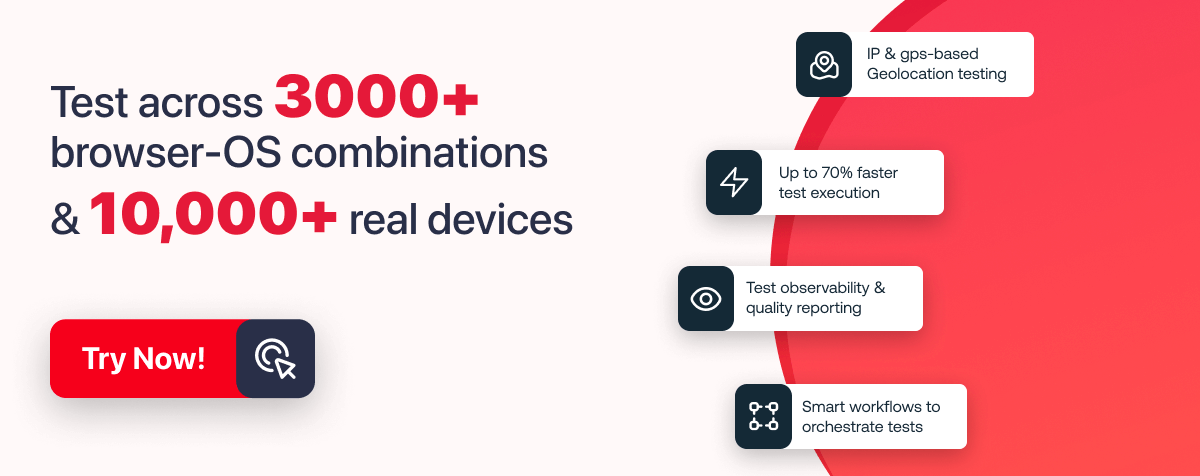
It enables you to run pytest and unittest tests across 3,000+ browser and OS combinations and 10,000+ real devices, while providing advanced debugging tools such as logs, video replays, and step-by-step screenshots. Integration with popular CI/CD tools ensures smooth automation, letting your team scale Python test execution efficiently and reliably.
Key features:
- Parallel Execution: Run multiple pytest or unittest tests simultaneously across different environments, reducing test cycle times dramatically.
- Cross-Platform Consistency: Execute tests on multiple OS versions and Python configurations without worrying about local machine differences.
- Real-Time Debugging Tools: Access detailed logs, screenshots, and video replays to pinpoint why a test failed, saving hours of troubleshooting.
- Seamless CI/CD Integration: Connect TestMu AI with Jenkins, GitHub Actions, GitLab, CircleCI, and more for automated test execution as part of your pipeline.
- Environment Diversity: Test across a variety of Python versions, OS combinations, and browsers (for web automation) to catch edge cases before they reach production.
- Scalability on Demand: Add more concurrent sessions as your test suite grows without investing in additional local infrastructure.
With TestMu AI, running pytest vs unittest tests at scale becomes more reliable, faster, and easier to manage. You get comprehensive insights into test performance, detect flaky tests, and ensure your Python applications perform consistently across environments.
To get started, follow the support documentation for setting up pytest with Selenium and unittest with Selenium on TestMu AI. These guides walk you through the setup, configuration, and best practices to run your tests smoothly on the cloud.
Conclusion
Both pytest and unittest bring unique strengths to Python testing, and the right choice depends on the priorities of your project and team. pytest emphasizes flexibility, faster test authoring, and powerful extensions that suit modern, evolving applications. Unittest, on the other hand, stands out for its built-in availability, structured approach, and alignment with long-standing xUnit practices.
Instead of asking which is universally better, it’s more useful to evaluate where each tool aligns with your workflow, pytest for speed and scalability, and unittest for consistency and stability. By understanding these differences, you can confidently select the framework that best supports your testing goals.


Frequently asked questions
Did you find this page helpful?
More Related Hubs
TestMu AI forEnterprise
Get access to solutions built on Enterprise
grade security, privacy, & compliance
- Advanced access controls
- Advanced data retention rules
- Advanced Local Testing
- Premium Support options
- Early access to beta features
- Private Slack Channel
- Unlimited Manual Accessibility DevTools Tests