

Next-Gen App & Browser Testing Cloud
Trusted by 2 Mn+ QAs & Devs to accelerate their release cycles


On This Page
- Advantages Of Microservice Architecture
- Microservices Design Principles
- Single Responsibility Principle
- Scope Of Functionality
- High Cohesion and Loose Coupling
- Unique Source Of Identification
- API Integration
- Data Storage Segregation
- Traffic Management
- Process Automation
- Minimal Database Tables
- Constant Monitoring
- Design for failure
- Business Tailored Microservices
- Scalability
- Real-Time Load Balancing
- Limitations Of Microservice Architecture
- Conclusion

14 Must Know Microservices Design Principles
Learn about the different microservices design principles to design an efficient microservices architecture.

Hari Sapna Nair
December 19, 2025
Imagine an airport humming with diverse operations, where each department serves as a meticulously crafted microservice dedicated to specific operations such as booking, check-in, and baggage handling. The airport architecture must follow fundamental design principles in this intricately designed architecture, mirroring the principles of microservices.
For example, the airlines operate independently yet interact seamlessly through standardized protocols, similar to how microservices are designed in a high cohesion combined with a loose coupling. And just as each flight is uniquely identified, microservices are distinguished by their endpoints or service names. Similarly, other design principles are implemented in microservices and a well-orchestrated airport for efficient working. Following the microservices design principles helps to increase agility, performance, and cost-efficiency for large and small organizations while enabling continuous testing and early delivery.
In our latest blog, you can explore the Monolithic vs Microservices debate to uncover the pros, cons, and key distinctions between the two architectures and navigate your choices wisely!
Advantages Of Microservice Architecture
With monolithic architectures, developers often face challenges of limited reusability and scalability. But, with a microservice design, this single unit can be broken down into different modules, making development, deployment, and maintenance easy. So, let’s look at some significant advantages of microservice architecture.
- Technological Flexibility: While monolithic architecture always leaves the developers looking for the ‘right tool for the job,’ microservice architecture offers the coexistence of multiple technologies under one cover. Different decoupled services can be written in various programming languages. This enables developers to experiment and scale their products by seamlessly integrating additional features and functionalities.
- Increased Efficiency: Microservice architecture speeds up the entire process of development. Teams can work simultaneously on multiple software system components, unlike a single unit. This, in addition to increasing productivity, makes it easier to locate and focus on specific components. The malfunctioning of a single component will not affect the entire system. Instead, this also eases error location and maintenance.
- Products, Not Projects: According to Martin Fowler, microservice architecture helps businesses create ‘products instead of projects.’ In simpler terms, microservice architecture allows teams to come together and create functionality for business rather than simple code. These can further be used for different lines of business if applicable. In addition, it also makes an autonomous, cross-functional team.
- Improved Scalability: Microservices architecture offers significant scalability benefits by allocating dedicated resources to each service and preventing overload on the entire system during traffic spikes.
- Better Fault Isolation: In a microservices architecture, the likelihood of one service failure adversely affecting other application components is minimized as each microservice operates independently.
- Better Data Security and Compliance: With each service assigned to a specific task, implementing security measures at the service level becomes more manageable than a monolithic database accessible by the entire application. Using secure APIs to connect microservices also helps to ensure that data is accessible only to authorized applications, users, and servers.
Find out how microservices design patterns can help you optimize your application for peak performance to scale smoothly, remain resilient, and integrate seamlessly with other systems.

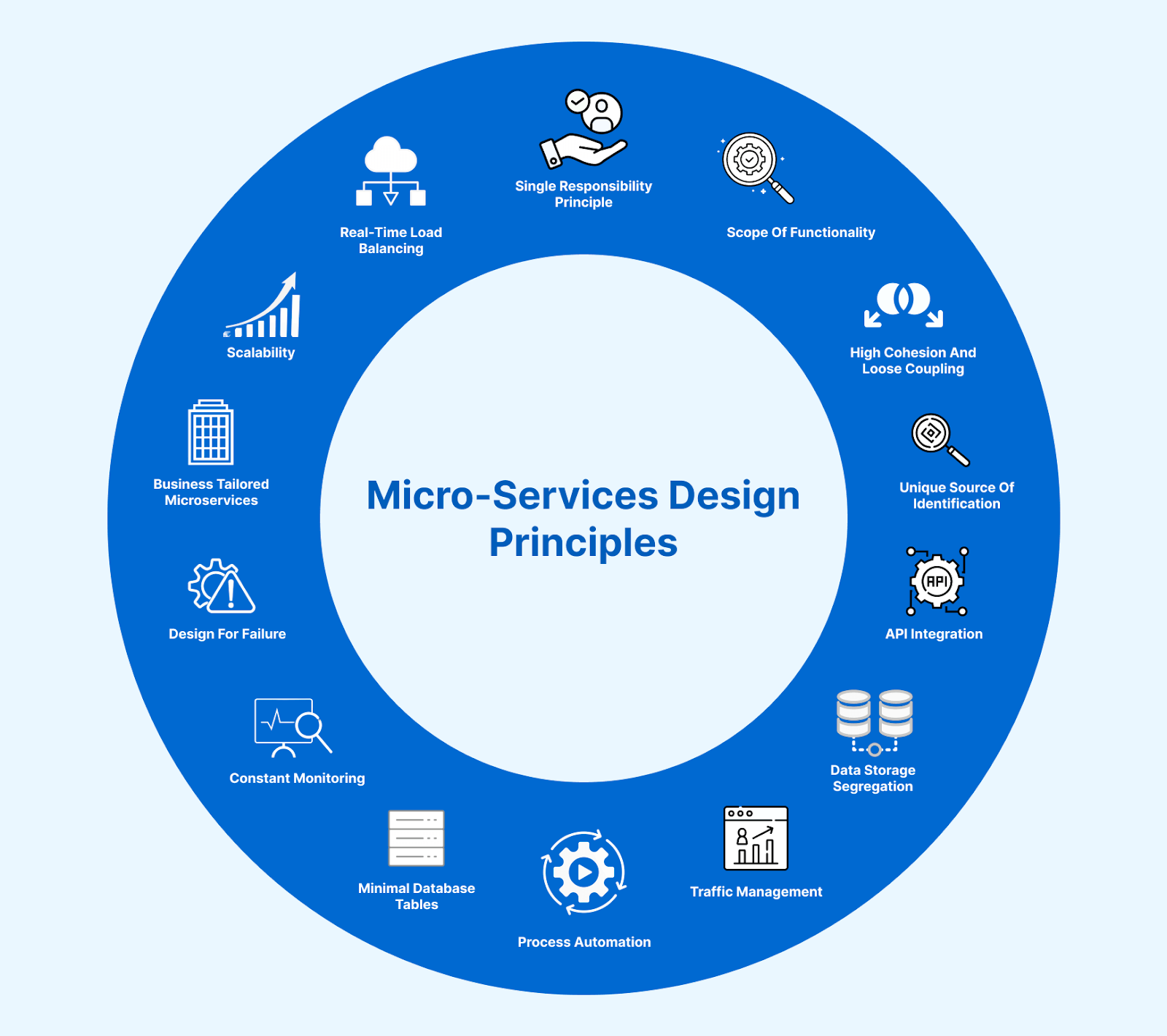
Microservices Design Principles
We know the advantages of a microservice architecture, but how do we achieve perfection? Are we aware of the microservices design principles? What are the best practices for designing a microservice architecture?
Let us answer these questions and look at some fundamental microservices design principles used to develop a successful microservice application. This will enable us to navigate the complexities during microservices testing and help us achieve optimal results.
Ready to master the fundamental principles used to build a microservice? Don’t miss out! Watch fundamentals to a successful microservice design that can elevate your microservice architecture.
Single Responsibility Principle
The Single Responsibility Principle(SRP) states that a class or module should have only one primary responsibility, and modifications should be made only for reasons related to that particular responsibility. This principle is crucial in microservices architecture because each microservice should align with a specific business capability, ensuring a clear and singular responsibility.
Each service must handle a distinct functionality or business domain in microservices. By adhering to the Single Responsibility Principle, developers design modules with a single, well-defined purpose, making them easier to understand, maintain, and scale. This principle helps prevent the inclusion of multiple unrelated responsibilities within a single microservice, promoting modularity and independence.
When a microservice follows the Single Responsibility Principle, it becomes more adaptable to changes related to its specific responsibility without affecting other system parts. This isolation allows for each microservice’s independent development, deployment, and scalability, contributing to the overall flexibility and maintainability of the microservices-based application.
Scope Of Functionality
With the simultaneous implementation of development and deployment by different teams to establish or support a unique functionality with a product, defining the scope of a microservice becomes an essential task. We can achieve this by following the Single Responsibility Principle (SRP). SRP guides us to design modules with a singular focus, this in turn narrows the scope of functionality to enhance maintainability and clarity in software systems.
When we talk about a microservice’s scope, we refer to the features of an independent software module. Identifying the features that a microservice will implement will help us define the scope of functionality of the microservice and establish clear boundaries. For example, consider a microservice responsible for user authentication within an e-commerce platform. Its scope would include functionalities such as user registration, login, password reset, and authentication token generation. This well-defined scope ensures that the microservice focuses solely on handling user authentication-related tasks, optimizing its efficiency and maintainability.
The question comes as to how one can define the scope of a microservice. Though there isn’t a well-defined set of rules to achieve this, there are a few guidelines or best practices to define a scope.
Following are some of the steps that you can consider while defining the scope of any microservice:
- The first step is to identify the pieces of code that are replicated under various modules. How often do you see them repeat? And how much effort goes into setting them up in different modules each time? If the answer to all of these is high, then the scope of the microservice would be to handle just the repeating pieces of code.
- Another step is to check if a module is not dependent on other modules or, in simpler terms, if a module may be loosely coupled with the rest of the services. If so, then the scope of the microservice will be the scope of the entire module.
- Another important metric to consider while defining the scope is checking if the features would be used with a heavy load. This would check if the microservice would have to be scaled up soon. If it does, then it’s a good idea to define the scalable bits as the scope of a microservice rather than combine it with other features.
High Cohesion and Loose Coupling
The main motive of any microservice is to have services independent of each other. This means one can edit, update, or deploy a new service without hampering other services. This is possible if interdependence is low. So, we must create a loosely coupled system where one service knows too little or nothing about others. This also makes testing easier as each component can be easily isolated for thorough testing.
It is essential to combine similar functionalities when breaking down a monolithic architecture into smaller services or components. This combination of related logic into a single unit is known as cohesion. The higher the cohesion, the better the microservice architecture. A low cohesion would indicate too much communication between different services, leading to poor system performance.
Hence, we must design a microservice with high cohesion and loose coupling to make it adaptable to changes and scalable.
Unique Source Of Identification
Following the fundamentals of microservice design, any service needs to be the unique source of identification for the rest of the system. Let us take an example to understand this.
After an order is placed on an e-commerce website, the user is provided with an order ID. Once generated, this order ID contains all the information regarding the order. As a microservice, the order ID is the only source for any information regarding the order service. So, if any other service seeks information regarding the order service, the order ID acts as the source of information rather than its actual attributes.
API Integration
In a microservices architecture, multiple services coordinate and work together to form the system. But how do these services communicate? Imagine using various technologies to create different services. How do they relate to each other? The simple answer would be using an API (Application Programming Interface). While designing a microservice, it is important to select the right APIs. This is crucial to maintaining communication between the service and the client calls. Easy transition and execution are essential for proper functioning.
Another important thing to note while creating an API is the domain of the business. Understanding the scope of the business’s operations will help us define the boundaries and differentiate the various functionalities the API will provide.
There are several clients that are external to the system. These clients could be other applications or users. Whenever a business logic is called, it is handled by an adapter (a message gateway or web controller), which returns the request and changes the database.
Data Storage Segregation
Each microservice maintains its dedicated database in a microservices architecture, contrasting with monolithic applications where multiple services may share a common database. The autonomy provided by individual databases supports the independent development, deployment, and scalability of microservices.
Any data stored for a specific service should be made private to that particular service. This means any access to the data should be owned by the service. This data can be shared with any other service only through an API. This is very important to maintain limited access to data and avoid ‘service coupling.’ Data classification based on the users is essential and can be achieved through the Command and Query Responsibility Segregation (CQRS).
Traffic Management
Once the APIs have been set and the system is up and running, traffic to different services will vary. The traffic is the calls sent to specific services by the client. In the real-world scenario, a service may run slowly, thus causing calls to take longer. Or a service may be flooded with calls. Both cases will affect the performance, even causing a software or hardware crash.
This high traffic demand needs management. A specific way of calling and being called is the answer to a smooth traffic flow. The services should be able to terminate instances that cause delays and affect performance.
Traffic management can also be achieved using a process known as ‘auto-scaling,’ which includes constantly tracking services with prompt action whenever required. Sometimes, a ‘circuit breaker pattern’ is essential to supply any incomplete information in case of a broken call or an unresponsive service.
Process Automation
Microservices designed independently should be able to function on their own accord. The automation would enable self-deployment and function without the need for any intervention. This process allows the services to be cloud-native and deployed in any environment. But to achieve this, it is very important to have a DevOps team constantly working towards evolving the services.
Minimal Database Tables
Accessing database tables to fetch data can be a lengthy process. It can take up time and energy. While designing a microservice, the main motive should revolve around the business function rather than the database and its working. To ensure this, a microservice design should have only a few tables, preferably isolated, even with data entries running into millions. In addition to minimum numbers, focusing on the business is key.
Constant Monitoring
Imagine breaking down a monolithic architecture into a microservice design. This needs a lot of time and resources. It is not easy to monitor all the changes made with the help of traditional tools. The insertion of data layers and caching increases performance but makes it difficult to monitor the entire process.
Hence, when designing a microservice architecture, it is important to establish a process for actively monitoring data storage in a central location. This will help reflect the frequent changes without affecting the system’s performance. In a typical scenario, the microservice monitoring tools will monitor individual services and combine the data by storing it in a centralized location. This is a necessary step while following microservices design principles.
Along with monitoring data storage, it is also important to continuously monitor API performance. API performance monitoring is crucial to any microservice architecture to ensure the functionality stays up to the mark regarding speed, responsiveness, and overall product performance.
Design for failure
Microservices architecture aims to enhance fault tolerance and resilience in software systems by isolating services to prevent the failure of one from impacting others. The objective is to ensure that issues like memory leaks, database connectivity problems, or errors in one microservice do not result in the failure of the entire application.
To achieve this goal, the circuit breaker pattern is a common method used in microservices. This pattern involves monitoring the status of a microservice and dynamically adjusting its behavior based on that status. If a microservice experiences repeated failures or errors, the circuit breaker pattern allows the system to temporarily cut off communication with the problematic service. Implementing the circuit breaker pattern allows a microservices-based application to prevent prolonged communication attempts with a failing service, thus avoiding performance issues and potential system-wide failures. This isolation mechanism ensures that other services can function independently, promoting overall system resilience.
Business Tailored Microservices
The microservices design principle of aligning each microservice with a specific business problem encourages developers to adopt the most suitable technology stack for each microservice’s unique requirements. Unlike monolithic applications that often use a single, homogenous technology stack throughout, microservices architecture allows for flexibility and diversity in technology choices.
In a microservices-based application, developers have the freedom to choose the programming language, framework, and database that best fit the specific needs of each microservice. This approach enables the optimization of technology choices based on factors such as scalability, performance, or data processing requirements for each component. This flexibility promotes agility and adaptability, as developers can leverage the strengths of various technologies to address specific challenges within the microservices ecosystem.
Scalability
Scalability is a crucial design principle in microservices that empowers the application to seamlessly adapt to fluctuating levels of traffic, data volumes, and complexity without compromising system performance. For instance, in an e-commerce application, scalability comes into play during peak demand, like the festive season when there’s a surge in application traffic. It dynamically adjusts the capacities of essential microservices, including databases and servers, ensuring optimal performance to meet the heightened demand.
Achieving scalability involves employing strategies like Service partitioning, Load balancing, Horizontal scaling, and Caching, providing a robust framework for effectively managing varying workloads.
Real-Time Load Balancing
In scenarios where a client initiates a request that requires data retrieval from multiple microservices simultaneously, the role of the Load balancer becomes crucial. The Load balancer plays a pivotal role in managing this complex operation by determining the allocation of Central Processing Unit (CPU) or Graphics Processing Unit (GPU) resources for each specific service that fetches the required data. It manages the distribution of computational resources and regulates how the client request is routed, ensuring an optimal and efficient process. This helps to minimize latency, allowing clients to receive prompt results without unnecessary delays, thereby enhancing the overall responsiveness and performance of the system.
Whether you’re a seasoned developer or just starting in the field, understanding and implementing these microservices design principles can revolutionize your approach to microservices testing and set the stage for successful application development.
To unlock the full potential of your microservices architecture with effective testing strategies, dive into our Microservices Testing Tutorial and Microservices Testing Quick Start Guide!

Limitations Of Microservice Architecture
While microservices are the best way to tone down a monolithic structure, they have drawbacks. But before concluding, let’s look at some of these.
- Development Environment Overload: With the growth of the application and its database, there is an expansion in the code base as well. With the code expanding for every microservice present, it overloads the development environment with every loaded application. This can cause a significant delay in productivity.
- Increased complexity: In microservices, each service becomes an autonomous unit, communicating through networks, APIs, or messaging protocols. This introduces a substantial rise in the application’s architectural complexity as there is a need for intricate coordination, additional considerations for data consistency, and the implementation of effective communication mechanisms.
- DevOps Complexity: Developing and deploying single-function microservices is not easy. Using multiple technologies and creating APIs to centralize the system is a challenge. This calls for an experienced DevOps team. Procuring such an experienced DevOps team is crucial to maintaining a microservice-based application’s complexities.
- Network congestion: Microservices make the network more chatty as numerous services interact. This increased chatter, often called the “microservices chatter problem,” can result in network congestion and reduce performance. The sheer volume of data exchange between microservices may lead to latency, slower response times, and the need for efficient network management strategies to optimize overall system performance.
- Increase In Resource And Network Usage: With multiple components working together, they need to communicate with each other at some level. This communication will lead to increased network usage. This demands a high-speed, reliable network connection. In addition, expenses increase to run these applications. All services run individually, raising the costs of operation.
- Difficulty in testing and debugging: Testing and debugging microservice-based applications pose unique challenges as the system is distributed across multiple servers and devices. The difficulty lies in the need for access to all components to ensure adequate testing and debugging. In large, distributed systems, coordinating access to various servers and devices becomes a complex task, impacting the efficiency of the testing process. Addressing these challenges requires thoughtful strategies and tools to streamline testing efforts in the intricate landscape of microservices architecture.
- Application Complexity: As microservices are independent components, each microservice will often have a technology stack that best suits its needs. For example, a machine learning module might use the Python stack, the metering service might use the Java stack, and the UI service might use the MEAN stack. This leads to complexity as the resource pools and the skills required to manage and build newer features will be very high.
- High Initial Investment: Microservices run independently and require independent containers or resources to run them. Each project might have a lot of microservices working together. It would need a much higher investment to set up all the clusters, including the microservices, security containers, load balancers, API gateways, etc.
- Challenges in providing security: Security is of paramount importance when it comes to web applications. With microservices, achieving this takes time and effort. When there are clusters of independent modules, each module needs to adhere to the authentication and authorization norms defined for the entire system. Each module might talk to others, and tracking the data flow becomes difficult. Additional measures, such as API gateways with load balancing, are required to ensure consistent behavior. These additional steps cause overhead on each of the microservices.
Check out our blog on Testing Challenges With Microservices Architecture to uncover insights, solutions, and best practices.
Conclusion
After reading the fundamentals of microservices design principles, it is clear that a certain set of best practices must be followed to design an efficient microservices architecture. But, we also observe how the microservices design principles ease the process of creating an application by breaking down the monolithic architecture. But, at the same time, certain challenges need to be overcome when adapting a microservice architecture. These complexities affect the operational processes, but in the long term, overcoming these challenges can lead to an optimized and more efficient application. In addition, it overcomes delays and flaws while increasing flexibility and performance.
The future of microservices architecture holds promising trends to reshape the software development landscape. The continued adoption of microservices is anticipated, with many organizations recognizing the benefits of scalability, flexibility, and ease of maintenance that this architecture offers. A prevailing prediction is that microservices will become the default software architecture system, indicating a shift toward modular and decentralized application development.
Many enterprises, including names like PayPal, Twitter, TestMu AI, and Netflix, have backed up the reliability of microservice architecture for deploying more scalable, functional, and robust software.


Frequently asked questions
Did you find this page helpful?
More Related Hubs
TestMu AI forEnterprise
Get access to solutions built on Enterprise
grade security, privacy, & compliance
- Advanced access controls
- Advanced data retention rules
- Advanced Local Testing
- Premium Support options
- Early access to beta features
- Private Slack Channel
- Unlimited Manual Accessibility DevTools Tests