

Next-Gen App & Browser Testing Cloud
Trusted by 2 Mn+ QAs & Devs to accelerate their release cycles


Embrace Continuous Testing for Flawless Software Delivery
Discover how continuous testing drives software excellence and quick releases in today's fast-paced tech landscape.

Smeetha Thomas
December 24, 2025

In today’s rapidly evolving technology landscape, organizations are under immense pressure to deliver high-quality software products and meet faster release timelines. With application delivery demanding unparalleled speed and agility, this report by PwC states that by this year, 500+ million digital apps and services are expected to hit the market.
The need of the hour is to deliver applications at the pace of business change. Enterprises are also starting to look to software as a source of competitive advantage. As a result, we are witnessing an evident shift from manual, time-intensive workflows to automated and faster development techniques.
With all this in the backdrop, application failure is not an option. It can lead to lost revenue opportunities and even adversely impact brand reputations. For these reasons, organizations are turning to agile development and DevOps methodologies in a bid to deliver quality software in less time. Additionally, given how time pressures are resulting in security shortcuts, nearly 74% of developers admitted to regularly releasing insecure applications. This brings in the need to test early, frequently, and quickly.
Drawing from our experiences, we have found that enterprises that are merging development and testing into a single continuous activity, have successfully managed to take the lead in the innovation race. In this article, we explain why continuous testing is the key to accelerating time-to-market and shipping higher-quality software.
Why Continuous Testing is Crucial in the DevOps Era
With organizations intensifying their investments in digital transformation programs, continuous testing becomes a key element in this transition. To guarantee consistent quality throughout the Software Development Lifecycle (SDLC)—incorporating the right tests at the right time across stages of the application delivery pipeline is key.
As a critical component of DevOps, the practice of continuous testing helps engineering teams mitigate the risk of bugs beforehand, minimizing the chances of costly mistakes and potential delays further along the process.
With a spike in demand for mobile-based applications and software, incorporating continuous testing becomes essential. Though challenging, adopting continuous testing practices and implementing appropriate automation at each stage of development ensures that quality is integrated into your application throughout its journey to production.
Fast-tracking Time-to-Market and Enhancing Software Quality with Continuous Testing
To succeed in today’s digital landscape, organizations need to roll out improved business capabilities continuously.
The traditional practice of including quality assurance only in the later stages of the development cycle is no longer sufficient
In the past, software development and rollout involved numerous iterations, with changes undergoing extensive review by a large team of testers over several weeks. This complexity often caused significant delays in software releases, leading many companies to limit major internal software changes to just a few times a year.
By adopting continuous testing models, organizations can streamline the process of creating digital products and services and achieve quicker time-to-market. Here are some of the many ways in which continuous testing prevails over traditional testing practices:
- While traditional testing occurs at the end of the development cycle, continuous testing spans the entire SDLC, involving testing at each stage.
- By testing early and often, continuous testing achieves higher test coverage compared to traditional models. Additionally, while traditional testing has longer feedback loops, continuous testing initiates immediate feedback, resulting in faster fixes. This way, teams are well-positioned to detect issues quickly and release software updates faster with fewer mistakes.
- Further, by using automated tools and systems, teams can test and release software quickly while still ensuring exceptional quality.
The Benefits of Continuous Testing
To deliver on the promise of speed and innovation, coders and infrastructure teams need to work in lockstep. Continuous testing makes this possible by embedding quality checks throughout the SDLC and transitioning away from the practice of treating testing as an isolated function at the far end of the development cycle.
Continuous testing offers a range of benefits, including:
- Reduces risks:Integrating continuous testing enables the detection of defects and errors in the early stages of software development, allowing for a swift rollback of failures and quicker fixes. This approach significantly minimizes the likelihood of vulnerabilities and issues slipping through undetected.
- Enhances software quality:Continuous testing ensures that software meets all quality standards. Moreover, early detection of issues allows for timely feedback, facilitating faster decision-making and improving the overall quality of the software.
- Accelerates time-to-market:With continuous testing, companies can move faster and make updates swiftly, reducing the time-to-market. Furthermore, by incorporating continuous testing, organizations can experience a notable reduction in the time and resources dedicated to manual testing, allowing for enhanced scalability without compromising on software reliability.
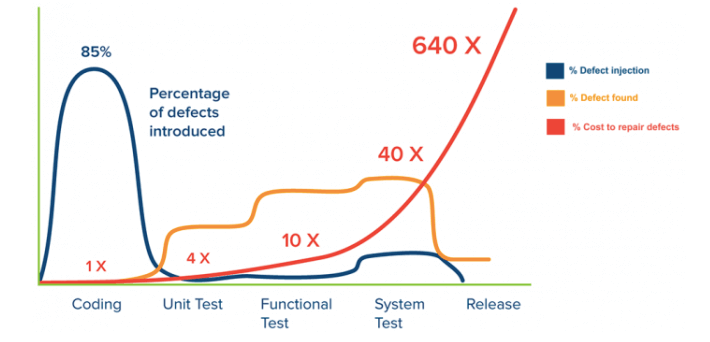
- Lowers costs:Continuous testing enables organizations to spot critical issues in the initial stages of development, saving them the cost of fixing errors further down the line. With the early detection of defects and shorter product-testing periods, continuous testing substantially reduces the cost of delivering new products and services. As shown in the image below, timely defect detection leads to significant cost savings.
- Boosts customer satisfaction:By releasing better quality software faster, organizations can respond quickly to changing market and user demands. Continuous testing not only accelerates release timelines and increases speed to market but also delivers differentiated user experiences. With continuous analysis of user preferences and prompt implementation of customer feedback, developers can tailor experiences to resonate with users on a deeper level.
- Improves efficiency and team collaboration:Continuous testing helps developers, testers, and operations teams work faster and better together. With continuous testing in place, teams benefit from a steady flow of code-quality feedback. This, in turn, facilitates seamless collaboration and heightened efficiency between operations and developer teams.
6 Best Practices to Implement Continuous Testing
By leveraging the full capabilities of continuous testing, enterprises can fast-track digital application testing and considerably improve the market potential. These six best practices for implementing continuous testing will empower your organization with limitless potential and a competitive edge.
- Early and frequent testing: Testing should be implemented as early as possible in the development lifecycle and integrated throughout the project.
- Switch to test automation tools: Accelerate testing at every stage with automation tools. Opt for tools that are easy to use and find the best fit by understanding your project requirements such as: what aspects of the testing process need automation?
- Establish frameworks: Build an effective test automation framework that is scalable and flexible to meet the growing project needs.
- Integrate testing into the DevOps pipeline: From code commit to production release, continuous testing must be integrated throughout the DevOps pipeline.
- Leverage containerization: Make continuous testing easier and ensure a reliable environment by bundling all components of an application together using containers.
- Utilize the right test data: Employing test data that accurately mirrors real-life scenarios enables comprehensive testing and ensures the software is evaluated under conditions similar to actual usage, providing more reliable results.
Bottom Line
Continuous testing will help enterprises infuse greater speed and intelligence into the development process of their products and services. Although the implementation of continuous testing is not without potential roadblocks, following the six best practices will set your teams off to a great start. As the world’s leading testing tool, TestMu AI caters to the test execution needs of 500+ global enterprises and 600,000+ users across 130+ countries. Talk to our experts to know how you can conduct parallel testing across 3000+ browsers and release software to the market at the pace and quality that customers expect.



Did you find this page helpful?
More Related Hubs
TestMu AI forEnterprise
Get access to solutions built on Enterprise
grade security, privacy, & compliance
- Advanced access controls
- Advanced data retention rules
- Advanced Local Testing
- Premium Support options
- Early access to beta features
- Private Slack Channel
- Unlimited Manual Accessibility DevTools Tests