

Next-Gen App & Browser Testing Cloud
Trusted by 2 Mn+ QAs & Devs to accelerate their release cycles


AI-Based Test Execution: Transforming and Optimizing Strategies
Explore the need for AI-based test execution strategies and how AI impacts test execution, analysis, and defect predictions for optimal software quality.

Smeetha Thomas
March 16, 2026
It’s safe to call 2022 and 2023 the breakout years for Artificial Intelligence (AI) In the field of testing, AI has evolved as a revolutionary force—promising greater functionality and adaptive learning as well as continuous improvement. It has emerged to offer innovative solutions to address the shortcomings of traditional test automation.
For instance, AI-based test execution strategies have a multitude of benefits to offer, especially in identifying defects. These tools help to increase defect detection rates by nearly 90% when compared to manual inspection rates.
Backed by advanced algorithms, AI-powered tools can process and analyze vast amounts of data and pinpoint defect-prone areas with greater precision, allowing for targeted test case selection. Utilizing machine learning techniques, development teams can identify patterns and correlations between code changes and defect occurrences—and make intelligent, data-backed decisions.
Whether it is generating test cases and executing tests or predicting anomalies and analyzing test results—organizations that leverage AI-based test automation applications are experiencing a significant increase in testing efficiency, enhanced accuracy, accelerated time-to-market, and a reduction in software defects.
With the demand for high-quality software and faster delivery cycles, traditional test execution strategies (mostly manual and linear) are failing to keep up. In this article, we will take a look at how AI-driven test execution strategies are bringing about a paradigm shift in the software development landscape.
Understanding AI-Based Test Execution
Reliable tests are pivotal. AI-based test automation applications have emerged as a game-changer, dynamically updating tests to minimize test maintenance despite significant application changes.
When it comes to testing, it is the increased time to value that makes AI so promising. AI has redefined software testing by introducing intelligent algorithms and automated systems that can analyze large volumes of data and make informed decisions.
AI makes test executions more fluid and dynamic. With AI and machine learning algorithms, organizations can translate user stories, documentation, and acceptance criteria to create executable test cases. AI-based test execution also ensures greater efficiency by prioritizing test cases based on risk, code coverage, real-time analytics, and historical data.

The Need for AI-based Test Execution Tools
Smart test execution strategies are the need of the hour, considering the increasing code complexities and shorter release cycles. With AI algorithms, you can execute tests, analyze test results, and monitor system behavior in real-time.
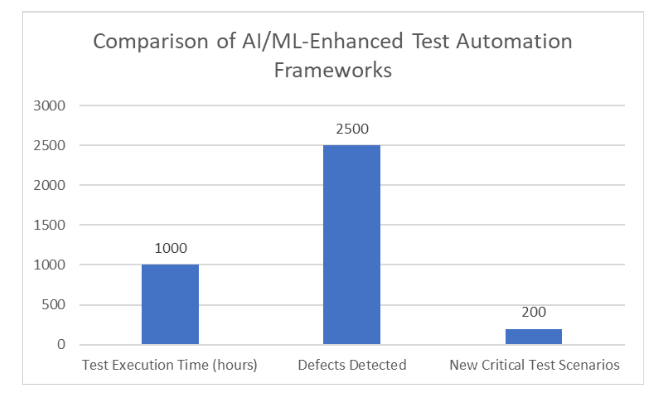
Source: IAEME
A few of the primary reasons for transitioning from traditional testing methods to AI-based test execution tools include:
- Greater speed in testingOne of the most time-consuming aspects of software testing is test case generation and covering various scenarios and edge cases. The synergy of AI and automation unlocks a world of possibilities in testing. AI-based testing tools automate repetitive and laborious tasks, boosting testing efficiency and speeding up testing cycles. By quickly addressing code coverage issues and accelerating bug resolution, AI-based test execution enables faster time to market.
- Enhanced reliability of test resultsAI algorithms can be used to execute tests and analyze test results and data in real-time to identify patterns, detect anomalies, and predict potential defects. Machine learning techniques can further provide insights into which areas of the software application are prone to errors, ensuring QA teams are spending their time wisely and concentrating on critical areas that require additional investigation.
- Capability to self-healWith AI-based test execution tools, you can automatically fix broken test scripts caused by changes in the application. AI provides teams with intelligent and adaptive test frameworks for continuous testing. These test frameworks introduce auto-healing capabilities, also known as self-healing test automation, as they adapt testing dynamically to changes in the application in order to continue testing without human intervention.
The self-healing test functionality studies testing data to identify potential issues or element changes that caused a test script to break, and then it applies changes to fix the issue while continuing to run the test. Moreover, the self-healing feature speeds up the testing process, all the while providing exclusive insights into application issues and component performance.
Key Factors Driving the Shift to AI-Based Test Execution
As the world gets more obsessed with artificial intelligence, it is important to understand how AI can be applied in testing and its impact in key areas like test execution, analysis, and defect prediction.
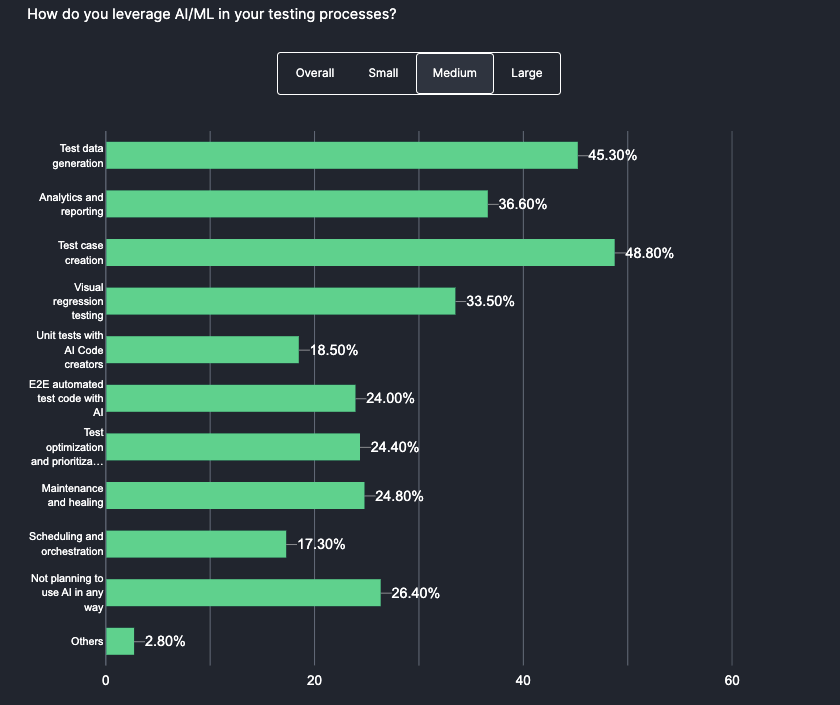
- Optimizing test case prioritizationAs per The Future of Quality Assurance Survey, for 48.80% of medium-sized organizations and 48.60% of large organizations—test case creation is the most sought-after use case of AI. Prioritizing test cases with AI reduces testing costs and speeds up the product delivery of test projects. AI-based test execution tools help software teams ensure that the most critical test cases are executed early in the development lifecycle.
- Increased test coverageAccording to reports, AI-driven testing has the ability to increase test coverage by up to 85%. It ensures comprehensive test coverage by considering different scenarios and edge cases that might get overlooked by human testers.
- Lowers dependency on manual interventionAccording to a survey by Capgemini, automating the Quality Assurance (QA) processes and making them smarter was the top priority for 42% of the organizations. AI tools’ self-healing capabilities not only reduce the occurrence of false positives, but the auto-healing test functionality fixes failures in real time—without human intervention.
- Continuous improvementAI-based test execution strategies effectively address the complexities and variations present in modern software applications and provide predictive insights into potential flaky tests and failure points. These AI models learn and improve from every test execution and past test results. This ensures a dynamic and responsive testing process along with continuous improvement. It further streamlines the testing pipeline, enabling faster feedback loops and greater agility in software development cycles.
Many modern automation architectures discussed in MCP and AI Agents show how intelligent systems maintain testing context and coordinate tools across the QA workflow to enable this continuous learning cycle.
To learn more about how intelligent algorithms are reshaping quality assurance workflows, check out this detailed guide on AI in software testing, which explores practical applications and benefits across the testing lifecycle.
What are the Benefits of AI-Based Test Execution Strategies?
Test automation is a critical element of a software development lifecycle. AI is augmenting traditional methods with intelligent algorithms and helping prioritize tests based on user impact, potential risk level, and code coverage.
AI-based test execution is a pioneering step forward in software quality assurance. With AI, test suites are optimized to maximize efficiency, bring down redundancy, and find the quickest path to code coverage. In turn, this allows testers to spend more time validating critical functionality.
Here’s a rundown of the key benefits of leveraging AI-based test execution tools:
- Boosts resource efficiency: AI helps automate repetitive development tasks such as code reviews and documentation, freeing up developers to focus on higher-value tasks. Testers can leverage intelligent chatbots that use Natural Language Processing (NLP) to handle common developer queries. AI also empowers testers to dynamically prioritize critical test cases based on their impact and risk levels.
- Instant feedback on testing: Utilizing AI-powered analytics to monitor test execution and provide instant feedback on test results empowers testers to identify and address issues as they arise.
- Early detection of issues: With AI’s advanced algorithms and machine learning models, testers can analyze historical patterns and current trends. This way, testing teams can foresee potential vulnerabilities and identify defects even before they occur, enabling teams to preemptively address these issues and take up proactive mitigation strategies.
- Predictive analytics: AI-native test analytics will help maximize testing accuracy. By leveraging advanced machine learning models, testers can delve deep into vast datasets, extracting valuable insights to further refine test execution approaches and enhance decision-making based on up-to-date data.
AI-Based Test Execution is Transforming the Software Landscape
To find success with AI-based test execution, it is crucial to find a tool that will offer you advanced AI capabilities.
With TestMu AI, organizations can bid goodbye to flaky tests. Its built-in self-healing capability detects changes in element attributes and builds stable tests for functional, visual, and API tests in one flow.
To ensure your applications work seamlessly, you can run tests across 10,000+ real device, 3000+ browsers and device combinations. That’s not all; backed by AI-native test intelligence insights, you can predict and mitigate potential issues even before they take root.
With the rise of AI in testing, its crucial to stay competitive by upskilling or polishing your skillsets. The KaneAI Certification proves your hands-on AI testing skills and positions you as a future-ready, high-value QA professional.
Experience the ease of TestMu AI’s AI-native Unified Test Manager and maximize efficiency across all testing phases.


Did you find this page helpful?
More Related Hubs
TestMu AI forEnterprise
Get access to solutions built on Enterprise
grade security, privacy, & compliance
- Advanced access controls
- Advanced data retention rules
- Advanced Local Testing
- Premium Support options
- Early access to beta features
- Private Slack Channel
- Unlimited Manual Accessibility DevTools Tests