

Next-Gen App & Browser Testing Cloud
Trusted by 2 Mn+ QAs & Devs to accelerate their release cycles


On This Page
- What does it mean to be an SDET?
- What skill set can be considered an asset?
- How can you engage developers in a team to feel the support and be engaged?
- How can we ensure that we can manage quality-related situations and achieve the set expectations by the end users?
- Why do you look at your respective roles as an asset?
- Q&A Round!

- Home
- /
- Blog
- /
- Panel Discussion: What π Has to do with Good Software Quality and with Career Opportunities [Testμ 2022]
Panel Discussion: What π Has to do with Good Software Quality and with Career Opportunities [Testμ 2022]
In this interactive session, Inga, Thomas, and Mohit talk about the demand of people with a “π-shaped profile” and what a typical SDET profile looks like.

TestMu AI
January 10, 2026

The speed of technical requirements changes, and user expectations are constantly growing. Therefore, quality assurance is an essential part of software development.
In this interactive session, the three panelists spoke on the demand of people with a “π-shaped profile” and what a typical SDET profile looks like. To start with a basic introduction of the speakers:
Inga Becker is a member of the Quality Engineering Leadership team at Accenture and the QE Recruiting Lead. Thomas Karl leads the Quality Transformation Services, and Mohit Srivastava is an SME for Test Automation and Performance Testing & Engineering at Accenture DACH.
To highlight this interesting session:
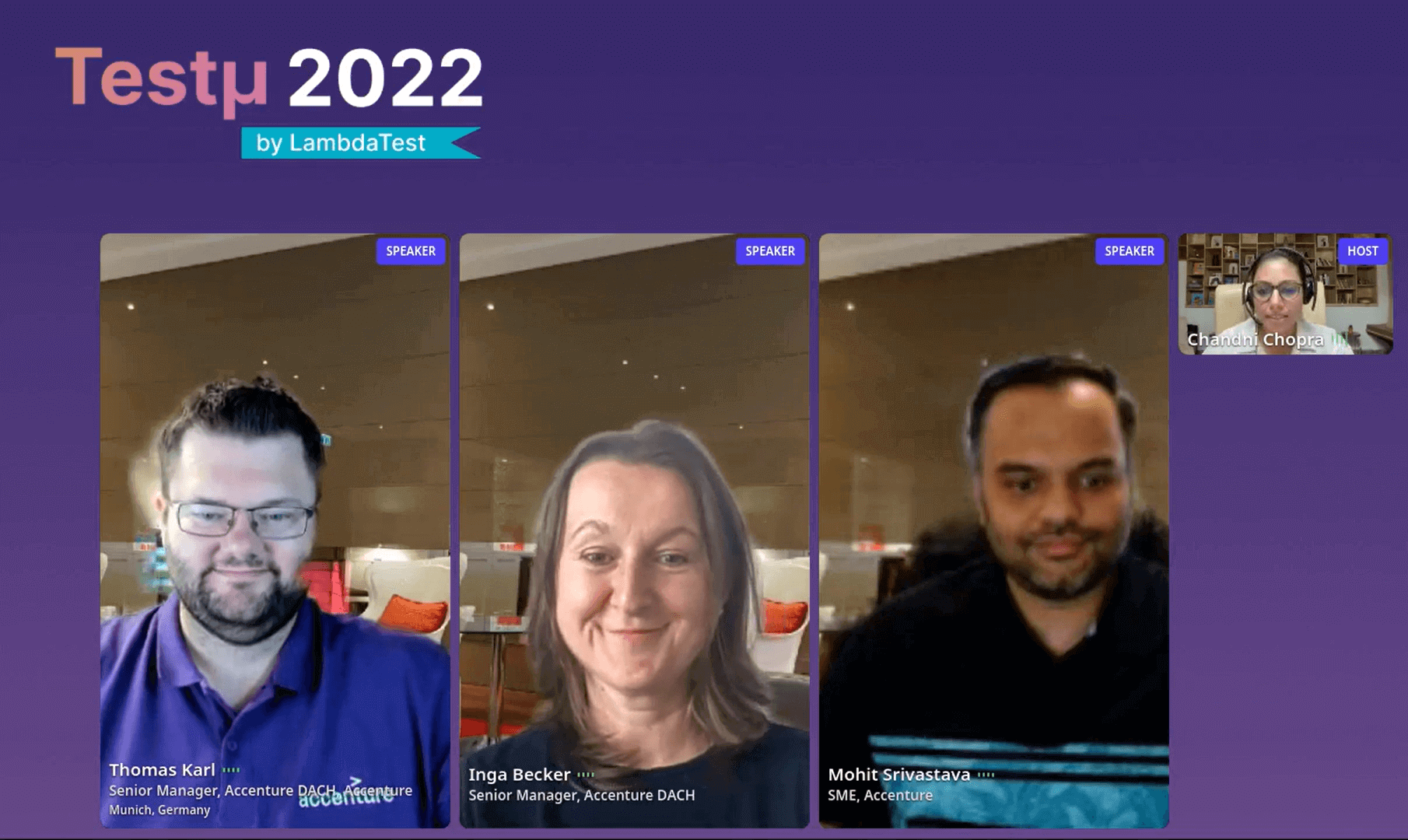
After sharing their experience and work areas at Accenture, Thomas starts the conversation by talking about Software Quality. He focuses specifically on the terminals’ quality engineering because he states that it’s relatively new, and many people have different understandings about what is exactly made with those terminals.
Inga talked about her beginnings at Accenture and shared seeing testers using Excel to manually add data to tests. But that has changed; with test automation as the first step, everyone is now moving toward AI testing. Similarly, with Quality engineering, the focus is on the software from the start rather than looking at the data from a week or month ago.
Mohit also shared his point of view calling this a significant transformation from just a testing process before deployment to giving it an identity as “Quality Engineering.” This led to the company inculcating a big rotation where more teams came together to integrate ways for faster output.
What does it mean to be an SDET?
Mohit talked about how as an SDET, he has the opportunity to not only focus on test automation but how to have more automation on the test data management, how one can generate more test data, and how different toolings can be integrated as well.
Compared to the earlier days, now there is more room for an SDET to understand:
- The product’s vision.
- The expectations through quality.
- The different test cases and acceptance criteria that have to be met.
What skill set can be considered an asset?
Mohit added that as an SDET, you should know, if not more, at least one programming language. This, together with experience in understanding the agile process and the DevOps, because, without DevOps, we cannot do Agile. This makes an SDET more of an architect at the testing level who glues all different test phases into one.
And moving to Inga, who works closely with recruiting people, Thomas questions if it is difficult to meet people with the correct requirements. In answering this question, Inga highlights that it is rare, and recruiters often call them “unicorns.” Testers who haven’t been exposed to hands-on technical things in the past still need to learn. Or the developers with the technical skills but often lack interest or skill set in the testing processes.
This brings her to the concept of π. She explains it as an HR model combining the skills of two areas because everything is becoming increasingly interlinked in the current scenario. Therefore, being shaped is a good profile that reflects the understanding of two specializations in depth.
Adding more to the conversation, Thomas highlighted a question:
How can you engage developers in a team to feel the support and be engaged?
In agreement, Mohit and Inga shared that SDET is currently a new role in the market, and there aren’t many people around. So, by being inclusive and training, one can build a team where they would find an SDET who is part of the DevOps but also look towards the developers with the technical skills to help onboarding quality.
Secondly, being more communicative and collaborative is necessary to build strong teams.
Why do you look at your respective roles as an asset?
Mohit gladly shared that it is more about being closer to programming and automation if you love them. Though the role of an SDET allows you to work with different technologies and tools, which helps you gain knowledge on how to integrate them together and make them communicate with each other.
Lastly, Inga talked about her two personal pillars; her experience in the field of Quality Engineering for 17 years and knowing what’s required in the future allows her to transform it with her past experiences to help her clients improve the way they get quality into their software products. She also highlighted the huge role Accenture played to help grow her love for her work and appreciated the culture and people.
Q&A Round!
- As per your experience, how can an SDET lead help his team members build a culture where everyone can help each other with a π-shaped profile?Panel: As an SDET lead, it is important to communicate with the team members. It helps understand the interest and motivations of every person and helps bring them together.
Supporting and helping the team is a great starting point as a leader. As well as being positive and formulating targets can always help a team stay motivated.
- Do you think AI/ML and Cloud AWS and Azure knowledge is essential for future proof of the testing career?Panel: Yes, because it gives you so much more flexibility if you just scale up additional test environments on-demand. Also, the AI can easily configure or identify the different elements on the page, which helps you to automate faster. Therefore, knowing how the cloud is moving forward is great.
- To develop a π-shaped profile during mid-career, what is the right path to approach it?Panel: If you’re focusing on SDET and assuming that you’re already a test engineer, it’s the technical thing that you should go deeper into, and as Mohit stated earlier, starting somewhere simple that catches your eye can be a great approach. You don’t need to start from zero; you can look at it as already having completed one part of the journey and discover what you should conquer next. The sky’s the limit!
After the successful Testμ Conference 2022, where thousands of testers, QA professionals, and developers worldwide joined together to discuss on future of testing.
Join the testing revolution at TestMu AI Testμ Conference 2023. Register now!” – The testing revolution is happening, and you don’t want to be left behind. Join us at TestMu AI Testμ Conference 2023 and learn how to stay ahead of the curve. Register now and be a part of the revolution.



Did you find this page helpful?
More Related Hubs
TestMu AI forEnterprise
Get access to solutions built on Enterprise
grade security, privacy, & compliance
- Advanced access controls
- Advanced data retention rules
- Advanced Local Testing
- Premium Support options
- Early access to beta features
- Private Slack Channel
- Unlimited Manual Accessibility DevTools Tests