

Next-Gen App & Browser Testing Cloud
Trusted by 2 Mn+ QAs & Devs to accelerate their release cycles


On This Page
- What is Log Analytics?
- Traditional Log Analysis Problem
- Transforming Test Log Analysis with AI Techniques
- Key Benefits of AI for Test Log Analysis
- 1. Accelerated data processing through log categorization:
- 2. Automatic issue detection minimizes manual intervention:
- 3. Prioritized alerts for timely responses:
- 4. Early anomaly detection for preventing chain reactions:
- 5. Efficient resource allocation through reduced analysis time:
- 6. Identification of recurring patterns and deviations for process improvement:
- Best Practices for Test Log Analysis
- Enhance Test Log Analysis Efficiency with AI-Native Tools

AI-Driven Test Log Analysis & Reporting for Extracting Test Insights
Discover how AI-driven test log analysis is revolutionizing software testing, enhancing efficiency, and ensuring QA.

Smeetha Thomas
December 19, 2025
As your tech stack expands, the influx of machine data, particularly in the form of distributed log data, becomes overwhelming. Machine data, growing 50 times faster than traditional business data, includes logs documenting events across systems, networks, and applications. The sheer volume and diversity of logs can be daunting. Having said that, log data holds valuable insights into application and infrastructure behavior.
The integration of machine learning into log analysis tools offers a promising solution. ML algorithms can proactively detect patterns and anomalies within logs, minimizing the time and effort required for manual analysis. As organizations increasingly embrace automated solutions, such as generative AI, the potential for precise and effective log analysis becomes more attainable.
In this article, we’ll explore how cognitive AI techniques are transforming test log analysis. By harnessing ML algorithms, businesses can uncover valuable insights from extensive log data, ultimately enhancing quality assurance processes.
What is Log Analytics?
Log analytics involves the systematic review and interpretation of computer-generated log messages. These logs include audit logs, transaction logs, event logs, error logs, message logs, and security logs.
Organizations utilize log analytics to enhance performance, identify and resolve issues, mitigate various risks, enforce security policies, understand online user behavior, and conduct forensic investigations. By analyzing log data, organizations can gain rich insights into system health, detect anomalies or irregularities, and optimize system efficiency.
Moreover, log analytics plays a crucial role in cybersecurity by enabling organizations to monitor and respond to security incidents proactively. By analyzing security logs, organizations can detect and mitigate threats, ensuring the integrity and confidentiality of their systems and data.
Traditional Log Analysis Problem
The growing scale and complexity of contemporary software systems have rendered traditional, manual log inspections almost impractical. Today, these systems generate gigabytes of log data per hour, inundating organizations with information. Distinguishing between routine business activities and potentially malicious behavior is nearly impossible using manual methods alone.
Manual log analysis relies heavily on the proficiency of the individual conducting the review. While someone with a deep understanding of the system may make some headway, this approach has significant limitations. It places the entire team at the mercy of one person.
Moreover, manual analysis struggles to keep pace with the dynamic nature of modern software systems. As systems evolve and grow more complex, manual methods become increasingly inadequate for effectively managing and interpreting log data. This reliance on manual processes not only hinders productivity but also introduces unnecessary risks to organizational operations.
Transforming Test Log Analysis with AI Techniques
AI emerges as a solution to the challenges of traditional log analysis, leveraging algorithms to detect patterns and anomalies. According to TestMu AI’s survey report, ‘Future of Quality Assurance’—77.7% of organizations are planning to use AI tools in their workflows. This includes:
- Utilization of AI in test log analysis and reporting, which comprises 35.7%
- Test data creation, another crucial aspect, accounts for 50.6% of the entire process
- Formulating test cases is an essential task that makes up 46% of the overall process
Modern software systems, particularly commercial cloud applications, are prolific data generators. The exponential growth of data volume and complexity in logs directly correlates with the expanding scale and complexity of these systems. Given how traditional methods fall short, machine learning-driven test log analysis comes into play—it streamlines routine tasks, allowing engineers to focus on innovation.
Applying machine learning to log analysis involves several key steps, such as—gathering data, defining normal ranges, and deploying algorithms for anomaly detection. Through this approach, tech teams can offload repetitive tasks, allowing engineers to concentrate on tasks that require human cognition, creativity, and problem-solving abilities.
Key Benefits of AI for Test Log Analysis
In large enterprises, analyzing test logs and creating reports is the most common use of cognitive AI, making up 37.9% of its usage. Implementing AI for test log analysis facilitates automatic identification of the root cause of problems. This accelerates issue resolution and minimizes downtime.
Here are some of the many benefits of leveraging AI-driven test log analysis:
Here are some of the many benefits of leveraging AI-driven test log analysis:
1. Accelerated data processing through log categorization:
AI categorizes similar logs, streamlining data organization for faster retrieval and analysis—and, in turn, reducing the time required for log analysis.
2. Automatic issue detection minimizes manual intervention:
AI-driven algorithms automatically detect anomalies in test logs, surpassing human capacity. As a result, it reduces manual intervention, ensuring timely issue identification and resolution.
3. Prioritized alerts for timely responses:
Furthermore, alerts prioritizing critical information in test logs pave the way for timely responses to potential issues. This allows for proactive problem resolution and minimizes disruptions.
4. Early anomaly detection for preventing chain reactions:
AI-native test log analysis enables early detection of anomalies, preventing potential chain reactions that could lead to system failures or downtime.
5. Efficient resource allocation through reduced analysis time:
Consequently, by reducing the time spent on test log analysis, organizations can allocate resources, enhancing productivity and operational efficiency.
6. Identification of recurring patterns and deviations for process improvement:
Analysis conducted by AI identifies recurring patterns and deviations in test logs, providing valuable insights for improving quality assurance processes and empowering organizations to optimize performance, enhance security, and drive innovation.
Best Practices for Test Log Analysis
A significant 60.60% of organizations express confidence in AI’s capability to enhance team productivity, while simultaneously emphasizing the enduring importance of human involvement in the testing process.
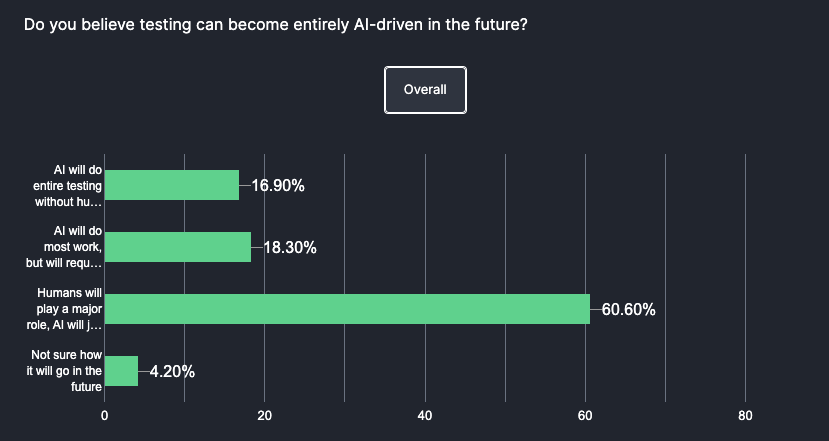
Implementing the below standardized and structured approaches to test log analysis not only optimizes efficiency and effectiveness but also ensures accurate insights and actionable recommendations.
With the rise of AI in testing, its crucial to stay competitive by upskilling or polishing your skillsets. The KaneAI Certification proves your hands-on AI testing skills and positions you as a future-ready, high-value QA professional.
Use standardized and structured formats:
- Employ standardized formats like log4j, Syslog, or the ELK stack to maintain consistency across the logging infrastructure.
- Facilitate the parsing and processing of test log data in structured formats, enhancing the ease and efficiency of analysis.
- Capture essential information such as timestamps, log levels, messages, and exceptions uniformly to ensure comprehensive and accurate log data.
Define your goals and scope:
- Determine relevant metrics such as error rates, response times, throughput, coverage, and reliability to establish clear evaluation criteria for system performance.
- Clarify objectives and areas of focus for test log analysis to ensure alignment with organizational goals and priorities.
- Define the scope of analysis, including the time period, test environment, test cases, and test levels, to establish clear boundaries and objectives.
Visualize and report:
- Choose appropriate formats (HTML, PDF, Excel) for visualization and reporting, catering to stakeholders’ preferences and needs.
- Customize visualization and reporting methods based on audience, purpose, and context to effectively communicate findings, insights, and recommendations.
- Present findings and insights clearly and concisely using charts, graphs, dashboards, or tables to facilitate understanding and decision-making.
Automate and integrate:
- Reduce manual errors, increase efficiency, and ensure consistency by automating and integrating processes related to data collection, storage, analysis, visualization, and reporting.
- Automating these processes will help optimize the test log analysis workflow and enhance productivity.
Apply filters and queries:
- Utilize filters and queries to extract meaningful insights from vast test log data, enabling targeted analysis and the identification of relevant information.
- Filter by error level, test case, time range, or performance metric to focus analysis on specific aspects of the data.
Enhance Test Log Analysis Efficiency with AI-Native Tools
Streamlined test log analysis is essential for identifying high-impact quality issues and ensuring smooth operations in your software ecosystem.
TestMu AI, a comprehensive enterprise test execution cloud platform, has cutting-edge AI-native test failure analysis functionality within its solution, HyperExecute, which is close to 70% faster than other test execution grids.
Leveraging HyperExecute, users can bid farewell to laborious manual test log analysis as the platform autonomously categorizes errors, streamlining the identification of failure types.
TestMu AI has bolstered its test intelligence analytics platform with a range of features aimed at providing users with greater control over Selenium command logs. Empower your team with comprehensive AI-native test execution insights—book a demo with TestMu AI today!



Did you find this page helpful?
More Related Hubs
TestMu AI forEnterprise
Get access to solutions built on Enterprise
grade security, privacy, & compliance
- Advanced access controls
- Advanced data retention rules
- Advanced Local Testing
- Premium Support options
- Early access to beta features
- Private Slack Channel
- Unlimited Manual Accessibility DevTools Tests