

Next-Gen App & Browser Testing Cloud
Trusted by 2 Mn+ QAs & Devs to accelerate their release cycles


On This Page

Why Quality of Digital Experience is Important to Achieve Business Goals: A CXO View
In today's fast-paced digital environment, investing in quality digital experiences is crucial to business success and staying competitive.

Navya
December 19, 2025

According to a Gartner Report – “By 2026, at least 60% of I&O leaders will use Digital Experience Monitoring to measure application, services and endpoint performance from the user’s viewpoint, up from less than 20% in 2021.”
In the current digital era, a company’s success can be made or broken by the quality of its digital experiences. Providing clients with top-notch digital experiences is becoming more and more crucial as more businesses move their operations online.
In this post, we will discuss the significance of the quality of digital experiences for accomplishing business objectives as well as the actions businesses can take to raise that quality.
The effect that high-quality digital experiences can have on consumer engagement, conversion rates, and general satisfaction will be covered first. We’ll also look at how great digital experiences may raise brand recognition and consumer loyalty while also boosting sales.
We’ll then get into the significance of usability and accessibility for digital encounters. We’ll talk about how a product or service can be more inclusive and user-friendly for a wider group of individuals by putting an emphasis on quality assurance.
Finally, we’ll offer some useful advice for enhancing the caliber of digital experiences, emphasizing the value of Personalization, performance, and security
Overall, this blog will demonstrate how investing in high-quality digital experiences can boost engagement, conversion rates, and overall satisfaction with a product or service. It can also boost brand reputation and customer trust while increasing accessibility and usability for a broader range of users. Ultimately, this can lead to increased revenue and customer loyalty, assisting businesses in meeting their objectives.
Significance of Digital Experience
According to a Gartner Report “Through 2025, 50% of large organizations will have failed to unify engagement channels, resulting in a disjointed and siloed CX that lacks context.”
Realizing company goals depends on the effectiveness of digital experiences on websites and mobile applications because it directly affects consumer satisfaction and engagement. A positive digital experience can lead to increased sales, customer loyalty, and positive word-of-mouth, whereas a negative digital experience can lead to customer loss, a negative brand reputation, and lost revenue.
High-quality digital experiences can have a significant impact on consumer engagement, conversion rates, and overall satisfaction.
- Customer engagement: A well-designed and user-friendly website or mobile app can increase the likelihood that visitors will stay on the site longer, view more pages, and visit it again in the future. Increased engagement and recurrent usage may result from this, which may ultimately boost revenues and build consumer loyalty.
- Conversion rates: A satisfying online experience can boost the likelihood that customers will finish a transaction and raise the average order value. For instance, a well-thought-out checkout procedure can lower friction and increase the likelihood that customers will finish their purchases.
- Overall satisfaction: Increasing consumer happiness can result in positive word-of-mouth and growing brand loyalty. A high-quality digital experience can do this. Customers are more likely to return to a website and refer it to others when they had a great experience.
If a website takes too long to load or is difficult to navigate, customers may become frustrated and leave. A well-designed and easy-to-use website, on the other hand, can increase the likelihood that customers will complete the actions and return to the site in the future. Similarly, an intuitive and user-friendly mobile app can result in increased engagement and repeat usage, whereas a poorly designed app may be deleted and never used again.
Businesses might also think about gamification, push alerts, and location-based services to improve the user experience, in addition to personalization, AI-driven chatbots, and other interactive elements.
The Holy Trinity of a Quality Digital Experience
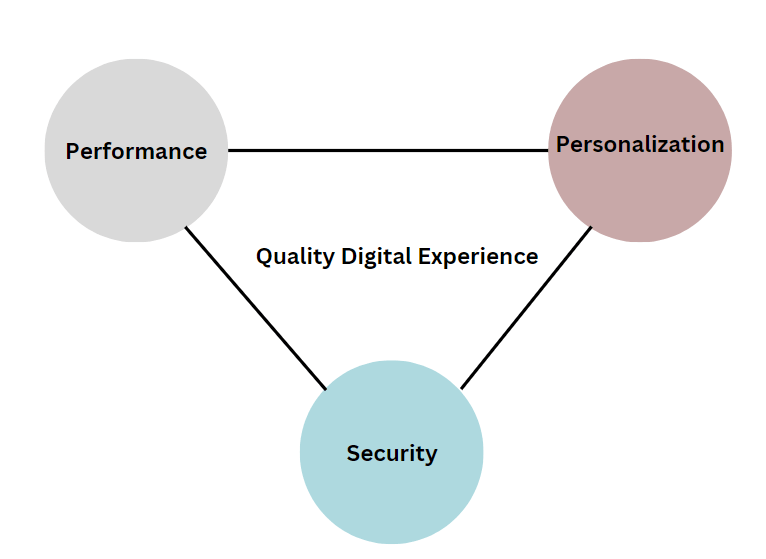
Businesses may improve the quality of digital services and offer a better user experience by putting a greater emphasis on personalization, performance, and security. Performance may improve efficiency and enjoyment, personalization can make the experience more relevant and engaging for the user, and security can safeguard the user’s data and foster trust in the good or service.
1. Personalization
Personalization can enhance the digital experience by making it more relevant, efficient, and engaging for the user. It can also increase conversions and revenue for the business and can lead to increased customer loyalty.
- Increased engagement: Personalization can make the user feel like the digital product or service is tailored to their needs and preferences, leading to increased engagement and satisfaction.
- Relevancy: Personalization can increase the relevance of the content, offers, and recommendations provided to the user, which can improve the user’s experience and lead to increased conversions and revenue for the business.
- Efficiency: Personalization can make the user’s experience more efficient by reducing the number of steps needed to find what they are looking for and by providing relevant and useful information.
- Personal touch: Personalization can make the user feel like the product or service is tailored to them and can create a sense of personal connection with the brand, which can increase customer loyalty.
- Personalized offers and recommendations can also increase the chances of purchase because the product is more likely to be of interest to the user.
2. Performance
Good performance of websites and apps can enhance the digital experience by providing a faster, smoother, and more responsive experience for the user. This can lead to increased engagement, improved productivity, and a more positive overall experience for the user.
- Speed: A website or app that loads quickly can provide a more positive user experience and can help to keep the user engaged. A faster website or app can also improve the user’s productivity and save time.
- Navigation: A website or app with smooth and intuitive navigation can make it easier for the user to find what they are looking for and can improve their overall experience.
- Responsiveness: A website or app that is responsive on different devices can provide a consistent and positive experience for the user, regardless of the device they are using.
- Search engine optimization: A fast website or app can also help with search engine optimization, which can increase the visibility of the website or app in search engine results and drive more traffic to the site.
- Reducing bounce rate: A fast website or app can also help to reduce the bounce rate, which is the percentage of visitors who leave the site after viewing only one page. A faster website or app can keep users more engaged, increase the chances of them staying on the site and reduce the bounce rate.
3. Security
By safeguarding user information, preserving privacy, fostering trust, and guaranteeing regulatory compliance, website and app security may improve the digital experience. This can improve customer experience and safeguard the company from any legal and financial problems.
- Protecting user data: Encryption and secure login procedures are two security techniques that businesses can use to safeguard user data from online risks including phishing, hacking, and identity theft. Users may feel more at ease as a result, which may boost their confidence in the good or service.
- Increasing privacy: Businesses can also increase the user’s privacy by putting security measures in place. This may be particularly crucial for goods or services that deal with delicate information like personal data.
- Building trust: Businesses can raise the likelihood that customers will utilize their product or service by demonstrating to customers that their data is safeguarded.
- Compliance: There are rules in place for many businesses that specify the security precautions that must be taken. Businesses can guarantee compliance with these rules and prevent legal problems by making sure the product or service is secure. Compliance also aids in preventing data breaches, which can cost the company money and damage its brand.
Importance of Usability and Accessibility for Digital Experience
Usability and accessibility are critical for the digital experience because they ensure that the user can use the product or service effectively and efficiently. Usability refers to a product’s ease of use and learnability, whereas accessibility refers to the product’s design and development to include users with disabilities.
Consider a website that sells products over the internet. If the website is not usable, the user may struggle to navigate the site, find what they are looking for, or complete a purchase. This can cause frustration and a poor user experience, leading to the user leaving the site without making a purchase. On the other hand, a website that is easy to use, with clear navigation, accessible product information, and a straightforward checkout procedure, is more likely to lead to a successful sale and a happy consumer.
Users with visual impairments could find it challenging to read the language or comprehend the information displayed on the screen if the app is not accessible. They may find it challenging to adequately manage their health and use the app as a result. On the other side, an app that is created with accessibility in mind will include users with visual impairments and offer a better UX for them by using larger text, high contrast, and alternative text for images.
Usability and accessibility are key in both cases for producing satisfying digital experiences. They make sure that customers can utilize the product or service successfully and efficiently regardless of their abilities, which raises customer happiness and loyalty. Businesses that place a high priority on usability and accessibility can also broaden their customer base and provide everyone access to their goods and services.
How to go about creating a Quality Digital Experience
A grasp of client needs and a dedication to ongoing improvement are necessary for a flawless customer digital experience. To find and fix problems and continuously enhance the customer experience, it’s critical to have a systematic approach to the quality of the digital experience assurance that involves both proactive and reactive procedures.
- User-centered design: Design the website or app with the user in mind, taking into account their needs and goals.
- Responsive design: Ensure that the website or app is easy to use and navigate on all devices, including desktops, laptops, tablets, and smartphones.
- Optimize for speed: Minimize page load times and ensure that the website or app is fast to load and use.
- Accessibility: Make sure that the website or app is accessible to users with disabilities, such as those who are visually impaired or have mobility issues.
- Test and iterate: Conduct user testing to identify any issues and make improvements based on the feedback received. Continuously test and iterate to improve the overall user experience.
- Faster Release velocity: Forrester Analytics survey data shows 33% of global developers at the manager level or higher consider speeding up cycle time to be a top-three priority; 30% said the same about increasing the automation of software development lifecycle (SDLC) tasks. Wait time is the silent killer of faster application delivery. Continuous testing can also help in finding and fixing bugs and security vulnerabilities more quickly, which can improve the stability and security of the software and increase release velocity.
- Faster feedback loop: Continuous quality checks can also lead to a more agile development process, allowing for faster response to changing user needs and preferences. According to a Gartner Report – “ By 2025, 70% of organizations will complement continuous delivery of applications with continuous infrastructure automation to improve business agility, which is a significant increase from fewer than 20% in 2021.”
- Personalization: Personalize the website or app to match the user’s preferences, interests, and behavior.
- Security: Implement security measures to protect user data and ensure that the website or app is secure to use.
- Clear navigation: Make sure that the website or app has clear and intuitive navigation so that users can easily find what they’re looking for.
- Use analytics: Use analytics tools to track user behavior and engagement, and use the insights gained to improve the website or app. According to a Gartner Report – “ By 2026, 60% of technology and service provider product teams will include practitioners of data and analytics to improve CX, increasing more than three-fold from 16% in 2021.”
- Provide support: Make sure that users can easily contact you for support and that you respond promptly to any issues or concerns they may have.

How to ensure the Quality of Digital Experience is good
There are several ways to test the quality of a digital experience:
User Testing
Companies can find areas for improvement in the digital experience and make adjustments to maximize the user experience, resulting in a high-quality digital product, by doing several sorts of user testing.
Usability Testing: A website’s user-friendly interface and straightforward navigation are built, but to verify this, a representative group of users is given specified tasks to complete, and their actions and feedback are observed, documented, and analyzed.
A/B testing: In order to increase the conversion rate of their e-commerce website, a corporation runs two distinct versions of the website in parallel and compares the conversion rates between the two.
Remote User Testing: Before releasing their new app, an app development company needs to test it. A set of people is emailed a link to the app and requested to do specified tasks and offer feedback, which is then recorded and evaluated. This is known as remote user testing.
Contextual Inquiry: Let’s say a corporation is creating a new healthcare app and wants to guarantee that elderly consumers will find it to be user-friendly. Contextual inquiries involve observing a user using the app in their environment to learn more about their experience and spot any difficulties they may be having.
Performance testing
It is a sort of testing that concentrates on assessing a digital product’s speed, scalability, and stability under a certain workload. Performance testing can assist ensure the quality of the digital experience in the following ways:
Load testing: A business may make sure that its website can support several concurrent visitors without becoming unresponsive or crashing. To assess a website’s performance and find any bottlenecks, load testing is done by simulating a lot of users visiting it at once.
Stress testing: An e-commerce company needs to ensure that its website can withstand abrupt spikes in traffic during busy shopping seasons. They conduct stress testing by progressively raising the workload on the website until it reaches its maximum capacity, then measuring its performance to detect any problems that need to be fixed.
Endurance testing: A mobile app development company needs to ensure that its software will continue to work properly over time. They do endurance testing by constantly running the app for several days and monitoring its performance to uncover any issues that may develop.
Accessibility testing
The process of analyzing how well a digital product is designed to be utilized by persons with impairments is known as accessibility testing. Here are a few instances of how accessibility testing might aid in ensuring the quality of a digital experience:
Screen Reader Testing: A corporation wants to ensure that its website is accessible to blind visitors who use screen readers. They do screen reader testing by navigating the website using a screen reader and analyzing accessibility features such as alt text for images, headers, and other elements.
Keyboard Navigation Testing: An app development business needs to ensure that its software is accessible to customers who have limited mobility and navigate with a keyboard. They do keyboard navigation testing by navigating the app with a keyboard and evaluate accessibility features such as keyboard shortcuts and focus indicators.
Color Contrast Testing: A website is developed with brilliant colors, but in order to verify that it is accessible to colorblind visitors, the company does color contrast testing by measuring the contrast ratio between the foreground and background colors to ensure they fulfill the WCAG guidelines.
Alt Text Testing: A corporation wants to ensure that its website is accessible to visually challenged users. They conduct alt text testing by reviewing picture alt text descriptions to ensure they provide a meaningful description of the content.
Security testing
It is the practice of assessing a digital product’s security against potential threats and weaknesses. Here are a few instances of how security testing might aid in ensuring the quality of digital experiences:
Penetration testing is used when a corporation wishes to identify potential security flaws in its website. They conduct penetration testing by mimicking an attacker’s attempts to breach the website’s security and identifying any flaws that must be repaired.
Cross-Site Scripting (XSS) Testing: A website is created to allow visitors to make comments and criticism, but to ensure that it is secure from harmful scripts, the company does XSS testing, which involves analyzing the website’s capacity to avoid cross-site scripting assaults.
SQL Injection Testing: A corporation wishes to ensure the security of its database-driven website against SQL injection threats. SQL injection testing is carried out by analyzing the website’s capabilities to avoid SQL injection attacks and identifying any vulnerabilities that must be fixed.
Session Management Testing: A retailer needs to ensure that its website is secure from session hijacking threats. They conduct session management testing by assessing the website’s session management system to guarantee that it is secure and protects the information of users.
Compatibility testing
It is the process of determining if a digital product will work properly on various platforms, browsers, and devices. Here are a few instances of how compatibility testing can aid in ensuring the quality of a digital experience:
Browser Compatibility Testing: A business needs to ensure that its website works properly on various web browsers such as Google Chrome, Mozilla Firefox, and Internet Explorer. Browser compatibility testing is done by accessing the website through various browsers and evaluating its functionality, layout, and appearance.
Mobile Compatibility Testing: An app development company needs to ensure that its mobile app works properly on a variety of mobile devices and operating systems, including iOS and Android. They assess mobile compatibility by accessing the app on various devices and analyzing its operation, performance, and aesthetics.
Operating System Compatibility Testing: A corporation needs to ensure that its software is compatible with various operating systems, such as Windows and MacOS. They examine operating system compatibility by installing software on several operating systems and assessing its functionality, performance, and compatibility with various hardware combinations.
Device Compatibility Testing: A website is designed for desktop devices, but to ensure that it is compatible with different screen sizes and resolutions, the company performs device compatibility testing, which involves accessing the website on various devices such as desktops, laptops, tablets, and smartphones and evaluating its functionality, layout, and appearance.
User Feedback
In order to guarantee the quality of the digital experience, user feedback is crucial. Users may help firms better understand their requirements, preferences, and problem spots while also enhancing the overall experience of their digital goods by providing feedback.
- Use analytics tools to monitor user behavior, page views, click rates, and other metrics. Examples include Google Analytics, Mixpanel, and Amplitude.
- Make user surveys Directly question users about their insights, viewpoints, and feedback.
- Follow heatmaps: Visualize the areas of the website where users are clicking, scrolling, and spending time.
- Examining server logs To learn how people interact with particular pages or features, look at the server logs.
- A/B evaluation Try out various layouts, functions, and contents to see how users react.
Continuous monitoring
It is a process of reviewing the performance and functioning of websites and apps on a frequent basis to ensure that users have a favorable digital experience. This can include, among other things, testing load times, checking for broken links, tracking user engagement metrics, and ensuring the website or app is accessible to all users. The purpose of continuous monitoring is to discover and rectify any problems as soon as possible before they have a negative influence on the user experience.
Here are some continuous monitoring strategies:
- Regular user testing: Conduct usability tests on a regular basis to understand how people interact with the site/app and identify areas for improvement.
- Monitoring website and app performance parameters such as load time and uptime to maintain a consistent user experience.
- Track problems and bugs with tools, and prioritize correcting the most essential ones that affect user experience.
- Tracking feedback: Review customer comments and ratings from multiple channels (e.g., social media, app stores, support requests) on a regular basis and reply to improve the experience.
- Analytics tracking: Constantly monitor analytics data to better understand user activity patterns and make informed decisions about site/app updates or modifications.
- Regular site/app updates: To improve the user experience, keep the site/app updated with bug repairs, security patches, and new features.
- User engagement metrics: Measure the success of the site/app by tracking engagement metrics such as time on site, bounce rate, and conversion rate.
It is critical to test the quality of a digital experience to ensure that users have a positive and productive experience with a website or app. The testing results should provide useful insights into user behavior and preferences, as well as areas for development. Organizations may boost user engagement, contentment, and overall success by prioritizing recommendations and continuously monitoring and enhancing the digital experience. The digital experience testing should conclude with a clear summary of findings, recommendations, and a plan for implementing modifications to improve the overall user experience.
What Happens When Digital Experiences Go Wrong
Providing a smooth and enjoyable digital experience for customers in order to maintain trust and a positive brand reputation is a priority. It’s important for companies to thoroughly test and optimize their digital products and services before launch to ensure a positive customer experience.
It’s important to note that the digital experience is an ongoing process and businesses should regularly assess and improve their digital touchpoints to meet the changing expectations of customers. There have been a number of stories of companies that have provided a bad digital experience for their customers, which has hurt their brands. Some examples include
- The rollout of the Healthcare.gov website also known as Obamacare in 2013, was plagued by technical difficulties and poor user experience, leading to significant frustration and dissatisfaction among customers and negative media coverage. The deficit-cutting effects of Obamacare will rise over time. The CBO projects that the ACA will cut the deficit by an average of 0.5 percent of GDP per year from 2023 to 2032, resulting in a total deficit reduction of almost $1.6 trillion over that ten-year period.
- The launch of the Pokemon Go mobile app in 2016, which was plagued by server outages and poor performance, led to significant frustration and dissatisfaction among customers. Nintendo confessed that Pokemon caused a $6.7 billion loss in Nintendo’s market value.
- Google’s release of Google+ failed to provide a personalized experience for its users, resulting in low engagement and the eventual shutdown of the platform. Less than 1% of the 2.2 billion people who used Google products, despite Google’s four years of work, were actually active users of Google+.
- The website and mobile app of Capital One in 2019, experienced a data breach that exposed the personal information of customers. The company’s initial response was criticized as inadequate and slow, leading to significant reputational damage and financial penalties. To satisfy charges that it put customer information in danger during this 2019 data breach, Capital One paid $190 million as part of a consumer data security litigation settlement.
- The website of Zoom in 2020, which experienced a surge in usage due to the pandemic, also faced a number of security and privacy concerns. The company’s initial response was criticized as slow and inadequate, leading to negative media coverage and damage to the brand’s reputation. In order to resolve a class action privacy lawsuit in the US, Zoom agreed to pay $86m (£61.9m).
Conclusion
In today’s digital landscape, the quality of a company’s digital experience is becoming increasingly important. Businesses may boost customer happiness, drive sales and revenue development, enhance brand reputation, streamline processes, and acquire important insights into customer behavior by providing a seamless, user-friendly, and engaging experience. In today’s fast-paced digital environment, investing in the quality of a company’s digital experience is consequently critical for attaining business goals and remaining ahead of the competition.



Did you find this page helpful?
More Related Hubs
TestMu AI forEnterprise
Get access to solutions built on Enterprise
grade security, privacy, & compliance
- Advanced access controls
- Advanced data retention rules
- Advanced Local Testing
- Premium Support options
- Early access to beta features
- Private Slack Channel
- Unlimited Manual Accessibility DevTools Tests