

Next-Gen App & Browser Testing Cloud
Trusted by 2 Mn+ QAs & Devs to accelerate their release cycles


On This Page
- What is AI-driven test automation?
- The benefits of AI-driven test automation
- The Ethical Considerations
- Real-world instances of how AI tools are biased
- Best practices for ethical AI-driven test automation
- Conclusion: Embracing Ethical Standards to Ensure a More Reliable and Responsible Use of AI-Driven Test Automation

The Ethical Considerations in AI-Driven Test Automation
Explore the ethical considerations in AI-driven test automation and learn how to ensure responsible and reliable use of this transformative technology. Best practices and real-world instances shared.

Pricilla Bilavendran
March 23, 2026
Hello there,
We all know that we are speaking quite a lot about artificial intelligence (AI) in recent times.
Artificial intelligence has transformed how we live, work, and communicate with one another. AI-powered technology has made our lives easier and more convenient in many ways.
AI-powered tools are advanced applications or tools that use artificial intelligence technologies to automate specific tasks or actions or workflows. Some common examples of such tools include virtual personal assistants, facial recognition and biometrics programs, customer service chatbots, and recommendation engines. These tools are useful for streamlining workflows, enhancing customer experiences, and providing better insights.
What is AI-driven test automation?

AI-driven test automation is a process of using artificial intelligence to automatically develop and execute tests. This entails teaching machines to recognize patterns in code and identify areas of the application that are prone to errors or can be improved upon, which speeds up testing and reduces the need for human involvement. AI-driven automation tools can also be used to automate repetitive tasks, such as running regression test suites, creating test data, and generating test reports.
AI-driven test automation has the potential to revolutionize the software testing industry, as AI-driven test automation helps reduce and maintenance and enhances speed, but it also has ethical implications that must be considered. We can guarantee that this technology is utilized responsibly and beneficially by addressing these concerns and defining ethical standards and best practices for AI-driven test automation.
In the rapidly advancing field of AI-driven and AI-native test automation, various tools are emerging to enhance the efficiency of test development and execution. Among them, KaneAI, a GenAI native QA-Agent-as-a-Service platform by TestMu AI, stands out. It integrates seamlessly with AI-native testing practices, providing advanced capabilities for generating precise test cases and conducting thorough error analysis.
By leveraging KaneAI, teams can maximize the benefits of AI in testing while maintaining ethical standards. KaneAI not only speeds up and improves the accuracy of testing but also supports the responsible use of AI, helping to establish best practices in the field.
With the rise of AI in testing, its crucial to stay competitive by upskilling or polishing your skillsets. The KaneAI Certification proves your hands-on AI testing skills and positions you as a future-ready, high-value QA professional.

To learn more on how AI-driven test automation can help you write test cases boost the testing process speed, watch the following video below.

The benefits of AI-driven test automation

There are several benefits to using AI-driven test automation.
1. Increased Performance: AI-driven test automation has the potential to significantly reduce the amount of human effort required to design and execute tests. This allows testers to concentrate their efforts on more critical areas of testing, greatly improving the overall performance of the testing process.
2. Improved Quality: AI Automated testing improves accuracy in test cases that span large-scale scenarios. It is also capable of detecting unnoticed defects, minimizing the likelihood of manual errors, and enhancing test coverage.
3. Improved Time-to-Market: Automated AI testing can assist software testers in running tests more quickly and efficiently, resulting in a reduced time-to-market for the product. It also reduces the need for manual test case preparation, allowing teams to focus on more critical tasks and discover areas for optimization.
4. Increased Accuracy: AI-driven test automation provides higher accuracy. AI-driven test automation technology can be trained to detect patterns and classify them more precisely than manual tests. This eliminates the potential for human mistakes and increases the overall accuracy of the testing process.
5. Reduced Costs: By augmenting the testing process with AI, companies can reduce costs in several ways. AI testing delivers insights that assist decrease the expenses associated with debugging and retesting due to low-quality code.
However, like with any technology, there are ethical concerns to be made, particularly when it comes to AI-driven test automation.
The Ethical Considerations

Any tool or technology which is being adopted and used by a variety of people and organizations across the globe must have certain rules and regulations that need to be followed. Set of policies to be written and tagged to the product.
Increased usage of Artificial Intelligence poses some threats and many countries are taking steps to mitigate them by introducing regulations.
For example, Europe is planning to propose a new regulation for AI. Refer to this site for more details on it. Not only Europe, but the US also has certain AI regulations as well. We need certain rules and legislation to be followed in this regard. Many countries started thinking about introducing and implementing regulations for the ethical use of AI.
As AI-driven test automation becomes more prevalent in software development, it is important to consider the ethical implications of this technology. Addressing these concerns systematically is a core part of testing AI applications, which includes bias testing, fairness validation, and compliance checks alongside functional and performance testing. Below are some of the ethical considerations:
- Bias: When AI systems are trained on biased data, they might become biased. This can lead to unfair testing practices and inaccurate results. It is important to ensure that the data used to train AI models is diverse and representative of the population being tested.
- Privacy: AI-driven test automation may collect and process sensitive data, such as personal information or user behavior. It is critical to ensure that sensitive data is managed securely and in accordance with applicable privacy laws. In a recent poll conducted by us, privacy even came up as a main concern by the community, highlighting the growing awareness and importance of safeguarding user data.
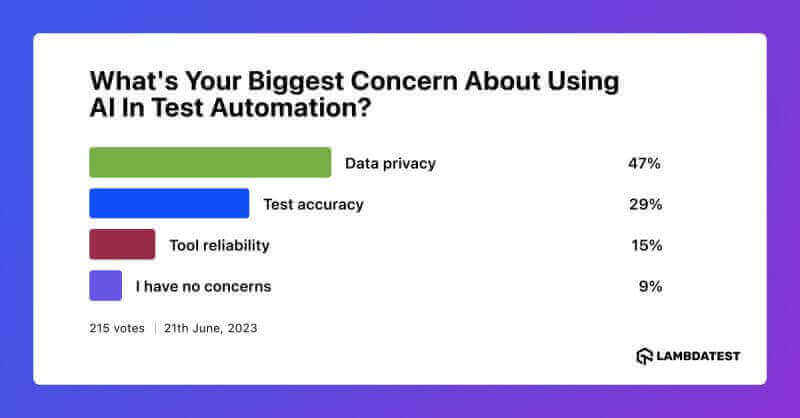
Source As we continue to advance in the realm of AI-driven testing, addressing these privacy concerns will be paramount to maintaining trust and compliance within the industry. Stay tuned for more insights and best practices on navigating the intersection of AI-driven test automation and privacy considerations.
- Transparency: AI algorithms can be opaque and complex, making it difficult to understand how they arrive at their conclusions. It is important to ensure that AI-driven test automation is transparent and explainable so that developers and stakeholders can understand how the technology is making decisions.
- Accountability: Ethical considerations promote accountability and responsibility in AI-driven test automation. It is important to ensure that there is accountability for these decisions and that there are mechanisms in place to address any negative outcomes. It is important to clearly define roles and responsibilities, ensuring that humans remain in control of the testing process and are accountable for the outcomes. This includes establishing mechanisms for addressing errors or unintended consequences caused by AI systems and taking appropriate corrective actions.
- Human oversight: While AI-driven test automation can improve efficiency and accuracy, it should not replace human oversight entirely. It is important to ensure that humans are involved in the testing process to provide context and make decisions when necessary.
- Impact on Human Testers: Many organizations are not mature enough to understand that AI can never replace Testers. So after seeing the temporary success of AI-driven test automation, they might reduce the number of Testers in the team or organization. This can lead to job loss and a loss of important human skills, such as creativity and problem-solving.
Real-world instances of how AI tools are biased
Case study about Amazon’s biased AI recruitment tool:
Amazon developed its own hiring tool to screen resumes in 2014. As you all know there are plenty of resumes received by Amazon each year. Also, they have plenty of job openings in different categories. So every year they have to go through umpteen resumes to find the right candidate. This is a tough job and needs a lot of manpower. So, Amazon developed a hiring tool to screen resumes. They used machine learning algorithms and fed loads of data to the machine learning model. After a year, they noticed that the system is automatically preferring male candidates and it’s downgrading the profiles which have text like “Female”, “Women”, “Women’s College” etc. This is because the system is predominantly trained using historical data which has more Male applicant details. So, the algorithm is biased towards the male candidates. They found that the tool is not gender-neutral. The media started thrashing Amazon for this hiring tool and later Amazon stopped using that tool. They even claimed that the tool was employed in real-time to screen the resumes of the applicants.
Racist AI Image Generator:
Recently there were a lot of tweets floating around the internet which showed that the AI Image generators show racial bias. Rona Wong, an Asian-American student was trying to get a professional headshot using an AI tool. And the results left us all worried. The resulting image made her white, with blue eyes. So do we all need to have fair skin to look professional? This clearly depicted the racial bias in AI.
Best practices for ethical AI-driven test automation
We learned the significance of ethical considerations in AI-powered test automation. Let’s look at some best practices now. Beginning with the establishment of ethical rules and standards, conducting frequent audits and evaluations, ensuring diversity and inclusion in the development team, and providing training and education on ethical issues in AI-driven test automation are all part of the process.
1. Prioritize Legality: Use AI technology and automated testing techniques in accordance with the relevant rules and regulations. Be diligent when you look into and understand the legal implications of automated testing.
2. Clarify Purpose and Goals: Before initiating an AI-powered test automation project, it’s vital to understand why AI is being employed. Consider the potential consequences of the technology and its application.
3. Respect and Maintain Privacy AI automation testing, adhere to data privacy and security requirements. Ensure that proper data protection procedures are in place and that any data acquired is appropriate for the AI project.
4. Monitor Automated Tests: To guarantee correctness and current results, closely monitor automated testing carried out with AI.
5. Maintain Transparency: Explain to stakeholders the rationale for your decision to automate your test tests using AI and any prospective advantages. Ensure that everyone is aware of the risk. Inform others on the performance of AI, including achievements and shortcomings.
6. Documentation and Version Control: Documenting tests, using version control, and setting up a quality assurance process can lead to more effective and efficient use of AI.
7. Use ethical data sets: Make sure that the data sets or test data used for automation are gathered responsibly and that appropriate privacy and data security mechanisms are in place.
8. Test for bias: Analyze test automation output and AI-driven models regularly for bias
9. Monitor results: Analyze the outcomes of AI-driven test automation and use analytics to find mistakes or anomalies. Make careful to record any results so they may be reviewed.
10. Develop trust: When stakeholders are involved in the AI-driven test automation process, they establish trust in the team’s work. This boosts trust in the accuracy and dependability of the outcomes.
11. Choice of Tools: Choose relevant automated testing tools for the project. Always ensure that these are secure, effective, and scalable.
To ensure the effective and ethical use of AI-driven test automation, it’s important to follow relevant best practices.
Conclusion: Embracing Ethical Standards to Ensure a More Reliable and Responsible Use of AI-Driven Test Automation

In conclusion, ethical considerations are of utmost importance in AI-driven test automation. They help mitigate biases, protect privacy, ensure transparency, promote accountability, and address the social impact of AI systems. By incorporating ethical principles into the development and deployment of AI-driven test automation, we can ensure that it benefits society while upholding fundamental values and principles. By doing so, we can ensure that AI-driven test automation is used responsibly and ethically.
P.C: Freepik.com


Did you find this page helpful?
More Related Hubs
TestMu AI forEnterprise
Get access to solutions built on Enterprise
grade security, privacy, & compliance
- Advanced access controls
- Advanced data retention rules
- Advanced Local Testing
- Premium Support options
- Early access to beta features
- Private Slack Channel
- Unlimited Manual Accessibility DevTools Tests