

Next-Gen App & Browser Testing Cloud
Trusted by 2 Mn+ QAs & Devs to accelerate their release cycles


Revenge of the Nerds: How to Build a Niche Testing Career in the Era of AI
Learn how to build a testing career in the AI era by leveraging AI tools, enhancing skills, and exploring emerging roles in QA and testing.

TestMu AI
January 27, 2026
The rapid evolution of AI is prompting professionals, particularly in fields like testing and quality assurance (QA), to reconsider their career paths. While concerns about job displacement are growing, the rise of AI also offers unique opportunities for testers to redefine their roles and stay relevant.
Instead of fearing these changes, QA professionals can leverage AI’s capabilities to build niche careers in this new era. By embracing AI-driven tools and techniques, testers can enhance their skills, keep up with industry trends, and find specialized roles that add value to their organizations.
Dona Sarkar, a leader in the tech industry and Chief Troublemaker at Microsoft’s AI and Copilot Extensibility Program, has guided many professionals in adapting to the AI landscape. She offers insights on how QA and test professionals can stand out and find unique career opportunities by leveraging AI effectively.
If you couldn’t catch all the sessions live, don’t worry! You can access the recordings at your convenience by visiting the TestMu AI YouTube Channel.
Getting Started with the Session
Dona emphasized that the current era is not just about consuming technology but actively creating it. As AI tools become more prevalent, professionals need to shift from a mindset of passive consumption to one of active participation in technology development. This shift involves understanding and leveraging AI technologies to create new opportunities, especially in the testing domain.
The Evolution of AI: A Brief History
AI has a rich history, starting from its early stages to the more advanced forms we see today. To understand the journey of AI, it’s important to explore its evolution from predictive models to the current generative technologies that are reshaping industries.
Predictive AI: The Beginnings
Dona highlighted that the concept of AI isn’t new; it has been around since the 1950s. Initially, AI began as Predictive AI, which was primarily focused on identifying patterns and making predictions based on statistical models. One of the earliest examples is the “Turing Test,” designed to determine whether an output was generated by a machine or a human.
- Purpose: Predictive AI was used to figure out whether the responses generated by a machine could be distinguished from those by a human.
- Early AI Concept: Humans and machines worked together to perform tasks, laying the foundation for more advanced AI applications.
Generative AI: A New Era
Over time, AI evolved from predictive models to a more sophisticated form known as Generative AI. This technology represents a leap from merely predicting outcomes to actually generating new concepts and creative solutions.
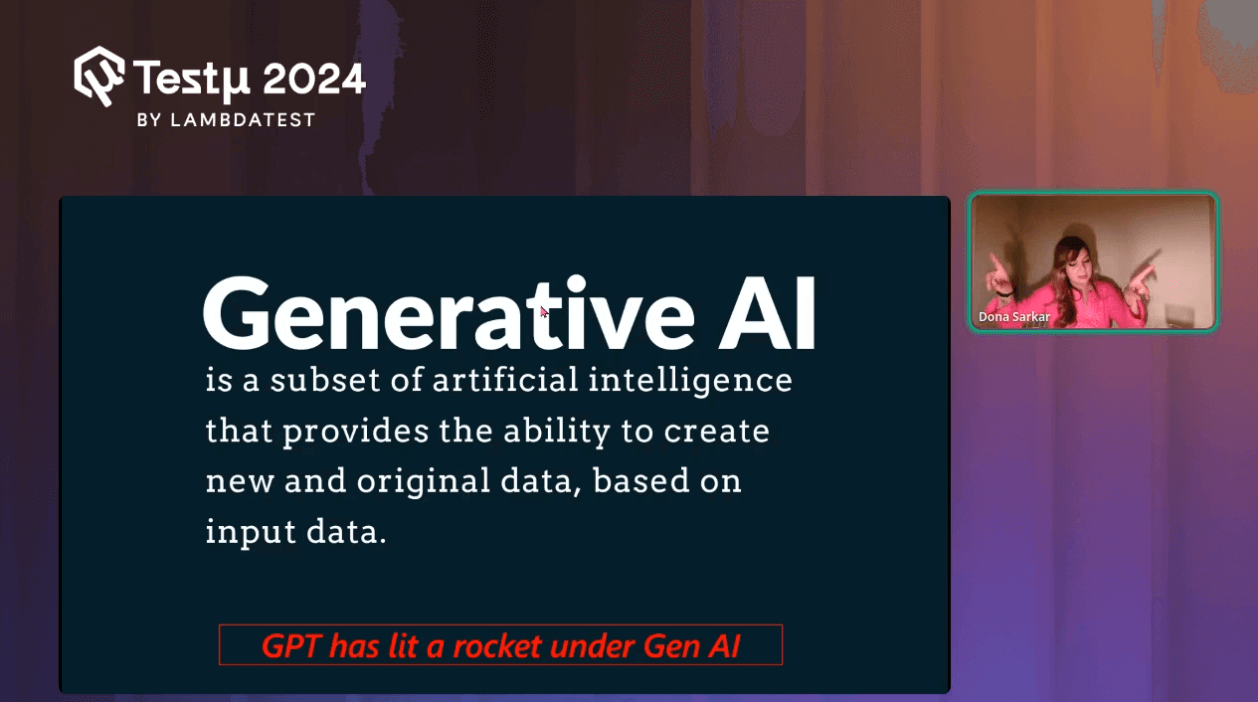
- Generative AI Defined: Unlike Predictive AI, Generative AI uses large language models to create new content. It does not just predict based on existing data but generates novel outputs.
- Understanding Generative AI: It relies on models like Generative Pre-trained Transformers (GPT), which are trained to produce coherent text by analyzing extensive datasets.
As AI evolves, its role in testing becomes more essential for boosting efficiency and precision. AI test assistants like KaneAI by TestMu AI highlight this shift, providing an advanced solution for creating and managing tests.
KaneAI, a GenAI native QA Agent-as-a-Service, supports high-quality engineering teams throughout the entire testing lifecycle. From creating and debugging tests to managing complex workflows, KaneAI simplifies the process using natural language. It enables faster and more intuitive test automation, allowing teams to focus on delivering high-quality software with less manual effort.
With the rise of AI in testing, its crucial to stay competitive by upskilling or polishing your skillsets. The KaneAI Certification proves your hands-on AI testing skills and positions you as a future-ready, high-value QA professional.
Understanding GPT and Large Language Models: The Core of Generative AI
Generative AI is built on models that can create new content. Unlike traditional AI models, which predict outcomes based on pre-existing data, Generative AI produces new concepts and outputs. This is known as Predictive AI—it simply predicts if the input matches a known category.
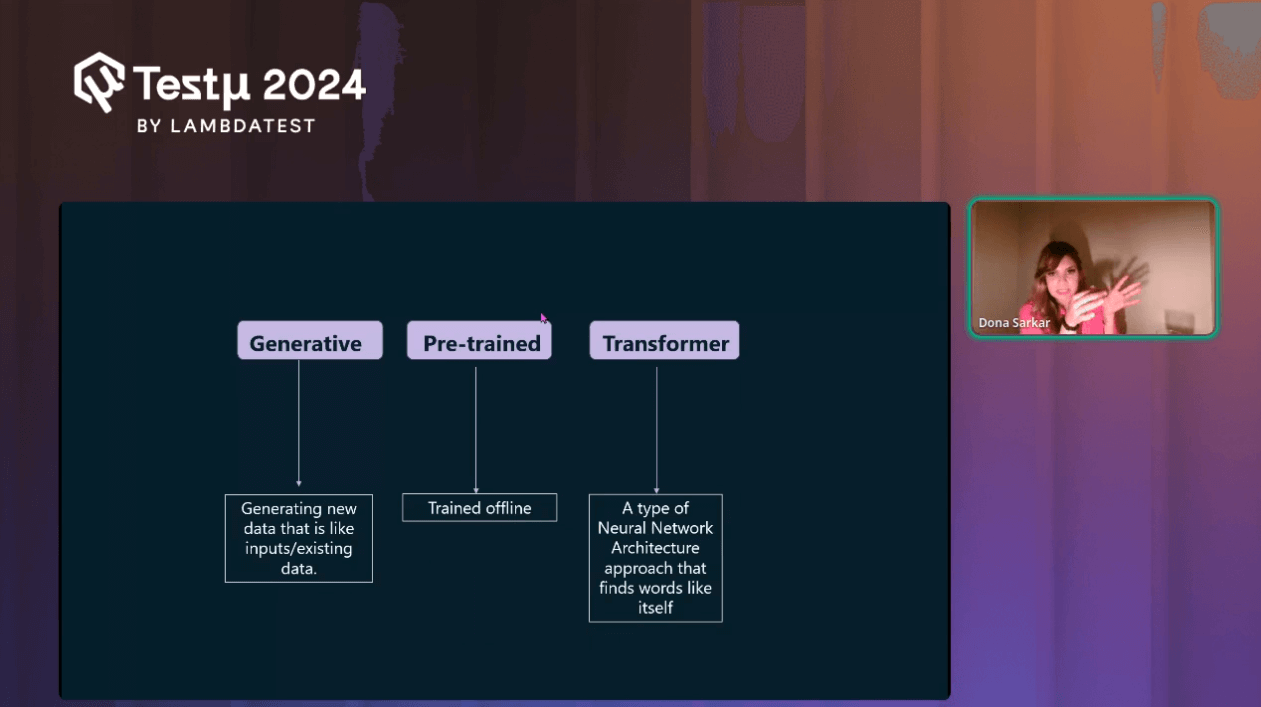
However, Generative AI goes beyond generating new content or ideas that do not exist in the original data set. This advancement allows AI to innovate and create rather than just classify or predict.
Understanding Transformers and Their Role
A key component of Generative AI is the Transformer, a type of neural network architecture designed to understand the relationships between words in a sentence. Transformers do not focus on every word equally; they identify the most critical words and their relationships within a sentence.
Transformers form the foundation of many advanced AI models, such as those used by Microsoft, Meta, and others. These models work by breaking down strings of words into smaller units called tokens.
How do Large Language Models (LLMs) Work?
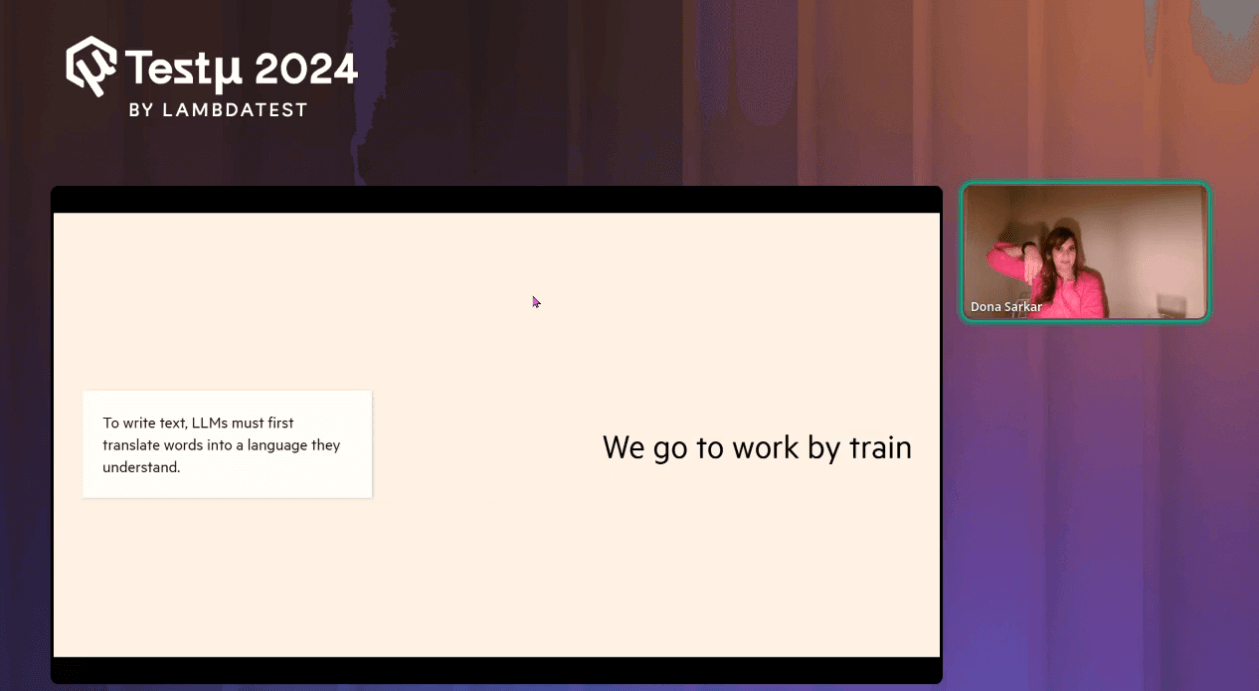
Large Language Models (LLMs), such as GPT, break down sentences into tokens, which can be as short as a syllable or a single character. For example, the sentence “We go to work by train” would be broken down into six tokens. This process allows the model to analyze and understand the relationships between these tokens to generate meaningful outputs.
Vector Representation and Semantic Similarity
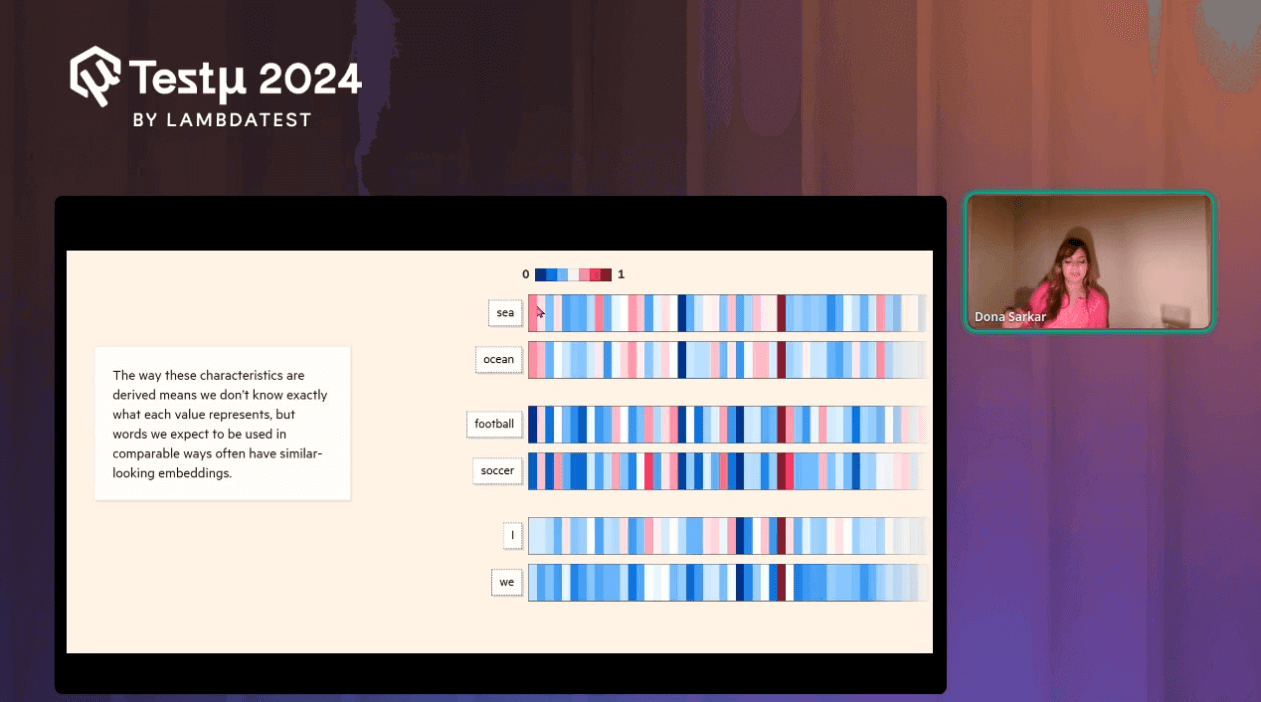
The model breaks the sentence into tokens. It analyzes the relationships between these tokens to find contextually similar words. Words with similar meanings or contexts will have similar vectors. For instance, “work” and “task” might have similar vectors, while “work” and “dog” would have very different vectors. This process helps the AI understand the semantic meaning of words beyond their literal definitions.
The Challenge of Keeping AI Up to Date
AI models, including GPT, often face the challenge of staying current. For example, if an AI model was trained on data up to March 2023, it would not know the outcome of events like the 2024 Olympics. To address this, methods like Retrieval-Augmented Generation (RAG) are used. This technique involves feeding the AI additional information or documents to help it provide more accurate, up-to-date responses.
By understanding these core concepts, QA and test professionals can better grasp how AI works and identify unique opportunities to contribute to the AI landscape, leveraging their expertise in validation, data quality, and ethical considerations.
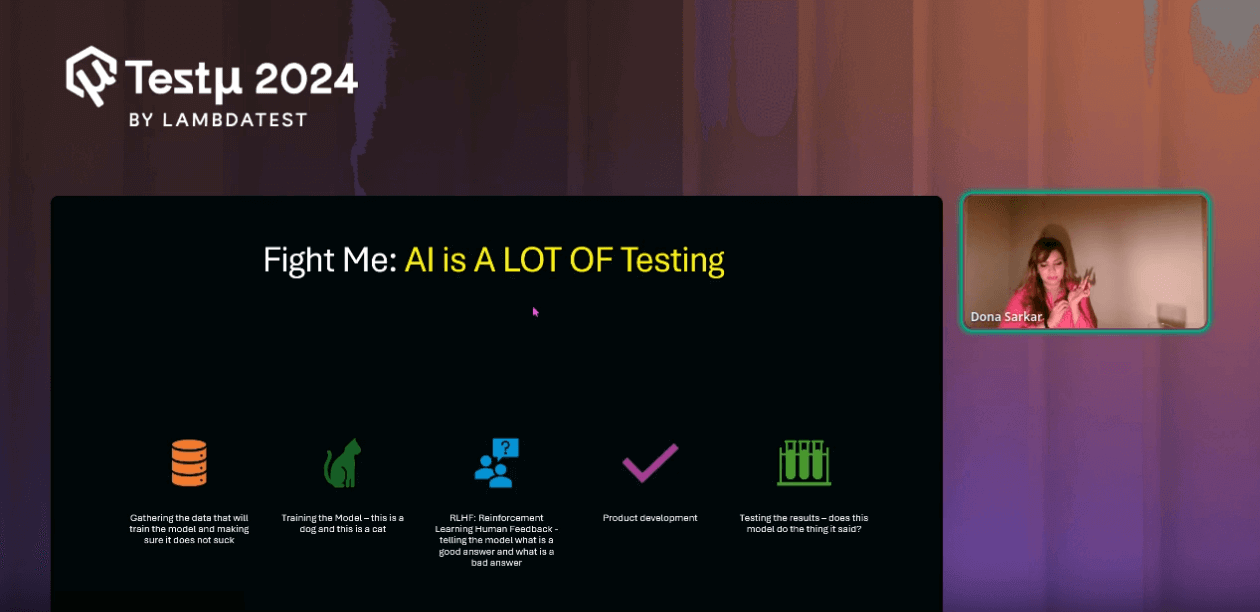
The Rise of New AI Roles
As the AI landscape evolves, everyone has a role to play in shaping its future. Dona highlighted the importance of understanding and defining these roles, especially as they relate to accessibility and inclusivity. Here are some of the emerging roles and responsibilities in the world of AI:
- Machine Learning Specialists:
- Individuals in this role need to dive deep into machine learning concepts and methodologies.
- They are responsible for understanding and defining solutions for complex AI problems, identifying the best models for specific tasks, and continuously learning new advancements in the field.
- Product Managers and Business Experts:
- These professionals determine which AI solutions are viable or necessary for their business or product.
- They are tasked with making critical decisions, such as whether a particular AI model is appropriate or if an alternative approach is needed.
- Data Specialists:
- Data experts play a crucial role in the AI ecosystem. Their primary responsibilities include identifying data sources, ensuring data quality, and detecting gaps in the data that might affect AI model performance.
- While they are in high demand, the constant need for their expertise means they may find it challenging to retire as their skills remain essential.
- Solution Builders:
- These are the developers or engineers responsible for building AI models and solutions.
- They must assess existing AI tools, determine if they fit the purpose, and, if not, develop new solutions from scratch.
- AI Validators:
- A relatively new but vital role, AI validators assess AI models for biases, inaccuracies, and ethical considerations.
- They ensure that AI systems are fair and accessible to all, such as checking if the AI model is biased against people with disabilities or those from different cultural or linguistic backgrounds.
- Security and Ethics Experts:
- With the growing importance of AI, security and ethical considerations have become paramount.
- Experts in this field evaluate AI models for potential security risks and ensure they meet ethical standards, such as data privacy and unbiased decision-making.
The Shift in AI Responsibilities
Dona points out that while AI technology can perform certain tasks effectively, it still requires human input to achieve true excellence. For example, just as the iPhone only became truly valuable when developers and testers built innovative apps around it, AI’s potential is unlocked when skilled professionals apply their expertise.
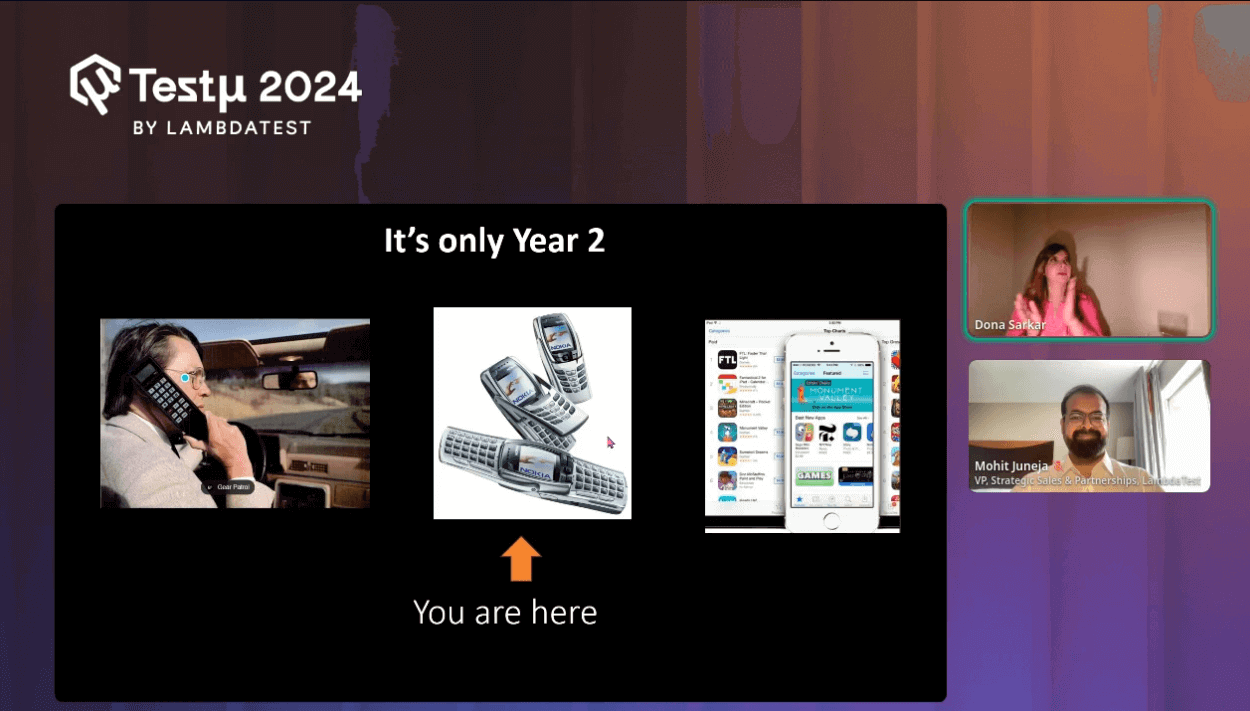
- AI can perform many tasks well but needs continuous development and oversight by human experts.
- Professionals must adapt and grow with AI, taking on new roles such as machine learning experts, product managers, data specialists, and validators.
The Future of AI Testing: What Lies Ahead?
Dona discussed the future direction of AI, moving from generative models to agentic AI. Agentic AI is about creating intelligent agents capable of performing tasks autonomously, using tools and functions to accomplish specific goals.
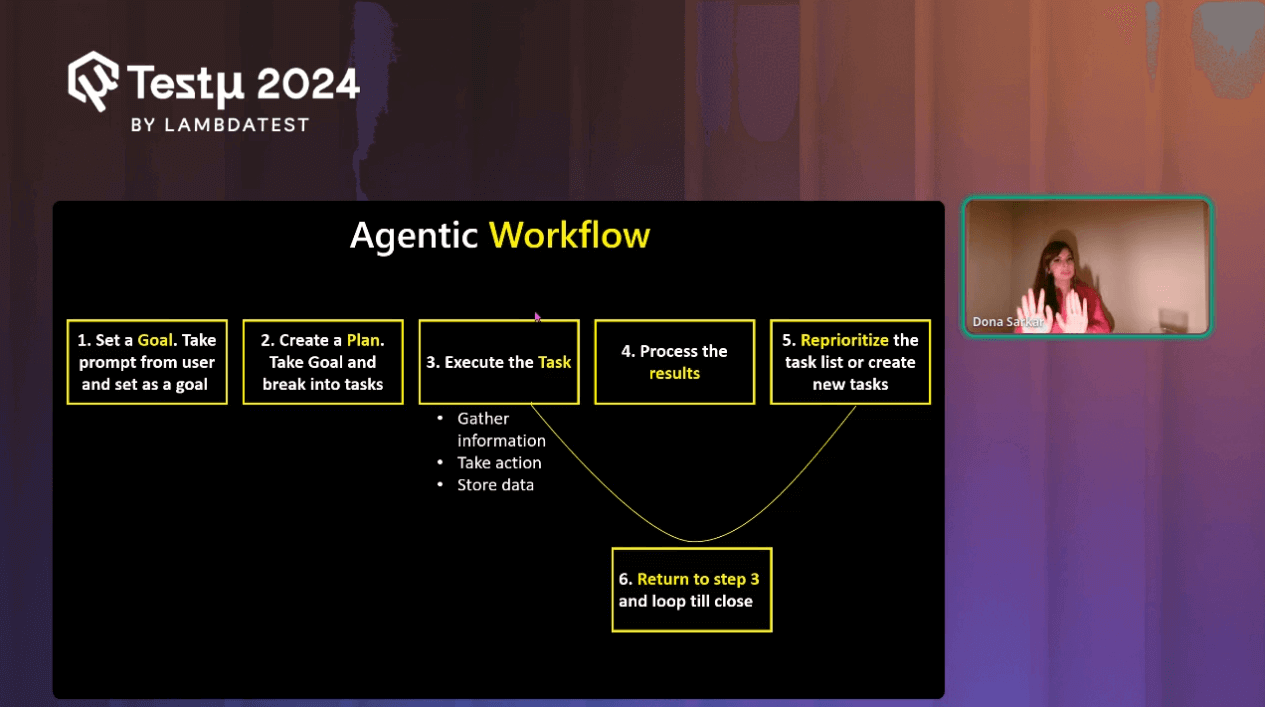
How Agentic AI Works:
- Agentic AI will operate based on a context-driven approach, where agents understand the task context and execute actions accordingly.
- For example, an agent could create a website for a business, plan tasks, execute them, and adjust based on feedback, demonstrating a higher level of autonomy than current AI models.
Summing Up the Session
The rise of AI presents both challenges and opportunities for professionals, especially in the testing and QA domains. While there is understandable concern about AI’s impact on job roles, this technological shift offers a unique chance for testers to redefine their careers and make themselves indispensable in the new AI landscape. By leveraging their core expertise in ensuring accuracy, reliability, and ethical standards, QA professionals can position themselves as critical players in validating and refining AI models, making sure these systems perform as intended and without bias.
The future will make them not just testers but also data specialists. By doing so, they can secure their place in the rapidly expanding world of AI, ensuring that they are not just adapting to changes but actively shaping them. As AI continues to transform industries, those who understand its capabilities and complexities will find themselves at the forefront of innovation and leadership in their organizations.
Time for Some Q&A
Here is a question that Dona took up at the end of the session:
Q. What will the job landscape look like in the testing space in the coming years, and where should I start to gain the necessary skills?
Dona: The testing landscape will shift significantly with the rise of AI, creating new roles focused on validating AI models for accuracy, security, and bias. Testers will be needed to ensure AI outputs are ethical, unbiased, and correct, making this a crucial area for growth. To prepare, start by:
- Learning the basics of AI and machine learning.
- Developing skills in data analysis, security, and bias detection.
- Engaging with AI testing communities and staying updated on industry trends.
By doing this, you’ll position yourself to thrive in a rapidly evolving field where demand for skilled testers is growing.
Got more questions? Drop them on the TestMu AI Community.


Did you find this page helpful?
More Related Hubs
TestMu AI forEnterprise
Get access to solutions built on Enterprise
grade security, privacy, & compliance
- Advanced access controls
- Advanced data retention rules
- Advanced Local Testing
- Premium Support options
- Early access to beta features
- Private Slack Channel
- Unlimited Manual Accessibility DevTools Tests