

Next-Gen App & Browser Testing Cloud
Trusted by 2 Mn+ QAs & Devs to accelerate their release cycles


Why Bloom’s taxonomy is noteworthy to Software Testing professionals?
Learn how Bloom’s Taxonomy organizes learning goals into cognitive levels and why it’s useful for better learning, assessment, and curriculum design.

Pricilla Bilavendran
December 30, 2025
Hello Folks,
You might be wondering what Bloom’s taxonomy is all about and how is it related to software testing, Test Automation, and your day-to-day activities in the software testing process.
Software testers have to continuously stay updated. But, are you doing it the right way? Do you just purchase an online certification course or look for software testing youtube channels but not really implement the learning? Are you just scraping or layer scooping the information and not deep-diving into the topic?
I recently came across this meme. It immediately caught my attention because it is how most of us learn.

But the message here is deeper. Don’t you think we need to sit and analyze the pattern? What are we doing wrong? Why we couldn’t focus and complete the learning in a stipulated period? We purchased the course since we wanted to learn it. Maybe your friend suggested it, or it’s your selection. Either way, it’s obvious that we are missing a strategy here since we couldn’t stay on track with the plan.
We heard you. Let’s learn together what it is all about and what are terminologies used here, and how that is related to polishing your testing and automation repertoire.
Introduction to Bloom’s taxonomy:
Bloom’s taxonomy is conceived to improvise the process and subjects around Teaching, Learning, and Assessment.

In this blog, we will focus on the cognitive-based (aka knowledge-based) hierarchy model in detail. This is denoted as the original version and has six different levels illustrated as a pyramid.
Origin of Bloom’s taxonomy:
Bloom’s Taxonomy is an approach devised for organizing the educational method and curriculum to increase the level of knowledge absorption by the students and for the post-assessment analysis. It was first published in 1956 after 16 years of research by Benjamin Bloom, along with his collaborators Max Englehart, Edward Furst, Walter Hill, and David Krathwohl. This aids in proper learning and the implementation of the learning.
Bloom’s taxonomy emphasized six different categories named Knowledge, Comprehension, Application, Analysis, Synthesis, and Evaluation. The base of learning starts with acquiring knowledge. Only then you can start comprehending and applying the new skill. Every level has a measurable action tagged to it.
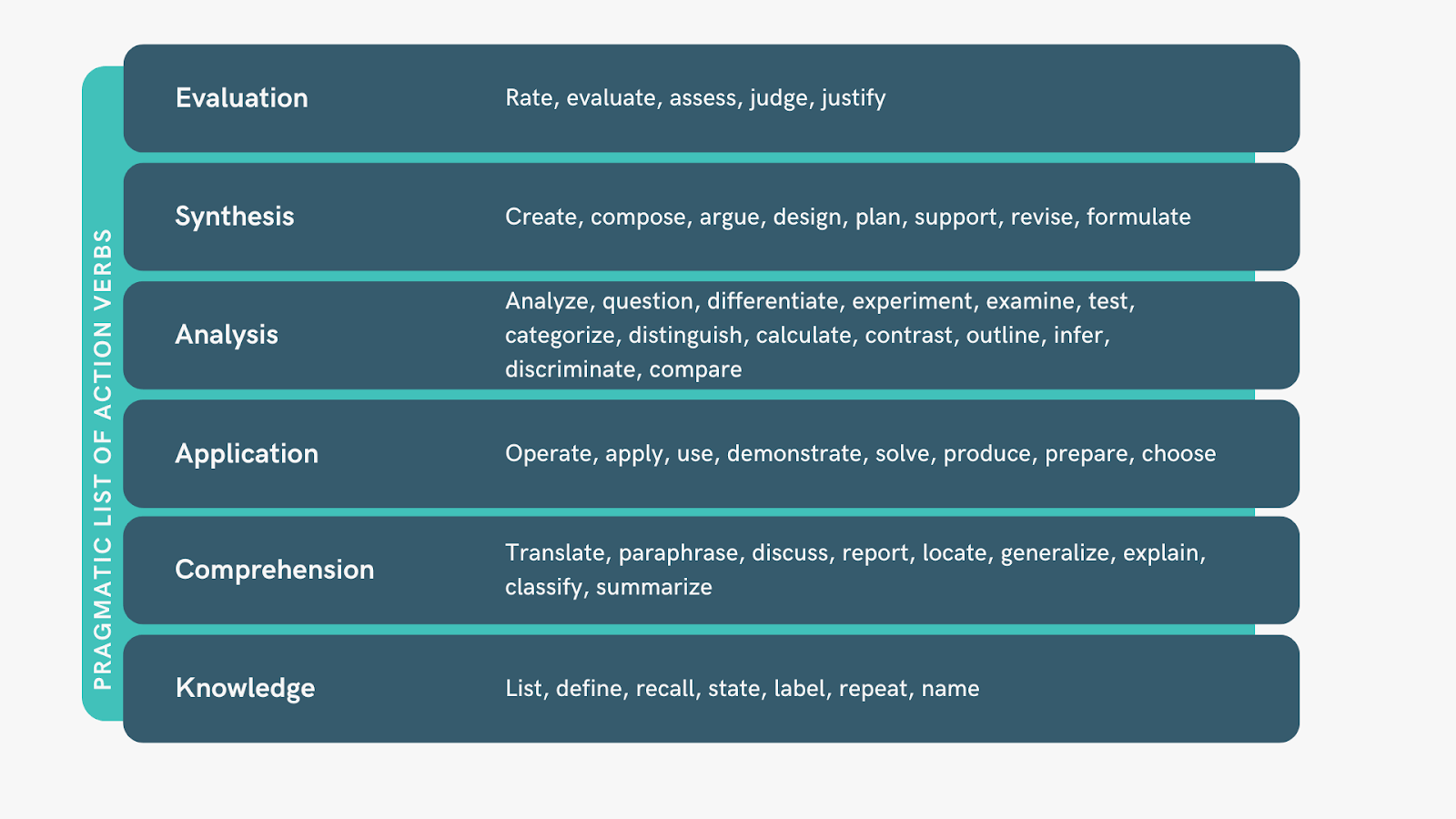
Revised “Bloom’s taxonomy:
In 2001, a few cognitive psychologists and a group of researchers, guided by Lorin Anderson who is a colleague of David Krathwohl continued the research and as an output, they decided to revise the existing hierarchical level of Bloom’s. And the new levels are named: Remember, Understand, Apply, Analyze, Evaluate and Create. The basic level is named “Remember” where the learner should start remembering the concepts, which is similar to “Knowledge” in the original version.
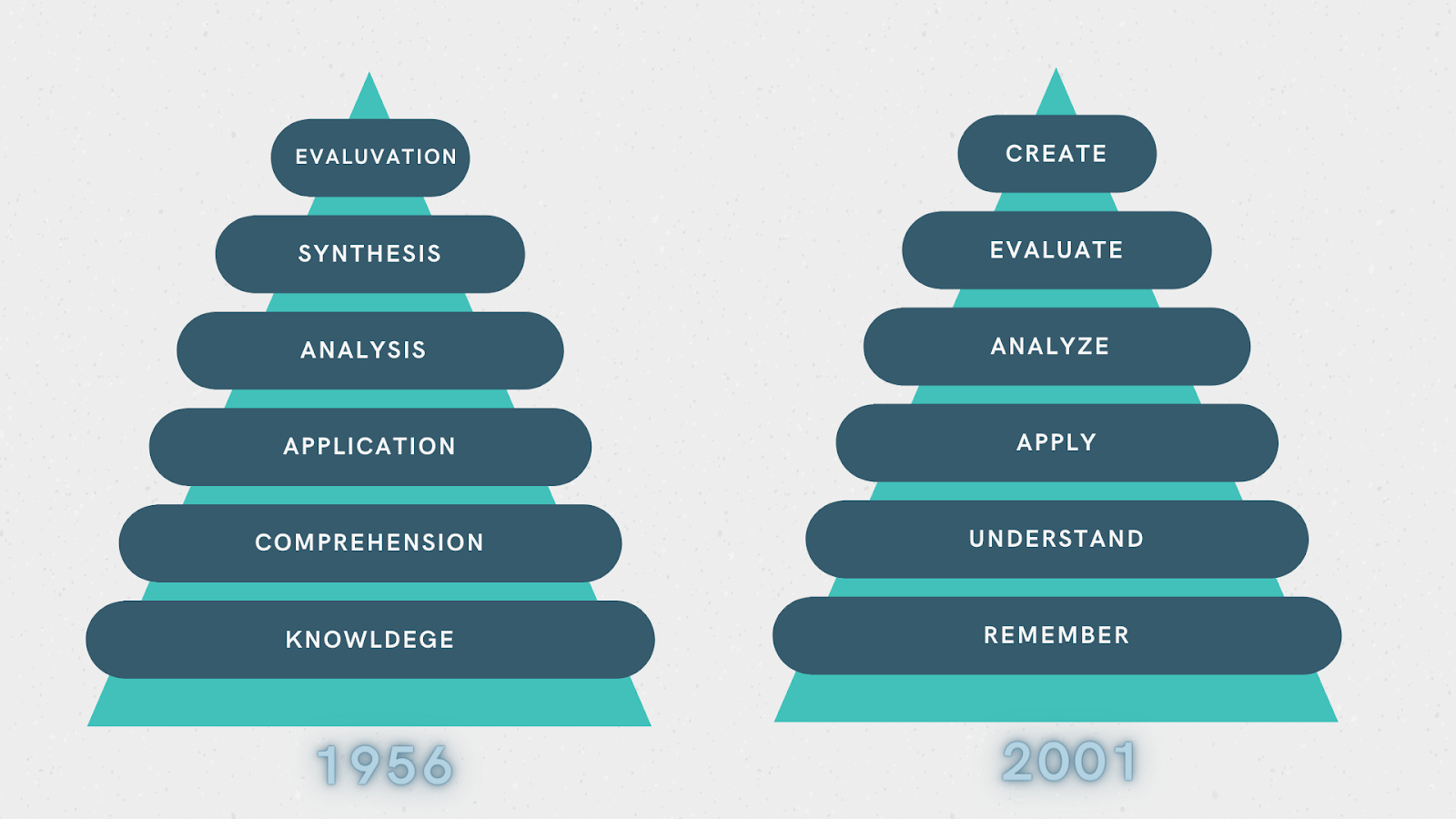
Here, the level names are renamed to “Verbs” from “Nouns”. Also, the top two levels are swapped. Revised taxonomy is followed in most places nowadays since this is more applicable and relatable.
Why is Bloom’s taxonomy crucial for you?
As testers, we are trying to match the technology trends and keep learning new tools. Learning is a continuous process for us. A plethora of automation tools and frameworks are available today. We cannot master every available tool in the market. So we choose certain tools and we learn based on our needs or passions or job requirements. But when it comes to the process of learning, we make a lot of missteps. We juggle between learning different tools and technologies. Sometimes we feel lost.
That’s why we have the different levels of Bloom’s taxonomy. It helps to improve the thinking process and helps you to stick to a pragmatic learning approach. Any new learning with a certain process is faster and more efficient. So plan and devise if you are planning to learn any new tool or technology.
Deep dive into each category of Bloom’s:
As we are aware, we will analyze more on each level and how that is related to software testing and test automation. There are six different levels in the pyramid and each level holds specific importance in your learning journey.
Remember: This is the first and basic level in the process of learning where it’s all about memorizing the concepts, terminologies, technical jargon, etc. This is the foundational level and hence it should be done extensively and meticulously. Testing and Automation principles, fundamentals, process-oriented topics, theories, and research papers provide the strong basics which are crucial in our journey. Collecting the required materials and processing/organizing them is the first step, and then trying to familiarize yourself with the concepts in the second step.
Pro-tip: Based on the current trend, if you pick a topic to learn, then try to invest more time researching, memorizing, and recalling the facts and details. For instance, before starting with Test Automation, make sure you are good with Test Automation jargon, definitions, principles, challenges, and outcomes.
Understand: By now we are already familiar with the concepts, it’s stored somewhere in your brain. Now, try to make your own story and interpret the information studied before. This is where we should be able to explain the content to a five-year-old. That is proof we are being strong and able to summarize the technical content. Now being strong with conceptual facts, we are good to go to the next steps. Make a note that this is where you will understand the importance of the topics learned. You should be able to categorize and mind map the learnings.
Pro-tip: Since your brain is already crammed with enough information, try to jot down them. It can be done using simple paper and pen. If you are looking for cool visualizations, you can try mind maps.
Application: We learned many theories and principles, and topics, and by now we should have clarity of it and when, where, and how to apply them. Here, we should be able to apply and demonstrate the learning. Think about the practical scenarios to apply the learnings.
Pro-tip: If you are learning any Test Automation tool, try to implement and solve a real-time challenge. This helps to remember well for the upcoming phases.
Analyze: This is the fourth level which helps to implement critical thinking in your way. Based on the previous level, we already applied and implemented it. Is that the right way? Here, we should compare and differentiate the good and bad. If you have solved any challenge using a tool or technology then verify if that is the right process.
Pro-tip: For instance, if you recently started hosting your applications in the cloud, try to compare, and distinguish the metrics in the cloud vs on-premise.
Evaluate: Think like a tester and look at what you implemented. Be your own critic. Can this be done better? Do a self-reflection.
Pro-tip: If you already developed a simple automation framework, try to evaluate it as a new user and you will find the flaws and improvisations that are needed.
Create: This is the final and complex state. We should be able to reciprocate and design an outcome based on our learning. This is different from implementation.
Pro-tip: Based on the effort which you spent all these months learning any new programming language, you could create a blog or a tutorial, and try to contribute to any open source to try your knowledge.
That’s pretty cool, right? This is an organized and proven method that helped many students across the globe. We hope you realized how helpful this is. We have another bonus section following, where there are a few more realistic tips.
Learn how to learn:
- Learning is not only a continuous process, it requires continuous efforts – Plan your day ahead and make sure to spend time every day to learn a small part of a lesson. You set your focus hours, to avoid distractions.
- Reading out loud – If you remember your school days, you’d know that teachers made us read aloud in front of the classroom. This is beneficial in two ways. The brain of the person who reads it can intercept the messages easily and the others could easily visualize by hearing the lesson.
- Create your own story or remember to use an analogy -Your brain is a unique and creative organ. Instead of simply studying, you could start developing stories and tying them up to your concepts.
- Work on smaller goals – Focus on smaller chunks and one day you can grab a big bite. Split your lessons and topics into small feasible ones. This strategy works like a charm everywhere.
- Develop and stick to the timelines – Set your timeframe, and mark your calendars. For instance, if you are planning to give for a certification exam, book your date and work backward and plan your chapters accordingly. Trust me, this works.
- Find a partner – Together we can achieve anything. Finding a learning partner can help you to stay motivated, and consume things in a simple easy manner. Pair-testing, Pair-learning, and for conference talks as well you can pair with another speaker.
- Celebrate the small wins – Don’t wait until you reach the last page of the book. For every small milestone, try rewarding yourself. This can motivate you and releases happy hormones which could result in greater outcomes.
- Take breaks – If you are overwhelmed with work and you are trying to stick with your plan you might get burned out. This might make you lose interest in learning, so it’s better to pause for a while. So take a short break and make sure that you get on track later.
- Write it down – Yes, it’s as simple as that. Start scribbling, this has multiple advantages. This helps in recalling stuff, relieving stress, and takes you down memory lane.
- Enough Self-care – We should not lose ourselves in the process of learning something new. Move a little, stretch a bit, eat healthily and sleep for the right amount of time. These personal habits and schedules influence your learning process.

Final Thoughts:
We hope by now you understood the importance of implementing Bloom’s taxonomy in our learning process along with a few other formulas. Start applying them when and wherever possible. This can do wonders. One step at a time.
All the ISTQB certifications are devised using Bloom’s taxonomy depending on the levels of exams. Also, many course instructors are using Bloom’s taxonomy to devise their course anatomy and structure.
So next time, before starting or learning any new skill, think about Bloom’s taxonomy and devise your plan. Good luck with your learning!!



Did you find this page helpful?
More Related Hubs
TestMu AI forEnterprise
Get access to solutions built on Enterprise
grade security, privacy, & compliance
- Advanced access controls
- Advanced data retention rules
- Advanced Local Testing
- Premium Support options
- Early access to beta features
- Private Slack Channel
- Unlimited Manual Accessibility DevTools Tests