

Next-Gen App & Browser Testing Cloud
Trusted by 2 Mn+ QAs & Devs to accelerate their release cycles


A Breakdown of Continuous Testing
In this blog, we understand how continuous testing enables software teams to approach the idea of evaluating quality at several stages of a pipeline where code is developed, delivered, and deployed continuously.

Navya
December 19, 2025
In the present world that we live in, the software is a vital component. As users, we interact with an ever-increasing amount of software every day. The wheels of innovation are constantly churning out new digital experiences.
The old way of testing was based on the waterfall model. The product was passed on from one team to another. A product would have separate development and QA phases. QA teams usually needed more time to ensure quality. If businesses want to keep up with the ever-increasing customer expectations, they’ll have to deliver their software faster without hindering its quality. Continuous Delivery (CD), a practice that ensures that the software can be released into production at any time, can help businesses with that. Businesses use a build pipeline to automatically test the software and deploy it to their testing and production environments with continuous delivery.
A common issue when developing software using CD principles is that businesses can only deliver at the speed of their slowest asset. After a feature has been created and released, the most time-consuming part is testing and associated activities. Testing can be achieved quickly with automation and at the same time, it can increase accuracy and thereby lower risk, which overall enhances product quality. So, automation is key in agile. Continuous testing enables software teams to approach the idea of evaluating quality at several stages of a pipeline where code is developed, delivered, and deployed continuously.
Software engineering leaders have identified reducing time to market without sacrificing quality as one of their top 3 challenges according to Gartner’s infographic: Sketching a Continuous Quality Strategy Over Coffee.
Finally, leaders must track the right metrics to ensure the move towards better quality is successful. The Gartner infographic previously cited indicates that the top three metrics for assessing application delivery are defect rate (52%), code quality (45%), and mean time to restore (MTTR-39%).
Watch this webinar to learn about enterprise-wide actionable strategies, the dos and don’ts of automation testing and DevOps tooling that will help you improve the release and test velocity.
The Era of Agile Development
Agile development does not ensure good quality by itself; continuous delivery aspires to test the quality of our software at any given point in the pipeline. Test and development teams collaborate efficiently in a continuous delivery model and cut down manual methods while streamlining the process with automation, guaranteeing timely releases. If you need to get the most from your continuous delivery model, you must make a significant investment in continuous testing. Continuous testing is a method that enables testing the quality of the product at any given point, as this method is all about:
- Testing at initial stages of the release pipeline
- Testing more before release
- Testing across environments and devices
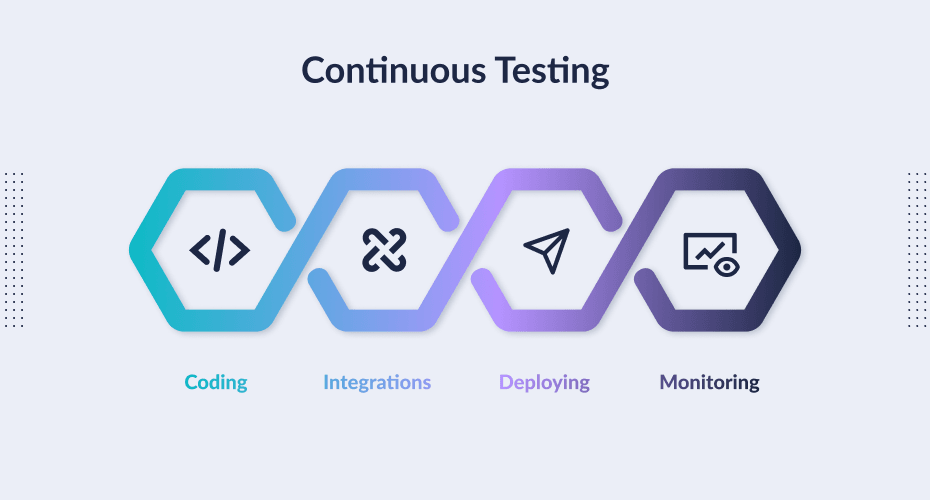
How Continuous Testing Powers Continuous Delivery
Without investing in continuous testing, a continuous delivery model will remain an unfulfilled dream. Continuous testing involves many automated test implementations each time code changes are made. These tests are conducted during the software delivery to drive feedback on code changes. In addition, continuous testing helps you save production costs as it’s a known fact that a bug caught during the production phase might prove to be ten times costlier than the one noticed during the continuous testing phase itself.
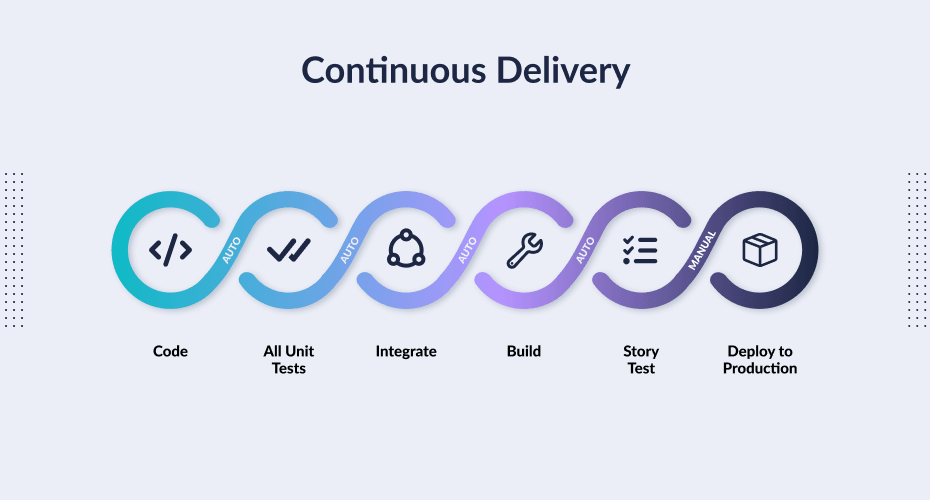
Proper implementation of continuous testing in continuous delivery can benefit your product. Developers can perform a live test of their code’s execution, functionality, and behavior with tools like Selenium. Regression testing, API, UI, and Performance testing, must be executed to ensure app quality in several customized cases. Businesses can test all the changes made on the go. After making the necessary changes in the CI environment, the DevOps team can implement parallel tests with automatic notifications, alerts etc., whenever there’s a failure in any build component. QA team then must approve by running regression, load, and functional tests deployment. If the test configuration is correct, the tests can go on continuously without any manual testing.
Obstacles in Continuous Testing
Continuous testing makes it possible to remove testing as a blocker for faster CD. But Continuous testing has its challenges:
- Lack of Test Support in software – Achieving continuous testing for new feature work done in legacy products becomes more complicated if the product doesn’t have testability support. Implementing test support features to these products is expensive, hindering the success of Continuous Testing.
- Absence of Standard Tools – Standard tools to implement continuous testing for many products does not exist. Teams usually use in-house automation tools or frameworks that lack proper documentation and maintenance. This adds to the problems of the testing team. They will now have to struggle with the issues of the tool/framework as well.
- Insufficient Testing Infrastructure – Continuous testing needs additional test environments to be maintained, kept up, and running round the clock. It would help if one also has advanced tools to implement faster feedback loops. Although these costs aren’t high compared to the price that is incurred due to the poor quality of the product, there is a need for organizational commitment. A halfway journey to continuous testing without adequate infrastructure only adds to the problems of the testing team and doesn’t help anyone.
- Scaling – Not all testing frameworks/tools may scale. Lack of support for sizeable concurrent test sessions and slow test executions can become severe blockers for the dream of achieving Continuous Testing. These scalability issues are not always seen in the beginning. They become visible only after a significant amount of tests have been added to the system, and the test system starts to get highly loaded.
Advantages of Continuous Testing
- Actionable feedback – Risk-based feedback helps developers and managers discover and fix critical defects while building code, not afterward. Risk-based insights from automated tools help cast a much wider safety net for business risk coverage than traditional manual testing. Instant feedback also helps developers make better design decisions at the moment.
- Faster Deployment – With quicker and more continuous feedback loops throughout the pipeline, bugs can be found earlier and fixed earlier. It also means that QA can happen faster, and deployment can occur sooner.
- Efficient Testing – Continuous testing helps developers and managers by enabling them to perform the correct tests at all times. This allows them to decide whether a shift left or a shift right is required in their delivery pipeline. End-to-end testing with automated tools helps reduce the false positives and timeouts which usually appear in standard test environments. As testing is done during every stage of development, developers can be confident of building a secure, highly-flexible product.
- Low Risk – Automated tasks perform much better at repetitive tasks with large quantities of data. These tasks are executed faster and with higher accuracy and can effectively mitigate risk in testing.
Introducing Test At Scale — a test intelligence and observability platform that shortens the testing durations & provides faster feedback. It enables devs to get early insights into flaky tests and enhances their productivity to ship code frequently with confidence. Start FREE Testing
Conclusion
Continuous testing is no longer an option for businesses but an essential software development and release process. Modern-age businesses must utilize the benefits of continuous testing, and having the right software to do that is essential. TestMu AI’s test execution platform allows users to run both manual and automated tests of web and mobile apps across 3000+ different browsers, browser versions, and operating system environments. Over 500 enterprises and 600,000+ users across 130+ countries rely on TestMu AI for their test execution needs.



Did you find this page helpful?
More Related Hubs
TestMu AI forEnterprise
Get access to solutions built on Enterprise
grade security, privacy, & compliance
- Advanced access controls
- Advanced data retention rules
- Advanced Local Testing
- Premium Support options
- Early access to beta features
- Private Slack Channel
- Unlimited Manual Accessibility DevTools Tests