

Next-Gen App & Browser Testing Cloud
Trusted by 2 Mn+ QAs & Devs to accelerate their release cycles


- Home
- /
- Learning Hub
- /
- Career in AI Test Engineer
Career in AI Test Engineer
Build a career as an AI Test Engineer by mastering QA and AI skills to ensure reliable, ethical, and accurate performance of AI-driven software systems.

Sumit kumar
January 20, 2026
The field of software testing is undergoing a significant transformation with the emergence of Artificial Intelligence. Traditional testing approaches, while still valuable, are no longer sufficient to handle AI-driven systems, which learn from data, adapt dynamically, and can behave unpredictably. Launch Your AI Testing Career is designed to help you navigate this evolving landscape, providing you with the knowledge, skills, and strategies needed to thrive in AI-enhanced testing environments.
What Will You Find in This Section?
AI Test Engineer Role Overview
Get a clear understanding of what an AI Test Engineer actually does. This includes the day-to-day responsibilities, the skills employers expect, and the qualifications that help you stand out in a competitive market.
AI Test Engineering Roadmap
Follow a structured roadmap that shows how to grow from a beginner to a highly skilled AI testing professional. The roadmap breaks your journey into meaningful focus areas:
- Software Testing Foundations: Build a strong base in traditional testing practices, methodologies, and QA principles.
- Generative AI for Testing: Learn how generative AI can support, accelerate, and enhance your testing activities.
- AI Fundamentals Roadmap: Understand essential AI concepts from machine learning basics to model behavior and evaluation.
- Exploring the LLM Ecosystem: Dive into the world of Large Language Models and discover how they fit into modern testing workflows.
- Programming Skills: Strengthen your career by developing the coding capabilities needed for automation and AI-driven tools.
- Specializing in AI Testing: Identify niche areas within the AI testing domain that match your interests and career goals.
- Building Real Experience: Explore practical ways to gain hands-on experience through projects, tools, challenges, and experimentation.
Why AI Testing Skills Are in Demand
AI is now built into most products, creating new quality and safety challenges. Organizations need testers who understand model behavior, bias, and unpredictability. Skilled AI testers help prevent risks before release. As AI adoption grows, demand for AI testing expertise continues to rise.
Skills You Need to Succeed in AI Testing
AI testers need strong QA fundamentals plus a basic understanding of ML concepts. Analytical thinking and data awareness are essential for spotting issues. Prompting and tool proficiency speed up testing tasks. Clear communication helps translate model behavior into actionable insights.
AI Test Engineer Job Description
An AI Test Engineer ensures that AI-driven systems behave reliably, ethically, and accurately across a wide range of scenarios. This role blends traditional software testing with data validation, model evaluation, and an understanding of machine learning workflows. It opens the door to specialized career tracks depending on your strengths in automation, data, performance, or functional testing.
Types of AI Testing Jobs
- AI QA Engineer: Responsible for validating the functional behavior of AI-driven features, verifying predictions, checking decision pathways, testing edge cases, and ensuring consistent behavior across user inputs.
- AI Test Automation Engineer: Designs automation frameworks for AI models, automates evaluation steps, dataset checks, prompt-based tests, API testing, and integrates automated checks into CI/CD to monitor drift and performance issues.
- Data Quality Assurance for AI: Ensures the data feeding AI systems is clean, unbiased, representative, and well-labeled; performs dataset profiling, anomaly detection, metadata validation, and collaborates with data engineering teams.
- AI Performance Testing Specialist: Evaluates how AI systems scale under stress, measuring response times, throughput, GPU/CPU usage, and inference speeds across models, versions, and hardware configurations.
Key Skills for AI Testing Jobs
- Testing Fundamentals: Strong grounding in test design, exploratory testing, automation frameworks, debugging techniques, and QA processes.
- AI & ML Concepts: Ability to interpret model outputs, understand training pipelines, detect issues like overfitting, drift, hallucinations, and evaluate model accuracy metrics.
- Data Science Foundations: Skills in handling structured/unstructured data, basic statistical analysis, identifying biases, and validating dataset quality using tools such as Pandas and NumPy.
- Programming & Scripting: Proficiency in Python for automation, dataset manipulation, API testing, model checks, and building test harnesses. Knowledge of shell scripting, SQL, or Jupyter notebooks is a plus.
Where to Find AI Testing Jobs
- Specialized Job Boards:
- https://ai-jobs.net/list/testing-related-jobs/
- TestDevJobs: https://testdevjobs.com/tag/ai-testing-jobs/
- General Job Boards:
- Indeed: https://www.indeed.com
- LinkedIn: https://www.linkedin.com/jobs
- SimplyHired: https://www.simplyhired.com/search?q=ai+tester
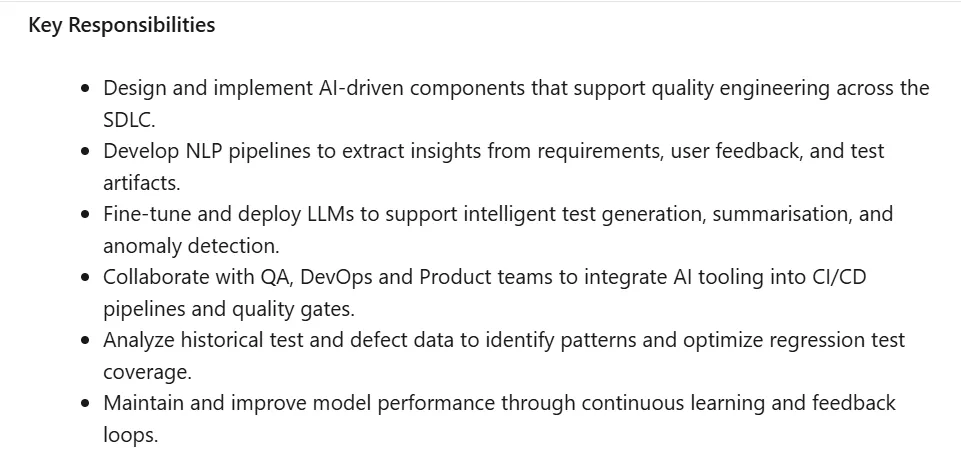
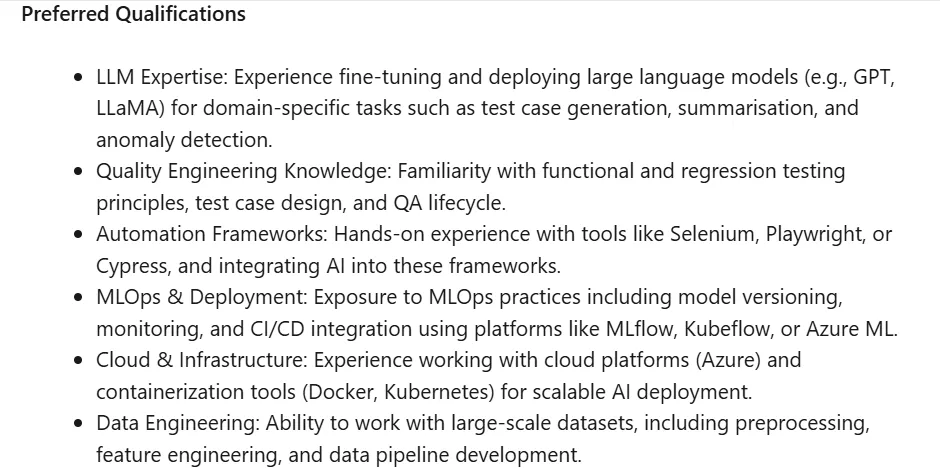
Sample Job Posts



Frequently asked questions
Did you find this page helpful?
More Related Hubs
TestMu AI forEnterprise
Get access to solutions built on Enterprise
grade security, privacy, & compliance
- Advanced access controls
- Advanced data retention rules
- Advanced Local Testing
- Premium Support options
- Early access to beta features
- Private Slack Channel
- Unlimited Manual Accessibility DevTools Tests