As businesses undergo rapid shifts in their technological landscapes, maintaining high standards, delivering seamless user experiences, and mitigating risks becomes crucial.However, navigating this complex landscape requires insights into building and sustaining effective quality processes that align with the agile transformation.
Moreover, leveraging data-driven decisions, managing performance, and guaranteeing quality assurance and compliance within digitalization emerge as pressing concerns. How can businesses effectively intertwine quality practices with digital transformation? Our expert panel discussed the strategies that drive successful digital transformation through robust quality assurance approaches.
Saahil Menoki, VP of Global Sales at TestMu AI was the host for this discussion and he kicked off the session by introducing the panel.
Anish Ohri: Anish Ohri heads Quality Engineering at Trepp as Director of Quality Engineering. With 15+ years of experience, he is a seasoned technology leader with a diverse background in software engineering, product management, and business strategy.
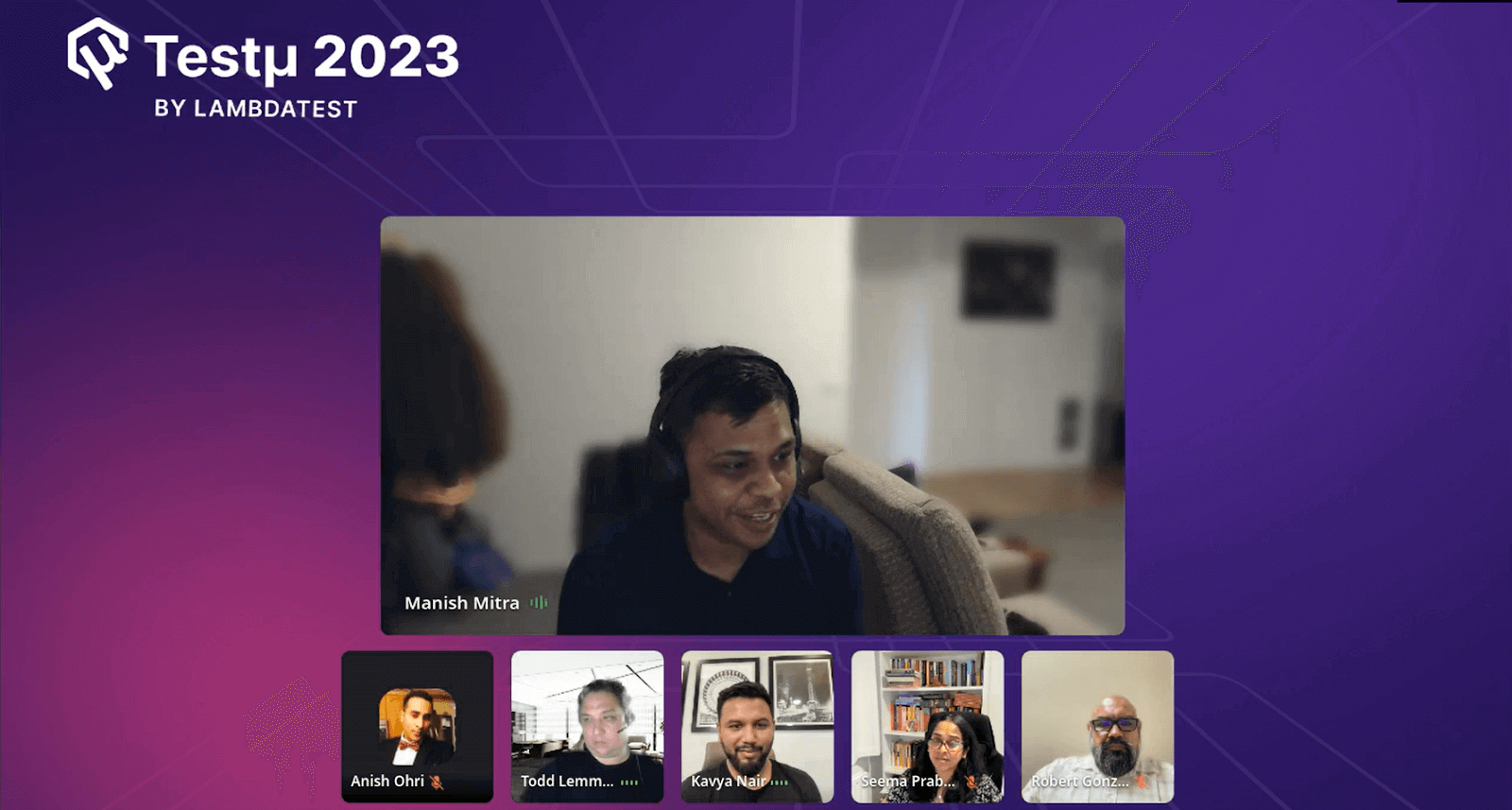
Manish Mitra: Manish is a Quality Engineering nerd who deeply understands building and deploying quality software to the customer’s hands. Manish has been heavily engaged in open-source platforms like Puppeteer and Playwright throughout his career.
Todd Lemmonds: Todd is a visionary in the software quality assurance field with more than 20 years of experience working in various vertices in the industry. His approach to software quality is simple…test early and test often…which drives his shift left testing strategies.
Robert Gonzalez: Robert is Vice President of Engineering at SugarCRM, a leading customer relationship management (CRM) software company. At SugarCRM, he leverages his extensive experience in organizational leadership and engineering expertise to steer the company’s engineering initiatives and drive innovation within the CRM domain.
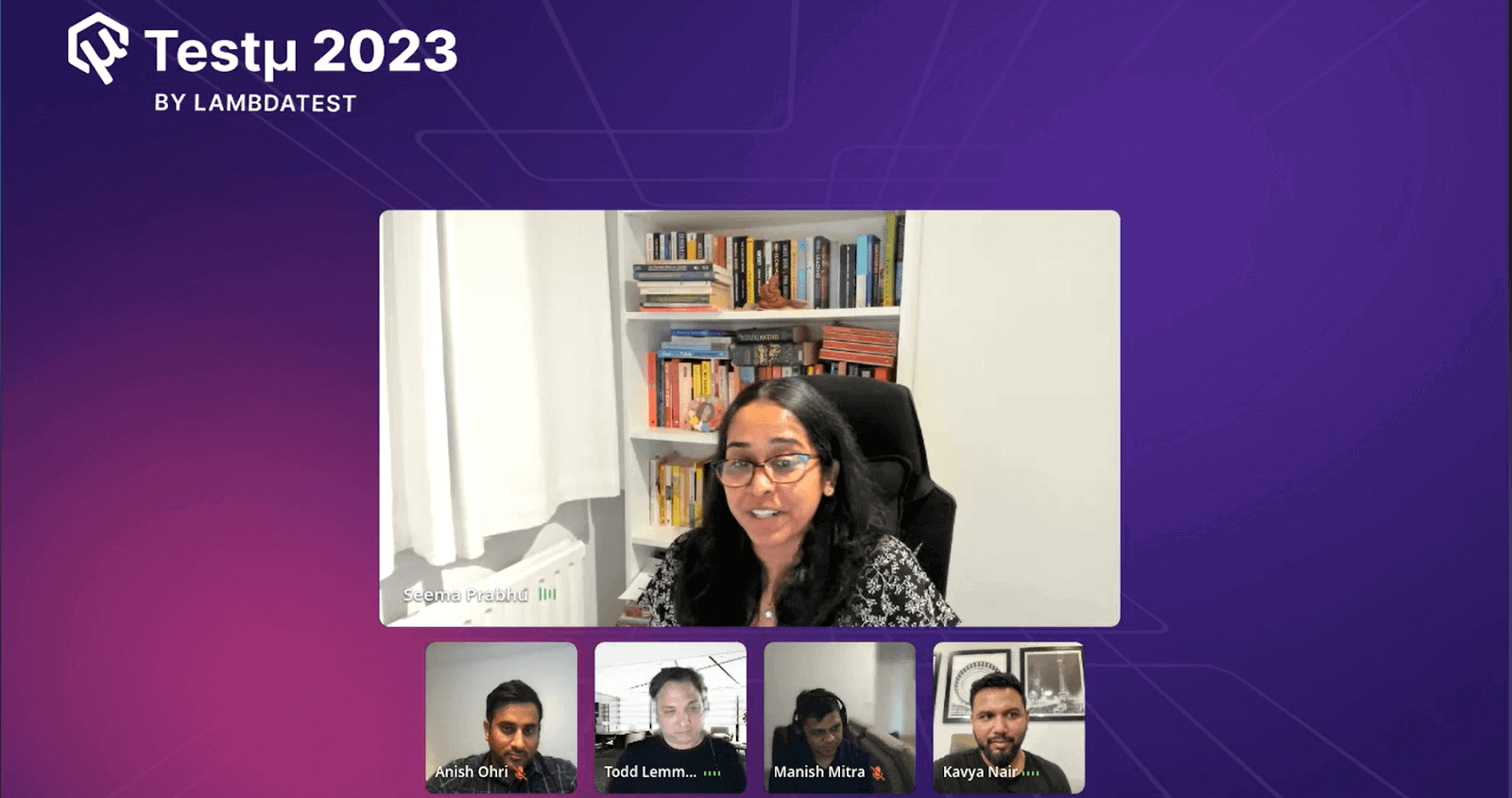
Seema Prabhu: Seema Prabhu is the Director of Quality at Hudl. A passionate quality advocate responsible for setting up the team(s) and establishing a culture of quality across the organization. She is a Certified Agile Coach, which enables her to coach and mentor teams to embed good Agile practices in projects.
If you couldn’t catch all the sessions live, don’t worry! You can access the recordings at your convenience by visiting the TestMu AI YouTube Channel.
Maintaining Quality Standards in a Digital Landscape
Moving on with the discussion, Saahil grabbed the panel’s attention by asking about their views and strategies for addressing the challenges while maintaining quality when it comes to digital transformation.
Seema Prabhu: Seema began by highlighting that digital transformation entails change in business processes to enhance effectiveness and efficiency. She emphasized the connection between quality processes and driving informed decisions by relevant data. Seema discussed the importance of understanding the purpose of the digital transformation and identifying the problem it aims to solve. She mentioned that challenges arise when gaps in understanding and communication emerge. Seema talked about the significance of changing processes, team alignment, and effective communication, particularly in remote work settings across continents.
Later, during the discussion, she added to regularly analyze data and feedback to ensure alignment with the intended direction, make necessary course corrections, and achieve transformation goals within set timeframes.
Todd Lemmonds: Todd deep-dived into different phases of maintaining quality during digital transformation. He mentioned that quality standards need to be integrated into the requirements phase, ensuring that what is being built is testable. During development, transparency and tooling to capture data for reporting are crucial for informed decision-making.
While discussing the importance of feedback loops during deployment, Todd emphasized the importance of change management to address issues and continually improve quality practices. He discussed the role of various tools and automation in achieving transparency, quick testing, and efficient information dissemination.
While answering the question, the panelists collectively emphasized the significance of understanding the purpose and problem-solving objectives of digital transformation, the importance of transparency, communication, and feedback loops, and the role of data-driven decision-making and relevant tools in maintaining quality standards. They provided insights into addressing challenges across various phases of the transformation journey.
Embedding Quality Processes for Security and Compliance
Having discussed the impact of digital transformation on UX, another pressing concern that often arises is how to ensure security and compliance while maintaining quality in this digital environment.
Todd Lemonds: Todd highlighted the significance of security and compliance, especially in industries like aerospace, banking, or medical fields. He further said that collaboration with compliance teams and proactive planning for security are essential. He mentioned two key aspects: security and compliance. Security involves practices like DevSecOps to ensure the application has the necessary security measures to prevent unauthorized access. Compliance, on the other hand, involves adhering to government regulations.

He discussed the importance of traceability, where test cases are linked to requirements, and issues are tracked using tooling and instrumentation. This allows for quick answers to auditors’ questions. The need to set a strong foundation in quality processes to address security and compliance issues early and respond to queries efficiently.
Anish Ohri: Anish added to Todd’s points by suggesting penetration testing and threat modeling as additional strategies to mitigate security issues during digital transformation. He indicated that proactive identification and addressing of vulnerabilities can enhance the security framework of the application.
Seema Prabhu: Seema mentioned her perspective on working with software and hardware. She emphasized that security and compliance considerations are not limited to software but also extend to hardware aspects. In the realm of hardware, she stressed the importance of early testing and understanding what needs to be compliant with regulatory organizations. She pointed out that timelines for compliance play a critical role in the project’s success.
Manish Mitra: Manish added to Seema and Anish’s points and explained that security needs to be incorporated as early as possible in the pipeline, with thorough testing of libraries and code before reaching the later stages of development. Manish mentioned companies like Sink and Orca that focus on early security testing and emphasized the importance of moving security practices to the left in the development process.
Through this discussion, the panelists recalled integrating security and compliance considerations early in the development process, using DevSecOps, penetration testing, and early quality testing for software and hardware aspects. This approach ensures that security and compliance are not compromised during digital transformation efforts.
Leveraging Data-Driven Decision-Making in Managing Quality During Digital Transformation
The discussion took a turn and went towards data-centric approaches. Saahil asked the panelists to share their perspectives on utilizing data effectively during digital transformation.
Robert Gonzalez: Robert opened the discussion by highlighting the central role of metrics in quality and performance management. He emphasized that quality encompasses various factors, including security, performance, scalability, and more. He discussed how data-driven decisions help in benchmarking, tracking, and evaluating the success of business processes, products, and offerings. Robert explained that data provides signals and insights that aid in making informed decisions, ranging from product functionality to security and ensuring a holistic approach to quality assurance.
Seema Prabhu: Seema shared practical ways to leverage data-driven decision-making. She mentioned using data for tool selection and code evaluation, making the evaluation process transparent. Data is also pivotal in root cause analysis, helping identify bugs and preventive actions to avoid similar issues in the future. Seema emphasized that data guides decisions related to production planning, resource allocation, and downtime optimization. Moreover, data from team health surveys and metrics provides valuable insights for managerial decisions and coaching.
Todd Lemmonds: Todd explained that data-driven decisions are about understanding the signals provided by collected data. He stressed the importance of instrumenting the process to produce meaningful data, interpreting that data to make informed decisions, and openly discussing the data’s implications. Todd highlighted that data-driven decisions are vital because software lacks emotions and feelings, and relying on data leads to smarter decisions that impact the success of a digital transformation
Manish Mitra: Manish discussed obtaining relevant data for data-driven decision-making. He shared insights from his startup, emphasizing the importance of experimentation, A/B testing, and real-time performance monitoring. Manish highlighted how customer behavior and usage patterns provide valuable insights for updating test cases and enhancing application quality. He pointed out the significance of narrowing the gap between testing and customer experience to prevent incidents and ensure alignment.

In a nutshell, panelists underscored the role of data-driven decision-making in managing quality and performance during digital transformation. Additionally, they discussed the need to interpret data signals, openly discuss findings, and use data to guide strategic decisions that enhance overall quality assurance.
Incorporating Quality into Each Layer of the Organization
Another question from the audience to the panelists was to share their views and strategies to ensure quality in each layer of the organization.

Robert Gonzalez: Robert shared his perspective on building a quality culture by placing quality at the forefront of the development process. Quality should not be an afterthought but an integral part of every step. He mentioned a real example from his company: they transformed their software delivery process to release software every quarter instead of over longer periods.
To ensure quality in this rapid innovation cycle, they brought quality to the forefront. They started by involving quality teams right from the beginning of feature planning. This allowed them to create test plans in parallel with feature documents, ensuring that quality considerations were deeply integrated into the development process.
Todd Lemmonds: Todd added to Robert’s point by highlighting the agile principle of having testable requirements. He emphasized that if a requirement cannot be tested before development begins, it questions the quality of the requirement itself. He mentioned that testers should act as gatekeepers, ensuring that every story can be tested from the outset. Todd’s recommendation was to adopt a mindset where quality checks start early in the development process, and testability becomes a criterion for moving forward with development.
Seema Prabhu: Seema expanded on the idea of making the work of testers visible throughout the organization. She showcased the importance of sharing test plans and processes beyond the testing team. By making test plans accessible to product, engineering, and other stakeholders, there’s greater awareness and understanding of the testing efforts. Seema stressed that making testing work visible leads to a better appreciation and buy-in from other teams, contributing to a culture where quality is everyone’s responsibility.
Panelists emphasized the need to integrate quality into every layer of the organization’s processes. This involves prioritizing quality from the beginning of development, ensuring the testability of requirements, and making testing efforts visible and appreciated by all stakeholders. Quality should not be an isolated function but a principle that influences decisions and actions across the entire organization.
Future of QA in the Digital Age
While the main focus of the discussion was digital transformation, everyone wanted to know the trajectory of quality assurance in the next wave of digital transformation.
Anish Ohri: Anish discussed several trends he sees in the evolution of quality assurance (QA) and quality engineering in the next wave of digital transformation. He mentioned the potential of low-code development platforms like Carrollton, which could facilitate faster test script development and integration with AI-driven tools. Anish also highlighted the importance of leveraging AI and machine learning to improve the analysis of test results and identify patterns of failure, contributing to more efficient regression testing.
He mentioned the emergence of self-healing applications and tools but expressed the need for further optimization to reduce feedback loops, particularly in heavy front-end applications. Anish concluded by emphasizing a shift towards context-driven testing, aligning testing strategies with the goals of addressing customer needs and achieving specific outcomes.
Robert Gonzalez: Robert provided a strong perspective on the trajectory of quality assurance. He emphasized that quality should be driving the direction of digital transformation. If organizations embrace quality as a foundational principle, it becomes embedded in every aspect of development, and quality-related challenges won’t arise as afterthoughts. Robert highlighted that quality should drive initiatives and discussions, eliminating the need to fight for investment or attention continuously. He conveyed that the quality trajectory should be forward, making quality a first-class citizen throughout development.
Manish Mitra: Manish shared his thoughts on the future of quality engineering in evolving technologies. He highlighted the changing technological landscape, from the emergence of applications to the advent of blockchain and GPT (Generative Pre-trained Transformer) models. He posed a thought-provoking question about how to test and ensure the quality of AI-driven models, as these technologies raise new challenges and uncertainties. Manish emphasized that quality engineering will continue to be crucial as new technologies emerge, and the need to test and ensure the reliability of these technologies remains a constant requirement.
The panelists strongly believe that quality engineering will continue to play a central role in ensuring the reliability and effectiveness of digital transformations.
Strategies for Organizations to Streamline Quality During Digital Transformation
With this insightful session coming to an end, Saahil concluded it by asking the panel a question from the audience to share their thoughts on how businesses should maintain quality during their digital transformation journey.
Todd Lemmonds: Todd advised focusing on building leaders within the testing community who understand the importance of quality. These leaders should be able to advocate for quality within boardrooms, development teams, and leadership circles. Todd emphasized that without such leaders championing quality, it won’t be integrated into the culture and processes effectively, especially during digital transformations.
Seema Prabhu: Seema emphasized the importance of understanding the impact of digital transformation on the business. She suggested putting the customer at the forefront of decision-making and considering what quality means from the customer’s perspective. By aligning the transformation goals with customer needs, businesses can ensure a quality-oriented approach throughout the journey.
Manish Mitra: Manish provided two key points of advice. First, he highlighted the significance of viewing the transformation from a customer’s point of view, underlining that customers should be the focus of quality efforts. Secondly, he cautioned against providing a “watermelon status,” where things appear fine externally but are problematic internally. Manish urged quality engineers to be open, transparent, and courageous in communicating the true status of projects to prevent hidden issues from surfacing later.
Anish Ohri: Anish reiterated the importance of starting the digital transformation process with quality considerations from the top. He emphasized that quality should be integrated into discussions about requirements, problem-solving, customer targeting, and product development at every step. By making quality a central aspect of all stages, a smooth and successful digital transformation journey can be ensured.
Robert Gonzalez: Lastly, Robert shared the advantages of test early, test often, and placing the user at the center. He encouraged teams to think of quality as a driving force behind decisions and processes. Robert also stressed the significance of testing early, even if it’s impossible to conduct physical tests, and reminded the audience that the user is also the tester. By keeping the user and quality in focus, confidence in the product and the business can be maintained.
This panel discussion didn’t answer your question? Feel free to drop them on the LamdaTest Community.