Run Rook in Jenkins
Use a Jenkins declarative Pipeline to run a reviewed Rook suite and archive its results. Jenkins executes the CLI directly; no coding assistant, skill package, or Rook-specific Jenkins plugin is required.
Prepare the Reviewed Suite
Use a safe target that is reachable from the runner. In a local rehearsal, select the project and agent, create and test the profile, review its hooks and possible writes, and prove the selected scenarios work. Commit the reviewed .testmuai/rook/ definitions and required hook scripts without credentials or old run histories. Do not generate new scenarios inside the release gate.
Download rook-ci.sh, inspect it, and commit it as ci/rook-ci.sh in your agent repository. The examples below call that checked-in file, not a script downloaded at execution time. The script requires Bash, jq, tar, and Rook CLI.
Configure these values:
| Setting | Meaning |
|---|---|
LT_USERNAME, LT_ACCESS_KEY | Rook account credentials, supplied only by the platform's secret store. |
ROOK_PROJECT_ID, ROOK_AGENT_ID | IDs matching the committed workspace definitions. |
ROOK_PROFILE | A reviewed, reachable test profile, for example staging. |
ROOK_SCENARIO_IDS | An explicit comma-separated suite, for example SC-001,SC-004,SC-014. Use your own IDs. |
ROOK_ALLOW_RULES | Optional newline-separated, exact tool grants observed during rehearsal. No blanket approval is added. |
| Target credentials | Variables required by your profile, such as AGENT_TOKEN; these are separate from Rook credentials. |
The staging profile names your test target, not the Rook service. ROOK_ENV=prod selects the public Rook service. The script uses the LT environment credential pair and isolated ROOK_HOME; it does not copy a developer's browser session.
Execution calls the real target and can spend Rook credits. Review the suite, tool grants, fixture isolation, and spending before enabling a job. Use a fresh checkout/output directory and avoid concurrent jobs against shared mutable fixtures.
What Makes the Job Pass
The shared script selects the project, agent, and profile; syncs the reviewed agent; and runs only the selected scenarios. It checks the process status, halted, discarded, and the run ID, then fetches that run's JSON report.
This example deliberately uses a strict release policy: every selected scenario must pass, with no Unable to Verify, unjudged, skipped/not-run, unrunnable, or compromised results. Missing fields, malformed JSON, a mismatched run ID, or an unexpected scenario count fail closed. A command exit of zero by itself is insufficient.
Unable to Verify remains its own verdict even when it blocks a release. The public skill's general CI recipe allows that outcome alone; this stricter policy is a documented choice, not a change to Rook's verdict semantics. Add criterion-level requirements if your release needs evidence beyond scenario totals.
Configure Jenkins
- Use a Pipeline job pointing at a reviewed branch. Do not provide these credentials to jobs running untrusted PR code.
- Provide a disposable Linux agent with label
rook-linux, Bash, jq, tar, curl, Git, and network access to the public Rook service and your test target. - Install the standard Pipeline, Git, and Credentials Binding capabilities needed by this Jenkinsfile.
- Add Secret text credentials with IDs
rook-lt-usernameandrook-lt-access-key. Addrook-agent-tokenonly if your profile needs that target credential. - Replace the project/agent placeholders, profile, selected scenario IDs, and tool grants in the Jenkinsfile. An empty grants value does not automatically authorize prompted operations.
Add the Jenkinsfile
Commit this at your repository root beside the reviewed definitions and ci/rook-ci.sh. Download the Jenkinsfile.
pipeline {
  agent { label 'rook-linux' }
  options {
    skipDefaultCheckout(true)
    disableConcurrentBuilds()
    timeout(time: 30, unit: 'MINUTES')
  }
  environment {
    ROOK_ENV = 'prod'
    ROOK_PROJECT_ID = 'REPLACE_PROJECT_ID'
    ROOK_AGENT_ID = 'REPLACE_AGENT_ID'
    ROOK_PROFILE = 'staging'
    ROOK_SCENARIO_IDS = 'SC-001,SC-004,SC-014'
    ROOK_ALLOW_RULES = ''
  }
  stages {
    stage('Reviewed checkout and assurance') {
      steps {
        // A new directory per build avoids stale result files in reused workspaces.
        dir("rook-job-${env.BUILD_NUMBER}") {
          checkout scm
          withCredentials([
            string(credentialsId: 'rook-lt-username', variable: 'LT_USERNAME'),
            string(credentialsId: 'rook-lt-access-key', variable: 'LT_ACCESS_KEY'),
            string(credentialsId: 'rook-agent-token', variable: 'AGENT_TOKEN')
          ]) {
            sh '''#!/usr/bin/env bash
set -euo pipefail
set +x
job_temp=$(mktemp -d "${TMPDIR:-/tmp}/rook-jenkins.XXXXXX")
export ROOK_HOME="$job_temp/home"
export ROOK_RUN_NAME="jenkins-$BUILD_NUMBER"
curl -fsSL https://raw.githubusercontent.com/LambdaTest/rook/main/install.sh \
  -o "$job_temp/install-rook.sh"
bash "$job_temp/install-rook.sh" --version 0.1.3 --dir "$job_temp/bin"
export PATH="$job_temp/bin:$PATH"
bash ci/rook-ci.sh
'''
          }
        }
      }
    }
  }
  post {
    always {
      dir("rook-job-${env.BUILD_NUMBER}") {
        archiveArtifacts artifacts: 'rook-results/**', allowEmptyArchive: true
      }
    }
  }
}
The pipeline uses a build-specific checkout directory and temporary Rook home. Use disposable agents or your organization's secure temporary-directory cleanup policy so credentials and transcripts do not remain on a shared machine after a job. disableConcurrentBuilds() serializes this job, not every other job targeting the same fixtures.
The shell script is single-quoted in Groovy so secrets are expanded by Bash, not interpolated into Groovy strings. Shell tracing is disabled. Jenkins masking is a safeguard, not permission to print secrets.
Run and Inspect the Build
Run Build Now for the trusted job. A successful build requires the complete selected suite to satisfy the strict gate. A failed shell step leaves the build failed while post { always { … } } archives results.
Open the build's Artifacts and download rook-results/run.json, report.json, and evidence.tar.gz when present under the build-specific directory. Configure Jenkins build/artifact retention and access control for your team's evidence policy.
Rook's JSON report is not JUnit XML. This example uses archiveArtifacts, not a junit publisher. If you build a JUnit adapter later, preserve Unable to Verify and incomplete outcomes instead of reporting them as passed tests.
Troubleshooting Jenkins
- Job waits for an executor: provision a node matching
rook-linux. - Credential binding fails: verify the credential IDs, Secret text type, and folder/job access.
- Interpreter or jq missing: install the prerequisites in the agent image, not on the Jenkins controller.
- Job cannot reach the target: check networking from the build agent.
- Stale output directory: use a new build/checkout; do not reuse a prior successful report.
- Artifacts absent: inspect checkout, installation, authentication, and sync before assuming a test ran.
See Jenkins Pipeline and credential handling for the platform behavior used here.
Review Results Locally and on the Web
The gate prints the run ID and saves run.json, report.json, and, when a run directory exists, evidence.tar.gz. Keep failure output too. The archive contains this agent's run folders, not ROOK_HOME; a clean checkout avoids including earlier runs. Set retention and access controls because target responses and evidence can contain sensitive data.
To investigate locally, restore the reviewed checkout and extract the trusted evidence archive at its repository root, preserving the .testmuai/rook/projects/… hierarchy. Select the matching project and agent, then run rook report <run-id> --json or rook ui --local. Inspect a run's scenario → criteria → files.
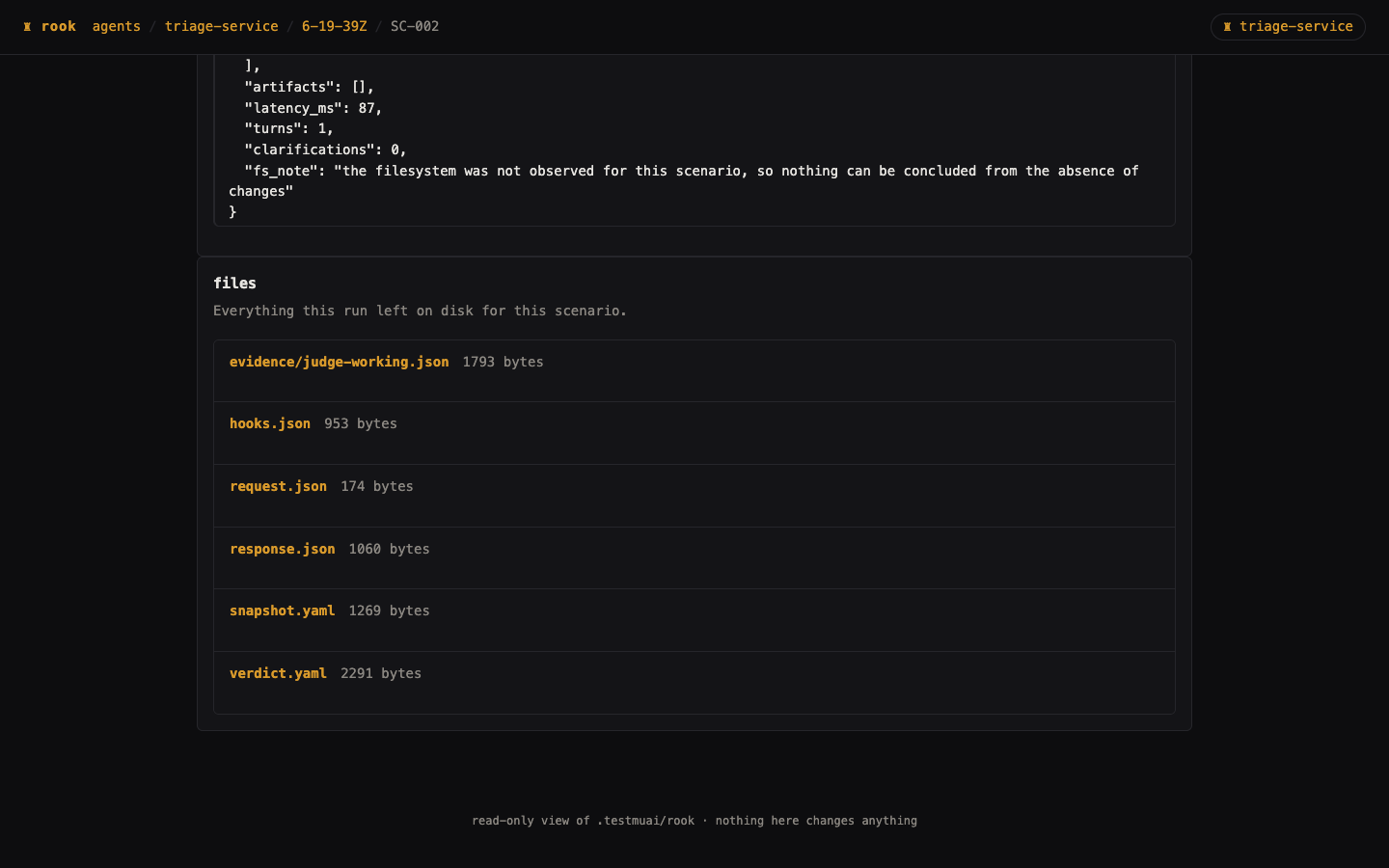
For uploaded results, open Rook projects → project → agent → run. Match the run ID before reviewing Response, Verdict, and Artefacts. A hosted record is useful for sharing, but the pipeline's validated report determines the gate.
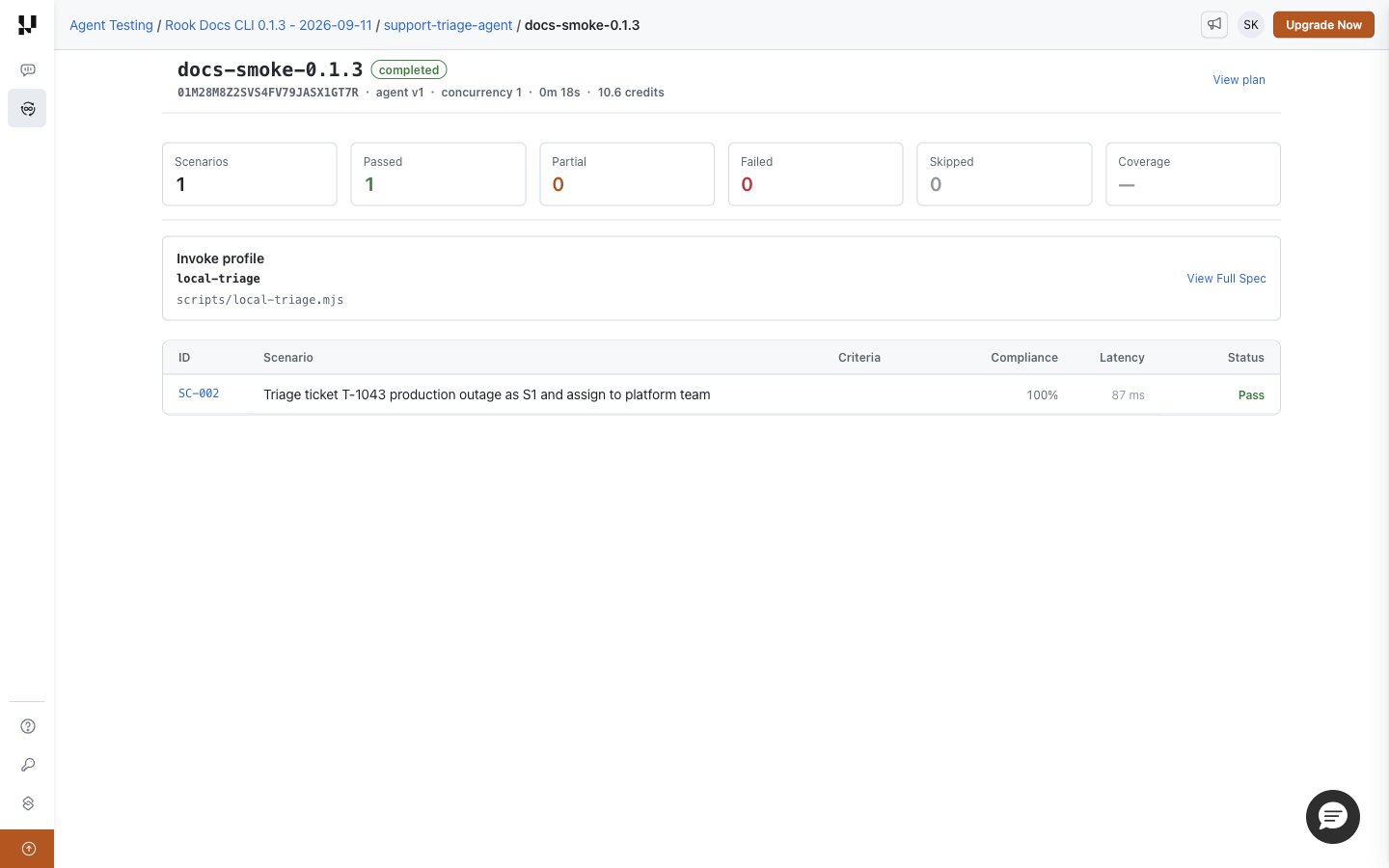
These are existing smoke-test result captures, not screenshots of this CI integration executing. A local URL on a CI runner is not accessible to teammates; do not expose the local UI publicly. If a hosted upload is missing, retain the evidence and investigate result synchronization rather than rerunning paid tests blindly.
Related Guides
These are reference integrations for your reviewed environment. Syntax and gate behavior can be validated locally, but a successful deployment/build must be demonstrated in your own configured platform.
 Chat with Us