Rook Lifecycle Phases and Hooks
Rook reaches an agent through hooks: scripts assigned to named points in a fixed run lifecycle. This makes agents behind logins, sessions, CLIs, asynchronous APIs, sockets, and custom evidence systems testable without forcing them into a predefined transport schema.
A profile must define an execute hook. The other hooks are optional. Rook owns their order; your scripts own how each phase talks to the target.
prepare                         once per run
  open                          once per scenario
    execute × N                 once per turn
  close                         once per scenario
  collect                       once per scenario
  judge                         Rook evaluates the recorded result
Run and Hook Phases
| Phase | Scope | Typical work | If it fails |
|---|---|---|---|
prepare | Once per run | Log in, mint a token, seed fixtures, or warm a cache. | The problem is reported and the run preserves its records. |
open | Before each scenario | Create a target session or reset scenario-specific state. | The problem is reported with the scenario. |
execute | Once per turn | Send the goal and return the agent's answer. This is the only required hook. | The scenario fails. |
close | After each scenario's turns | End a session or release a lock, seat, or other resource. | Rook records and reports the problem without discarding the answer. |
collect | After close | Fetch traces, tool calls, usage, logs, and other delayed evidence. | The scenario fails; the phase can be retried later when evidence is available. |
judge | After evidence is available | Rook evaluates each acceptance criterion. | The result records why a verdict could not be completed. |
judge is a Rook-owned run phase, not a user hook. The other five phases can map to one script or to separate scripts.
Define Hooks in a Profile
Hook paths are relative to the active agent's directory unless you provide an absolute path.
id: refund-staging
name: Refund staging
hooks:
  prepare: scripts/refund-agent.mjs
  open: scripts/refund-agent.mjs
  execute:
    script: scripts/refund-agent.mjs
    timeout_seconds: 300
  close: scripts/refund-agent.mjs
  collect:
    script: scripts/refund-agent.mjs
    delay_seconds: 60
    timeout_seconds: 120
env:
  - variable: REFUND_API_TOKEN
    purpose: Calls the staging refund agent
capabilities:
  multi_turn: true
  calls: true
  usage: true
concurrency: 1
Use /profile add to have Rook generate and verify this profile and its scripts from a prompt, cURL command, command line, integration note, file, or URL. You can inspect and edit the generated files afterward.
Hook Input Contract
Rook invokes a hook as:
node <script> <phase>
The phase name is the only argument. Context arrives through ROOK_* environment variables:
| Variable | Available context |
|---|---|
ROOK_HOOK | Current hook: prepare, open, execute, close, or collect. |
ROOK_WORKSPACE, ROOK_PROJECT, ROOK_AGENT | Workspace and active TestMu AI entities. |
ROOK_RUN_ID | Current run, beginning with prepare. |
ROOK_SCENARIO_ID, ROOK_SESSION | Current scenario, beginning with open. |
ROOK_TURN | Current turn during execute. |
ROOK_CONVERSATION | Conversation handle returned by open or the preceding execute. |
ROOK_STATE_DIR | Durable state for one scenario. |
ROOK_RUN_STATE_DIR | Durable state shared across the whole run. |
The scenario goal is sent on standard input during execute only. This avoids placing arbitrary model-written text in command arguments. A CLI hook must forward the goal to its child process and close the child's input stream.
Hook Output Contract
Write progress and diagnostics to standard error. Standard output must contain one JSON object when a phase returns data.
{
  "output": "Your refund was approved.",
  "conversation": "thread_abc123",
  "usage": { "input": 1200, "output": 340 },
  "calls": [
    { "name": "issue_refund", "arguments": { "order": "ORD-1042" } }
  ]
}
outputis required fromexecuteand is the answer Rook judges.conversationallows later turns and phases to continue the same target session.usageenables token-economy scenarios when the target exposes counts.callsenables tool-call assertions. Returncalls: []when you observed that no calls occurred; omitting it means calls were not observable.collectcan return trace data, calls, usage, and other evidence after the target has finished.
Exit with 0 on success and a non-zero code on failure. Rook captures standard error as the diagnosis. Failures from execute and collect fail the scenario; failures in other phases are reported while the run preserves completed work.
State Between Phases
Use ROOK_STATE_DIR for state that belongs to one scenario, such as a target session ID or fixture. Use ROOK_RUN_STATE_DIR for state established once in prepare, such as a run-wide access token.
Rook also writes each completed hook result to the run directory as it happens. This makes a later collect invocation able to recover the conversation and prior phase record after a delay, restart, or different process.
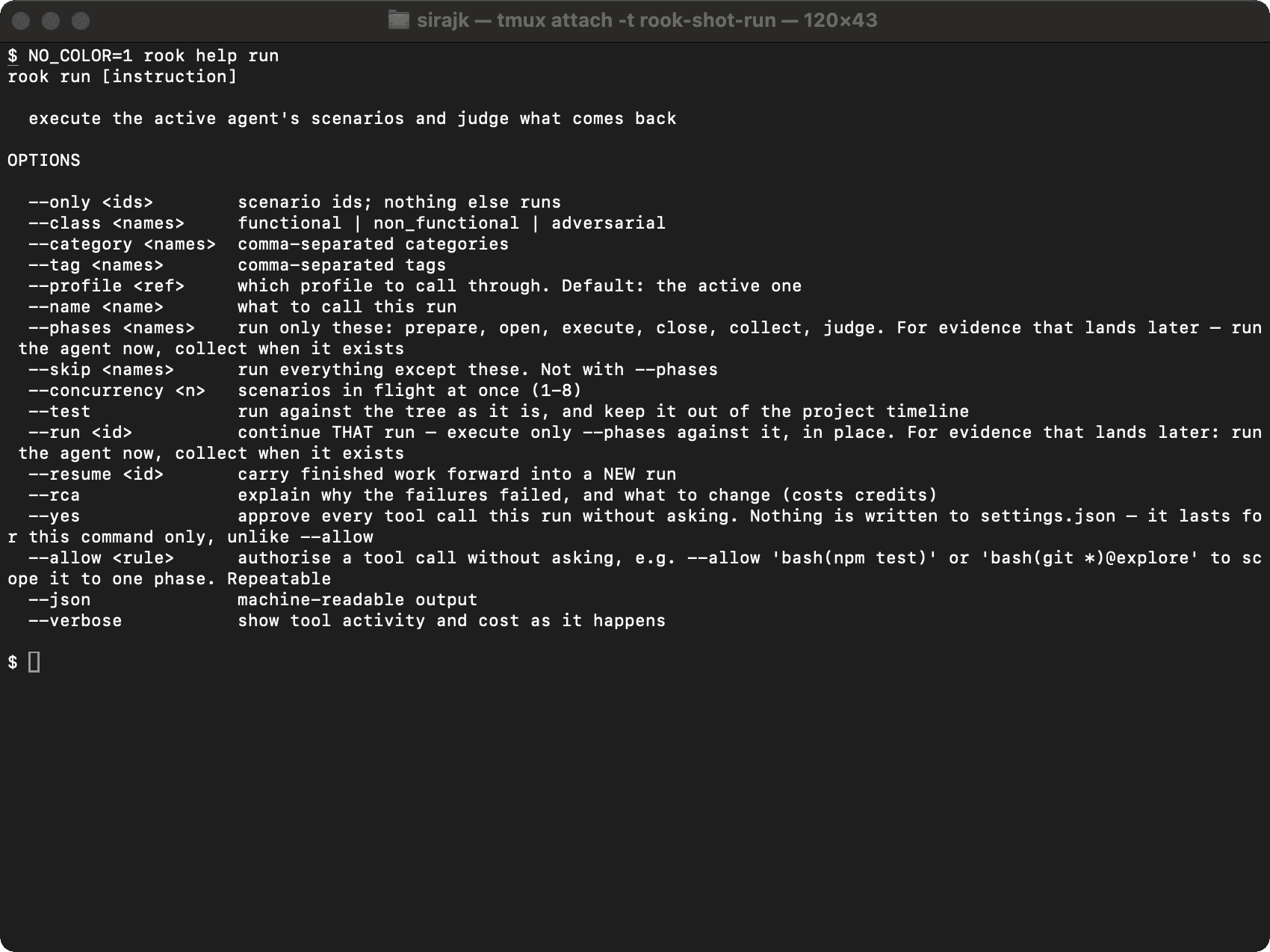
Run Only Part of the Lifecycle
Use phase selection when evidence becomes available after the agent responds:
rook run --phases prepare,open,execute,close
# Wait for the trace or log pipeline.
rook run --run <run-id> --phases collect,judge
--run continues the same run in place. --resume creates a new run and carries compatible completed work forward.
You can also omit a suffix:
rook run --skip collect,judge
Selections follow the fixed lifecycle order. Rook refuses a hole such as prepare,close when it would skip a defined prerequisite between the selected phases.
Timeouts, Delays, and Concurrency
Default hook timeouts are 60 seconds for prepare, 30 for open, 300 for execute, 30 for close, and 120 for collect. Override timeout_seconds on an individual hook when its real latency differs.
Use delay_seconds only when an external system batches evidence and there is nothing to poll. It represents the minimum time since the preceding phase finished; Rook waits only for the remaining time. Prefer polling inside collect whenever the evidence source exposes a readiness signal.
Rook runs one scenario at a time by default. Increase --concurrency only when hooks and fixtures isolate concurrent scenarios. If open resets shared state, keep concurrency at 1.
 Chat with Us
 Ask the Community